


Letters from Donbas: Translating Silence and Fury
July 29, 2026 | book reviews, news
Review by Todd Larkin Tremble, MFA ‘27
Silence Dressed in Cyrillic Letters
280 pp. Harvard Ukrainian Research Institute. $29.95
Furious Harvests
200 pp. Harvard Ukrainian Research Institute. $29.95
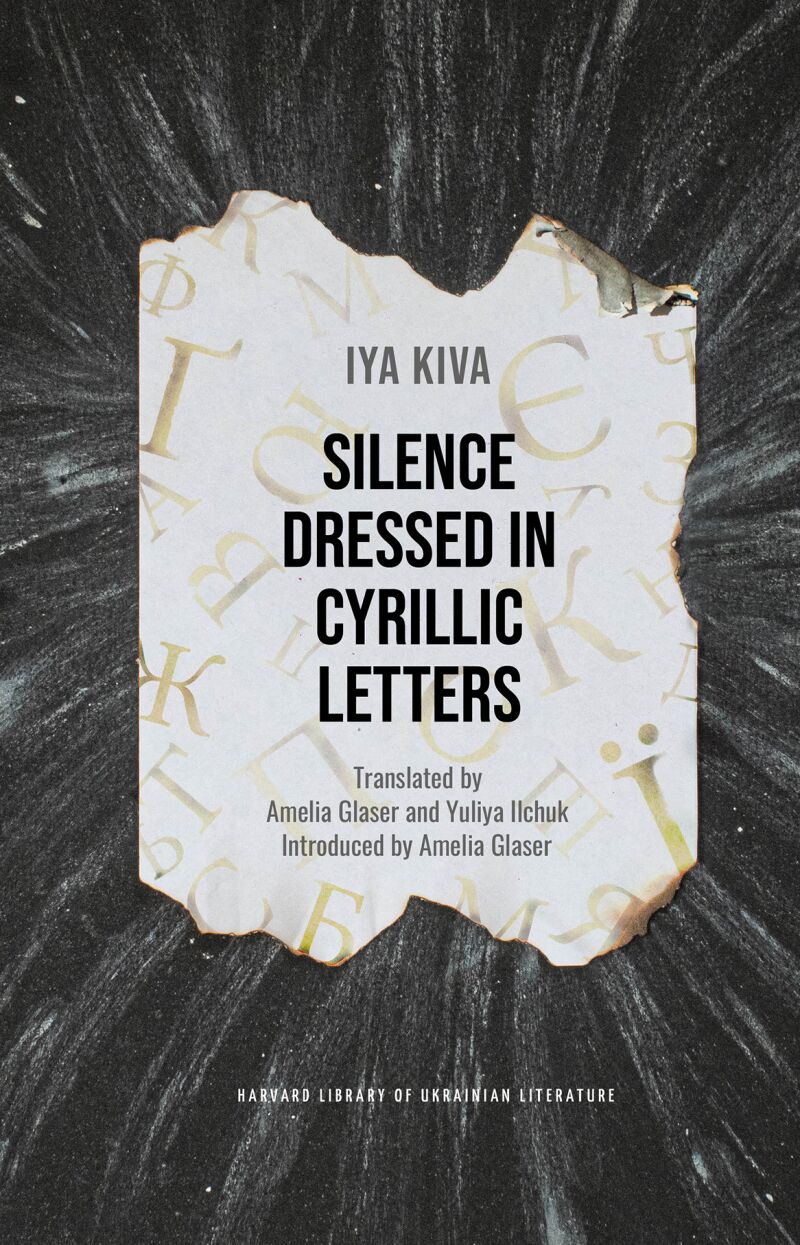
Locomoting in both space and time, Iya Kiva recons with the trauma of her family and her nation’s artillery-pocked history in Silence Dressed in Cyrillic Letters. Displaced by Russia’s invasion of her native Donetsk and then from Kyiv again as the violence moved West with her, Kiva is a poet twice-turned refugee. Using language as a distorted lens to capture her POV as she pulls us around Ukraine, Kiva’s new collection forces the reader to “look closer/ the ash of this piece of paper/ was once called Mitenka.” Addressing war, the great refugee maker of her family, Kiva considers, “the rain greets exiles with postcards from family albums/ where war always sits in every chair at once.” This collection, as with most translated poetry by the Harvard Ukrainian Research Institute (HURI), are presented in the original Ukrainian with the English translation alongside it. Just as Ukraine is a multi-ethnic nation of complex identities, so is Kiva whose unique idiolect comes from a mixed Jewish, Ukrainian, and Russian background. The reader will receive a tour of Ukraine’s diverse lingual terrain as they are moved through the past and the present dangers of Donetsk, Kyiv, and Lviv. In a few generations, Kiva’s bloodline has had to survive the Nazis, Stalin, and now Putin. “[T]hey say we had a clairvoyant in our family,/ which is how Yankel and Bluma ended up in Donbas/ on a cart with the their essentials, their valuables/ had they stayed in Berdychiv they’d lie at the airfield with the rest.” If silence is dressed in Cyrillic letters, then Kiva’s poems are the sounds of silence being undressed by expression and translation. As a native Russophone from the Donbas region, Kiva confronts the difficulty of translation and the limits of language. She writes in Ukrainian while still learning the language, as an act of resistance against Russia’s imperialist aggression. “[T]he day throbs in its veins in an interlingual expanse/ shifting keyboard layouts/ like crossing the Carpathians/ (this constant fear of misstepping—/ of addressing someone in the wrong language.”
Just as Kiva has been forced to move between regions and languages, her poetry moves through mixed and layered metaphors. “[A]nd the salt of my experience burns time’s scrawled paper/ like the coniferous wind of a lasting violin.” Translators Amelia Glaser and Yuliya Ilchuk certainly had their work cut out for them, but luckily Kiva was able to work closely with the them through every decision as she developed her English at the University of Iowa’s International Writers Program. This collection is an emotionally challenging read, with deeply explored themes of displacement, memory, resistance, and resilience. These poems are heavy with pain but also full of artistic and creative transformation, salvaging beauty from destruction. An appreciation for what was lost, what remains, and what may come. Kiva’s hope gives this collection the wings to carry that weight. This is beauty embroidered with lines that contain multiple cultures, like the thread pattern of a “freedom stained vyshyvanka.”
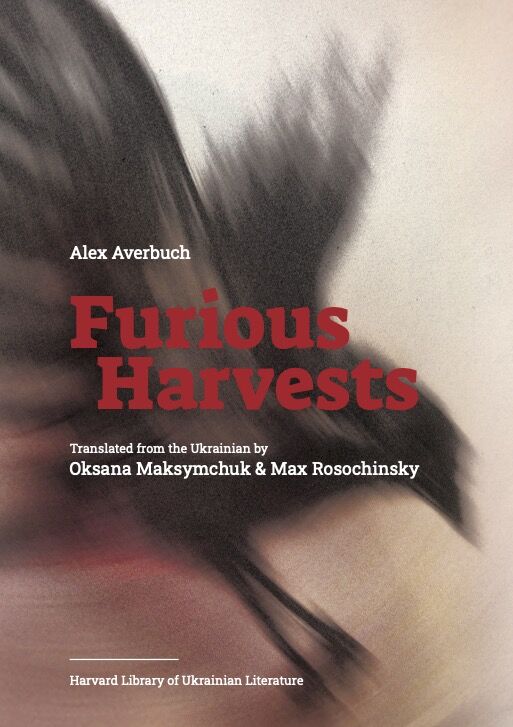
Furious Harvests, Alex Averbuch’s new poetry collection in translation interrogates humanity for our brutal actions while never taking its sights off a lower-case god for his perceived lack of intervention. In the unanswered questions and prayers found in these poems, Averbuch asks, “god, how long will you keep your mouth shut?/ how long will you carry the night on your shoulders?” A native of the Luhansk region where Russia has focused its violent occupation of Ukraine, Averbuch is not among the first generation in his family to experience dislocation and violence due to war. Of a mixed Jewish/ Ukrainian background, Averbuch has a painful personal and genetic memory; he is forced to confront his, and his nation-in-distress’s lineage that contains both sides of atrocity, perpetrator and victim. Reflecting on war’s gruesome and continual presence in Ukraine, he writes “gray and grim/ its chin tied to its head/ laid out on the table, unwashed and dumb—war// and nobody dares bury it.”
Furious Harvests is at once a personal exploration into Averbuch’s own genealogy and an act of archival reanimation, an accounting for the violence of Ukraine’s history. How much of his self is determined by who in his family survived atrocities, who perpetrated them? How much from what he and his hometown have witnessed? “how do you return to a town that does not exist/ to a home—how to return when/ it no longer exists like a heavy sorrow.” Questions, not answers, arrive in his personal excavation. “you ask: my beloveds, and where am I to go now?// where does one say goodbye to oneself these days?” After a life of dislocation and relocation, Averbuch goes beyond physical space and delves deeper into the self and the past.
This collection first chills the skin, then, like an early frost before the harvest, the blood rush and goosebumps warn of the present danger. We feel the cold in our bones, the reminder that this harvest is from a field fertilized by generations of bloodshed. Before entering into the historically inspired epistolary back half of the collection, Averbuch details a recent event of Russian occupying troops triaging at the hospital in which he was born, before Ukrainian forces shelled it strategically as, “big and dark/ as the church of the Moscow Patriarchate/ the children’s ward/ of the children’s hospital/ in the children’s Novoaidar.” This collection is full of hurt, but not hatred for the young Russians who were brainwashed and forced to fight. It begs for an acknowledgement and finally an end to the violence. Averbuch’s reimagined archival letters from Ukrainian Ostarbeiters, the laborers forcibly moved to Germany, and from Holocaust survivors are written in an array of common regional vocabularies that transport and gradually devastate the reader with their brutal simplicity. One of these poetic artifacts in its entirety reads, “in the town of Dashiv/ 2/1 42 all averbuch brutally murdered/ your relatives are no more/ the house of your relatives is occupied/ by local residents.”
Reading poetry in translation from war zones allows us to better see and understand how “the chaos of life/ turns/ suffering/ into profligacy// all that we wish for now/ is the recognition of our pain.”
These two volumes are part of a larger series of translated Ukrainian literature from the Harvard Library of Ukrainian Literature. Please check out the recent and forthcoming titles HERE.