


This Nameless Mantle
Alex Treuber | Flash Fiction
The first thing I did after they fired me was go to the park. I had expected them to hand me a cardboard box to pack my belongings, like they do in the movies, but I had brought nothing to the office except my company laptop, which they took, and a fidget spinner that easily fit in my messenger bag, so I left the building less encumbered than I had entered. They seemed to have anticipated this would be the case, because I didn’t see any sort of disposable container anywhere in the room behind them, just a whiteboard where someone had circled the word PROFIT in a black dry-erase marker that was running low on ink.
It was the middle of April and the fallen cherry blossoms had turned to a brown pulp that stuck to the bottom of my Florsheim shoes. My messenger bag, full of nothing more than a fidget spinner and a prescription for an antifungal cream that I had never filled, was mockingly light when it rocked against my hip as I walked. I wondered how quickly Lauren would be able to tell. “Your bag’s riding a little high. Did you get caught up in a strategic resourcing decision again?” I might be able to hold off the argument until dinner, maybe even until we put the kids to bed. Her voice became hushed after nine, regardless of where we were in the condo, and I could use that to my advantage.
Up ahead, a group took turns balancing on a strip of nylon stretched between two trees. It was incredible how simultaneously empty and full the park was at midafternoon. What did all these people do? Didn’t they have jobs? I tried to think of careers that facilitated park time on a weekday during business hours, but all I could think of was waiters. That was always Lauren’s default when we argued about my job. “What, you want to quit and be a waiter?” I didn’t really see her point. Waiting on tables seemed like a great job. Lots of camaraderie and cigarettes, I imagined, everyone harboring some truer passion in the margins of their life. Wake up, work on a screenplay, walk in the park, take a shower, wait tables, smoke cigarettes. There was a certain romance to it.
The path I was on came to a fork. Home was somewhere to the right, miles and miles away. I went left. The trees here were so dense with new leaves that they almost blocked out the sky, the wind forming odd little white polygons where the light squeezed through a gap in the canopy before it disappeared. I had never smoked a cigarette. It had always seemed like a mistake. But now I wondered if that in itself was a mistake. It was too late to start now, anyway. The kids would smell it immediately. It would be hard enough explaining why their father was going to be home during the day from now on; best not to throw in a new malodorous habit.
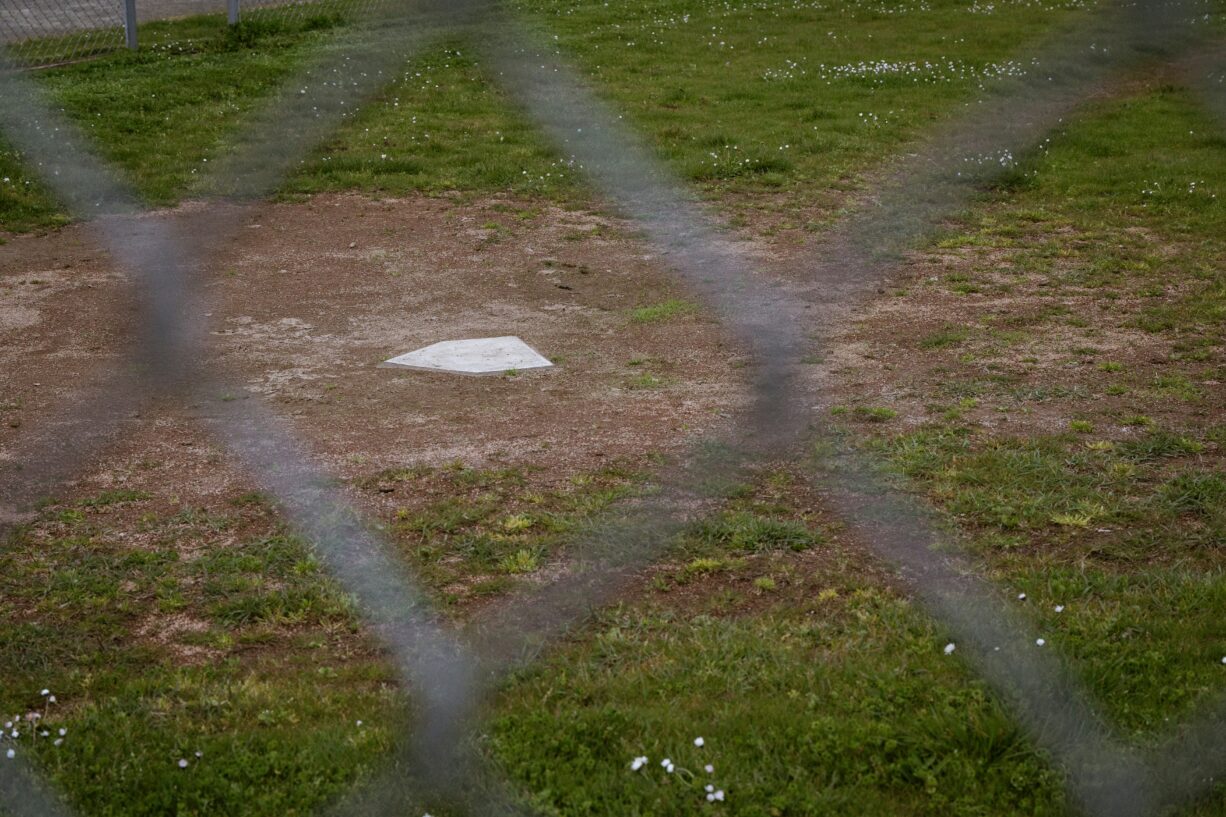
The trees stopped abruptly and the path opened onto a large field where a baseball team was practicing. Lanky teenagers stood in two rows playing catch, wrists like toothpicks in their oversized mitts. I sat on the bleachers and watched the middle-aged coach pitch to batters from behind a protective screen. Every few minutes a batter would hit a line drive at the coach and he would emit a sharp yelp before the ball bounced against the taut netting and rolled safely into the dirt.
After a while the bleachers became populated with parents. Some wore suits and spoke into cell phones as they paced up and down the foul line. Most seemed to know one another, exchanging smiles and pleasantries. I tried to keep my eyes on the coach.
“Which one’s yours?” a man next to me said. He wore a blue Winchester shirt and gray slacks and swung his car keys around his index finger.
I waved a hand in the direction of the diamond. “Oh, he’s out there somewhere.”
“Mine is the first baseman.” His knee bounced when he spoke. “I damn near crashed, trying to make it over in time, but I promised him I’d be here.”
I had nothing to say so I nodded. Here was a prototypical father, straight from central casting, his starched collar the color of overhead fluorescent lighting. I pictured him in his afternoon meetings, one eye on the clock, insisting he had to leave no later than four if he was to beat rush hour, his colleagues happy to oblige his effort at post-divorce parenting.
The aluminum below us popped and creaked as a woman slid down the bench. “How about that traffic?” she asked. “The man on the radio said there was an overturned semi on the interstate.”
“I was just telling him about it,” the man said, jabbing a thumb at me. “Barely made it here in time.”
I slid off the bleachers and made my way towards the street. The sun was firmly behind the trees now, their silhouettes black against the indigo horizon. As I walked the streetlamps came on, illuminating the sidewalk in big pools of yellow, red taillights flickering on the interstate beyond.
The office parking lot was nearly deserted when I finally arrived. I set my paper-light bag on the roof of my car, removed the fidget spinner, and tossed it as hard as I could into the bed of ivy that edged the lot. Something twitched in that tangle of vines, probably a scavenger, interrupted from its most essential task. I looked up at the building one last time. It had taken more than it had given, that was for sure. There was something I wanted to say to it, a reassertion of sorts, but before I could speak it slipped my mind. I waited a long while before I got in the car and drove home.
Originally from Portland, Oregon, Alex now lives in Brooklyn, New York. His work has been featured in literary journals such as The Los Angeles Review, The Raven Review, Bright Flash Literary Review, and Vol 1. Brooklyn. He is a winner of the PEN America/Robert J. Dau Literary Award for Emerging Writers. His short story, “Meteora,” is forthcoming in Catapult’s Best Debut Short Stories 2026. He spends his free time writing, traveling, and fending off surprise attacks from his cat, Napoleon. He can be found at Alex Treuber.