


Of Other Spaces: A Remix
Audrey Bauman | Essays
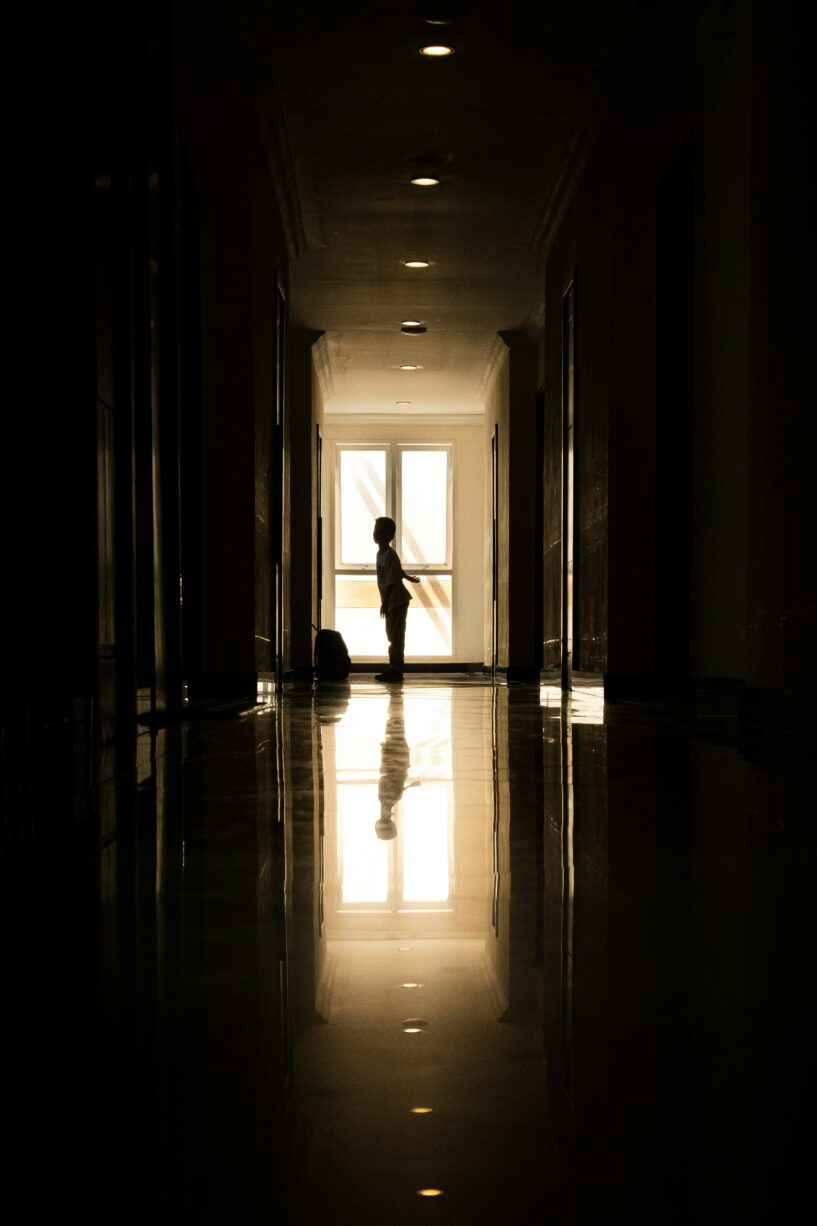
Places of this kind are outside of all places, even though it may be possible to indicate their location in reality. Because these places are absolutely different from all the sites that they reflect and speak about, I shall call them, by way of contrast to utopias, heterotopias.
Michel Foucault, “Of Other Spaces”
When two sets of images, assumed to be fixed and separate, nonetheless come together, it suggests that a third term is possible. This is the source of light.
Sofia Samatar, The White Mosque
1.
You have been to the other space. You remember it well: you entered it by stepping into an elevator. A child, you were following your family through a subway station, slouching up three flights of stairs to the turnstiles. But at some point you stopped following them and, daydreaming, wandered into a steel box stuffed with bodies. You thought those bodies were your family, yet when you left the space of your mind, you found that each body was a stranger. The elevator dinged. The bodies trickled out. Caught in the rush, you exited the steel box and were faced with darkness—darkness, and the rushing sounds of distant trains.
*
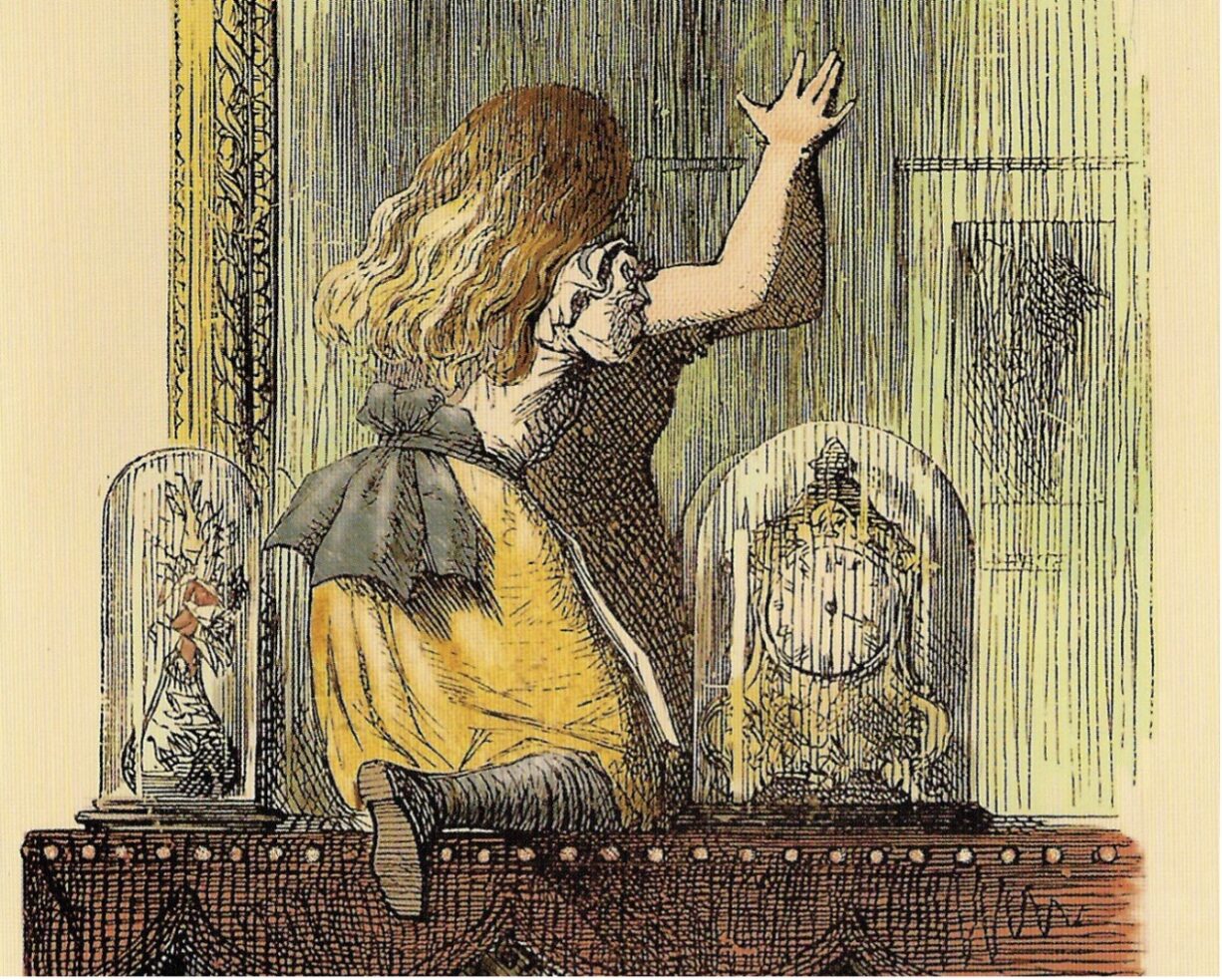
Other ways you visited the other space were through the mirror, an Alice slipping through the looking glass. A classic portal, according to Foucault, the mirror being a device that affirms both reality and unreality. And as you stared at the face there, you found yourself growing more and more unreal. Whose face was that? What did that nose signify? Those cheekbones? Those eyes? The other space was not a stand-in for the uncanny, but a place where the uncanny could be found, a place of home and un-home. Sometimes you didn’t even need the mirror to visit the other space. Sometimes, all you needed was your mind.
*
Your hand, your room, this moment became so real it disappeared, and dizzy, you wondered why you were born this year rather than at any other moment in history.
*
This is what you would like to propose: that the other space is a space you make, just as much as it is a space that makes you. And that, perhaps, it is not necessarily, not always, a physical space at all.
2.
The other space is a prism. The other space is a dusty street. The other space is an encounter with a stranger; as the two of you trudge down the sidewalk, you observe how the other swings their arms (or does not), how they smell of cologne or coffee, and how they stuff their hands in the pocket of their jacket or their jeans. You look down at your feet when you pass to pretend you weren’t looking at all, but sneak a glance after, hoping for another clue in the shape of their back, the curves of their posture. The street is empty. They have rounded the corner, entered a building, or perhaps have simply disappeared. You will find more questions than answers here.
The other space is both a space that is other(ed) and a space where others are. The other space is the land of monsters. Of gleaming teeth and feathered beasts. The collision of studium and punctum, of standard-issue culture and the unexpected or disturbing: the other space is where things collide, a place of unsanctioned meetings. An unsanctioned meeting is the definition of a monster. Jeffrey Jerome Cohen described how the monster is the harbinger of category crisis—a hybrid body. Smash together the body of a lion and the head of an eagle and you have something new. The other space is a site of newness and difference. It is the space that must be different from all other spaces, and that must contain all existing spaces within it. The other space, above all, is a celebration of paradoxes.
3.
Heterotopia is a concept most notably articulated by Michel Foucault’s lecture “Of Other Spaces: Utopias and Heterotopias,” delivered in 1967 and later published as an article in the French journal Architecture/Mouvement/Continuité. Heterotopias, or “other spaces,” are sites which “are linked with all the others [and] which contradict all the other sites.” And unlike utopias, which are “fundamentally unreal spaces,” heterotopias do exist, Foucault argues, in almost every culture. They might be crisis heterotopias, such as the boarding school or military service, which provide an “elsewhere” for a young man’s “first manifestations of sexual virility” and for adolescents who are “in a state of crisis” in relation to society. They might be heterotopias of deviation: rest homes, psychiatric hospitals, or prisons, where individuals with non-normative bodies and behaviors are placed. They might be “heterotopias of indefinitely accumulating time,” such as museums or libraries—highly modern institutions, according to Foucault, since “the project of organizing in this way a sort of perpetual and indefinite accumulation of time in an immobile place, this whole idea belongs to our modernity.” (One wonders what he might have said about the Internet.) And they might be heterotopias of purification, such as the Turkish bath or Scandinavian sauna, sites devoted to physical, and in some instances spiritual, cleanliness.
Foucault believed heterotopias spoke to his moment in time, writing that “we are in the epoch of simultaneity: we are in the epoch of juxtaposition, the epoch of the near and far, of the side-by-side, of the dispersed.” It did not make sense to imagine “a long life developing through time” when human experience ran more like “a network that connects points and intersects with its own skein.” Thus, rather than investigate texts, which necessarily in the Western tradition ran front to back, left to right, Foucault turned to spaces. Mediums with a spatial component such as architecture, and even deeply visual texts such as Richard McGuire’s Here or Mark Z. Danielewski’s House of Leaves, can escape or at minimum trouble linearity in a way that conventional written texts cannot. Foucault captured the potentiality of the other space, a place that juxtaposes incompatible sites, that facilitates “a sort of absolute break…with traditional time,” that is both isolated and penetrable, that has “a function in relation to all the space that remains.”
*
And you, metabolizing Foucault, wonder if it distills these ideas too much to take them away from physical spaces and apply them to narrative. How could narrative be an other space, a network that facilitates juxtaposition—between self and text, between story and discourse, between a space some call “reality” and a space where that reality is twisted and estranged and shown to be as illusory as the illusion with which we are presented? An other space for crisis, for deviance, for accumulated time, for cognitive estrangement, for finding connections between two incompatible sites?
4.
You spend much of your time thinking about the other space because you have skin in this game. You, too, are a juxtaposition. A paradox.
*
It’s easy to forget when you’re drinking your coffee or driving through town. Most monsters, probably, don’t obsess every moment over their own monstrosity. But like many narratives, it comes together in disparate pieces, a network of moments. When you visit an Asian grocery store in a new city, someone mistakes you for an employee. A substitute in your middle school Spanish class pauses by your desk and starts making sounds she thinks your mind will translate seamlessly into words. “I don’t speak Spanish,” you tell her, and she walks away, embarrassed. A woman approaches you and your father as the two of you are walking the dogs, and it’s only years later you realize: she thought the two of you were husband and wife. Because that’s the narrative, a white man and an Asian wife. And that is the narrative of your parents, of which you are the logical result.
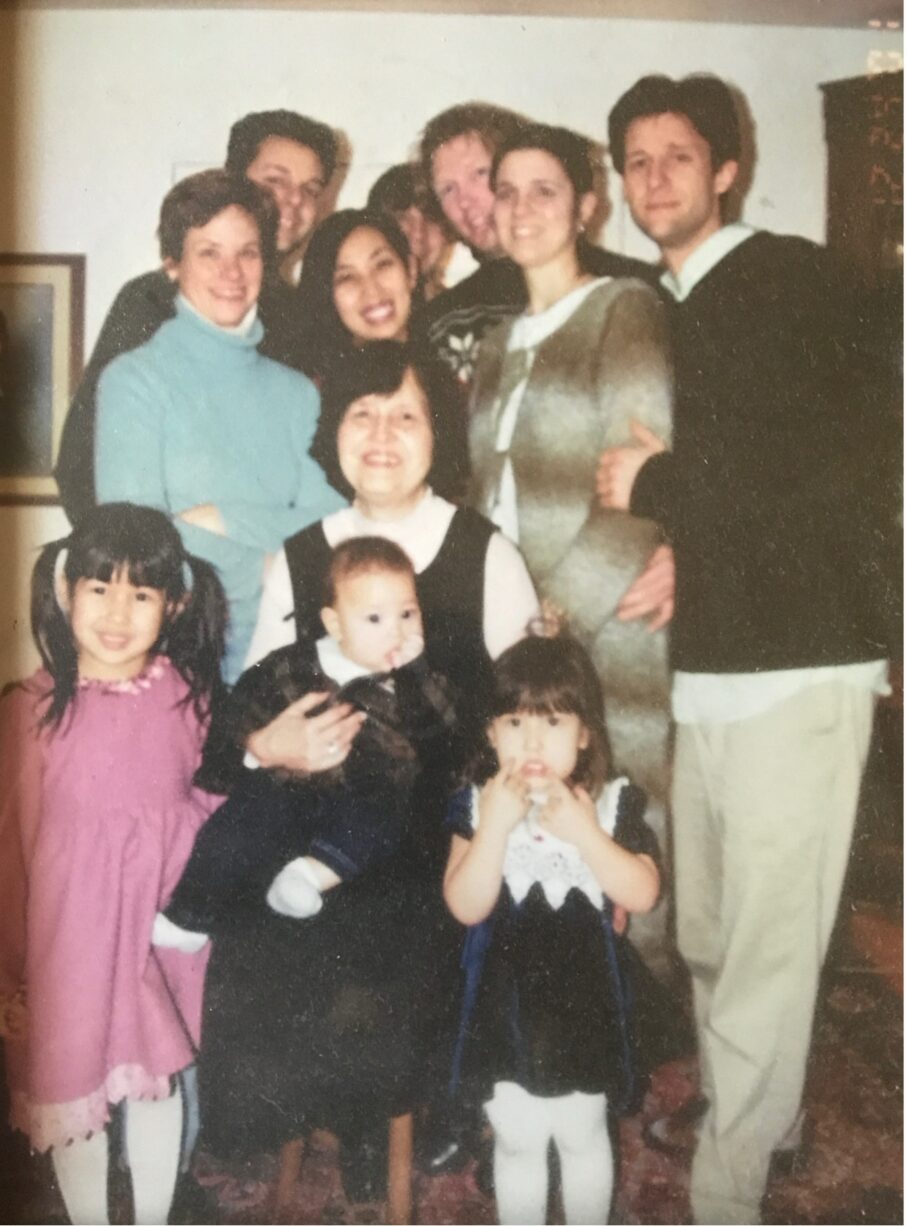
A story shapes itself from these moments that you find yourself on occasion rejecting, on other occasions embracing or enhancing, on most feeling a deep ambivalence towards. It’s tricky because to call yourself a paradox is in many ways to claim a significance that may or may not be there, and to concede to a masterplot: the mixed-race person seeking their category. Not X enough, never Y enough. Two selves, united by one body, brought to the closest possible proximity but never permitted to touch. Separated by hyphen: Chinese-American. It’s a tired story. Someone had to teach it to you. Someone taught you this: to split your face into separate parts and catalog the features that didn’t belong. To weigh the pros and cons of publishing with your ethnic-sounding middle name—is it cultural pride, or is it pandering? Is it a trope to think of it now, or is it naming something felt and real? The problem is that there is no answer. The problem is that both must be true.
5.
For a whole season, your identities made you queasy and sick. You barely ate. It was the summer no one went outdoors, when the library was empty of patrons, and books piled on tables labeled by days of the week in the building’s gallery spaces, to be quarantined for at least five days. The summer of dry, peeling knuckles. One afternoon you sat at the kitchen island with a bowl of cold noodle soup from a package, dressed up with cucumber and boiled egg. You took two bites and realized you weren’t hungry. Your body followed the directives of your mind. If you convinced yourself you weren’t real, trying on clothes that wouldn’t fit, with a face that confused categories and an experience that didn’t slot neatly, your body would make sure it followed through on that story.
*
Your composition students in Michigan were obsessed with writing about mental health and college, mental health and its physical impacts. “Mental health is physical health!” you wrote all over the margins. “Your brain is part of your body!” Not groundbreaking stuff. But you understood the temptation to compartmentalize. It was so enticing to think of everything in its perfect place. Bestiaries tried to tame the monstrous by taxonomizing it, hopelessly inventing order. And you were always an expert, during your job at the library, at spotting the books that didn’t belong—that were shelved too far down, or that were in the wrong part of the building entirely.
*


*
Samatar: “The creatures that we imagine and make up only exist within us; they only belong to the human. So they are at the same time absolutely not human and extraordinarily human. There’s nothing more human, really, than these monstrous creatures that only exist in our imagination.”
*
You wonder if all you can do is recycle narratives, steal words, personas, moments, memories, and to what extent any part of you is real. Even a metaphor you like, the idea of the self or story as mosaic, was stolen from someone else. And she (Samatar) probably stole it from someone else, too. Perhaps you only make up the details that form the seams, slab on the cement as a canvas for your pilfered pieces. Every mosaic is formed from tesserae, or the pieces of ceramic or glass, and interstices, or the cracks where the artisan puts the grout. Which means the interstices, the other spaces, are all that is yours.
*
Of the Muses. Or so the Greek word mouseios is defined, from which the word mosaic is derived. Perhaps this was on the mind of Theresa Hak Kyung Cha when she composed Dictee, putting image next to text and language beside language, pasting together with such care and in such a way the reader must also read the cracks.
6.
To write, always, is to create a monster. But what is the monster?
Is it the text? Or is it you?
7.
What you like about other spaces is how shifty they are. And as you think about spaces that are not spaces, places that are also placeless, you think about the Internet. That creature living in your computer and in your mind, but also outside of it, real and unreal.
*
Once, at a summer program, you wrote an essay about how desperately important your computer was to you. In the eighth and ninth grade, you had a computer that was frequently taken away because you stayed up all night making videos. Already you were interested in cutting and pasting, putting two scenes together or splicing found footage with music to see what could happen. The blue light from your screen kept you up till one or two each morning, and when you woke, your forefingers were sore—too much pressing and sliding across your trackpad. And if you weren’t manipulating images, you were typing hyperbolic messages into a sky-blue chat app, reams of asterisks and exclamation points and bug-eyed faces—this a space where you had to get more creative in your use of emojis. You hit enter and, like a magic spell, the voices on the other end, electrons crossing state lines and miles of wire, chimed their replies. Creating a character (you), talking to other characters (them). When you think about it, how much time have you spent logged in to an other space, between school and Internet and the art you make and the books you read? You know you can’t speak for all minds. But your mind seeks out those spaces that live outside lived time. And you wonder how much is pleasure and how much is fear—of the clock that is ticking, of time that lurches forward, of the accumulating moments that keep slipping by and how you know they will never stop changing you.
*
Paradox: the artist swings between freedom and control. Paradox: freedom abounds within control. For example, when you decide to create an other space like the videos you designed in high school, in which you smash two things together, combining found footage and music to make something new, you are equal parts shaping and uncovering. You’re chasing wonder and horror and you’ll never succeed, but once you’ve touched even one piece of it, you’ll spend the rest of your time polishing it to an even brighter sheen. Why would we put “capture” alongside “feeling” if we weren’t talking about something agile and alive?

Photographer: Jennifer A. Howard
You don’t want to be too general, here. The other space, while it might contain everything, cannot be everything. It can’t be your bedroom, your kitchen, or your car. It can’t be anything that belongs to you.
8.
You wanted to write about heterotopia and narrative and mosaics, and also of marriage. It was Le Guin who said that everything she wrote, she wrote about marriage. Not the institution, but the larger idea: one of convergence. “In broad terms, ‘marriage’ is about bringing things together into contact and harmony; it is about the achievement of integration without loss of identity. It rejects the singular, isolation, and alienation.” (Ria Cheyne, “Ursula K. Le Guin and Translation”)
Rhyming with a mosaic, where tesserae are other, apart, where pieces are distinct and the self is shattered yet unified in the shape of one seemingly whole thing. But isn’t there something about reading, too? Isn’t it true that when two things come together, something prior—a way of seeing, something once understood—must, through the weight of the encounter, fall apart?
*
In fact, tension between convergence and shattering, between what’s recognizable and what’s unsettling, between familiar and strange, has been held before—by Shklovsky, Suvin, Delany, and Jeffrey Jerome Cohen of monster theory. To cognitively estrange, to make strange what was once familiar, to make familiar what once seemed impossible: to unite the two into one object, one being, one fantastical story.
*
But even a paradox suggests purity. Two opposites, separate and in and of themselves whole—why are they not broken, missing, wrong? Who is to say they were not meaningless to begin with; who is to say they have not already contaminated one another; who is to say they are not the same thing, anyway?
9.
Through the window of your computer screen, you have your first two relationships.
*
Unsure if it was the feeling of being safer there, or if it was a simple matter of convenience. Not as if you could test-run romance in what some call “meatspace,” since, to hang out in the flesh, you’d need a car. And a car—specifically, your ex’s parents’ minivan—is where the clumsy teenage face-mashing happens, in the backseat, during a light rain, after an nighttime screening of Les Mis, parked next to the newly built Dunkin Donuts. But that moment feels weirdly gross and surreal. As does that relationship, which you remember mostly for a codependent partner and a compendium of red flags—an “I love you” after two weeks, a lack of digital privacy, an explosion during Senior Day. Once, your ex forgot to mute himself as he stormed through this bedroom, kicking over trash, knocking items off his desk—angry at you? At himself? You don’t remember. But you remember the disembodied voice echoing through your headphones, an other space, un-homely, defined by a powerful, petrifying emotion.
*
What’s heterotopic about a window? Of course, it’s touching two places simultaneously, inside and outside. It’s paradoxical in that way. And it’s also a contained container—when you look through the window of a train, you watch everything rushing by on the other side, neatly framed for you.
*
Something about windows suggesting longing or daydreams. Something in how characters in Miyazaki films stare out the window when they’re euphoric or lonely or bored. Something, too, about fear. The window being an example of a border, where the outside can also look in. (When you look at a picture, is it looking back at you?) After watching a movie where a creature lurches through darkness after the heroes and peeks over a ledge to watch them sit around a fire, you’re afraid of eyeballs materializing above your windowsill, a bulbous head leering in the dark. Even when you yank the blinds closed, there are too many crevices where something could get in.
*
Foucault writes that heterotopias are places where visitors are in turn invited and excluded—where the point of entry, the true site of coming in, is not often where you think it is. And windows are the unconventional entrances, places where, frequently, you are “not supposed to go.” People who go and leave through the window are at best weirdos, at worst intruders or outsiders. There’s the literal physical danger of falling down from a second-story window. And there’s the sexual connotation, too—you imagine a lover crawling up a wooden terrace to enter the beloved’s bedroom. In Rear Window, Jimmy Stewart’s character captures his neighbors, through windows, in their most private, violent moments. And in your first apartment, a basement unit, your lack of a good window left you depressed through the long Michigan winter. The window’s primary function, of course, being to let in light.
10.
Airplane window, a tiny portal. You stare at green-encrusted islands dotted with gleaming skyscrapers, necklaced with boats and bridges. You always choose the window seat, no matter how long the flight.
*
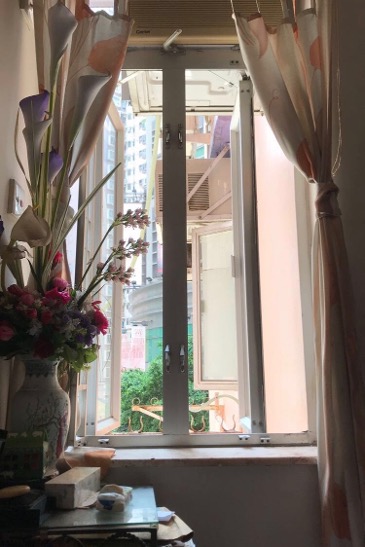
Your grandmother’s apartment in Mongkok is all tight spaces. In the space of two square feet, so much choice—you could enter the office, the kitchen, the bathroom, or the bedroom. The bathroom window faces a gray tiled wall and is filled with a fan. Sometimes she turns the AC off and cracks the bedroom window open to save power. Sticky, your skin sloughs off in big chunks. At night, sound creeps in—the bustle of voices and nightlife spilling through from two streets over.
*
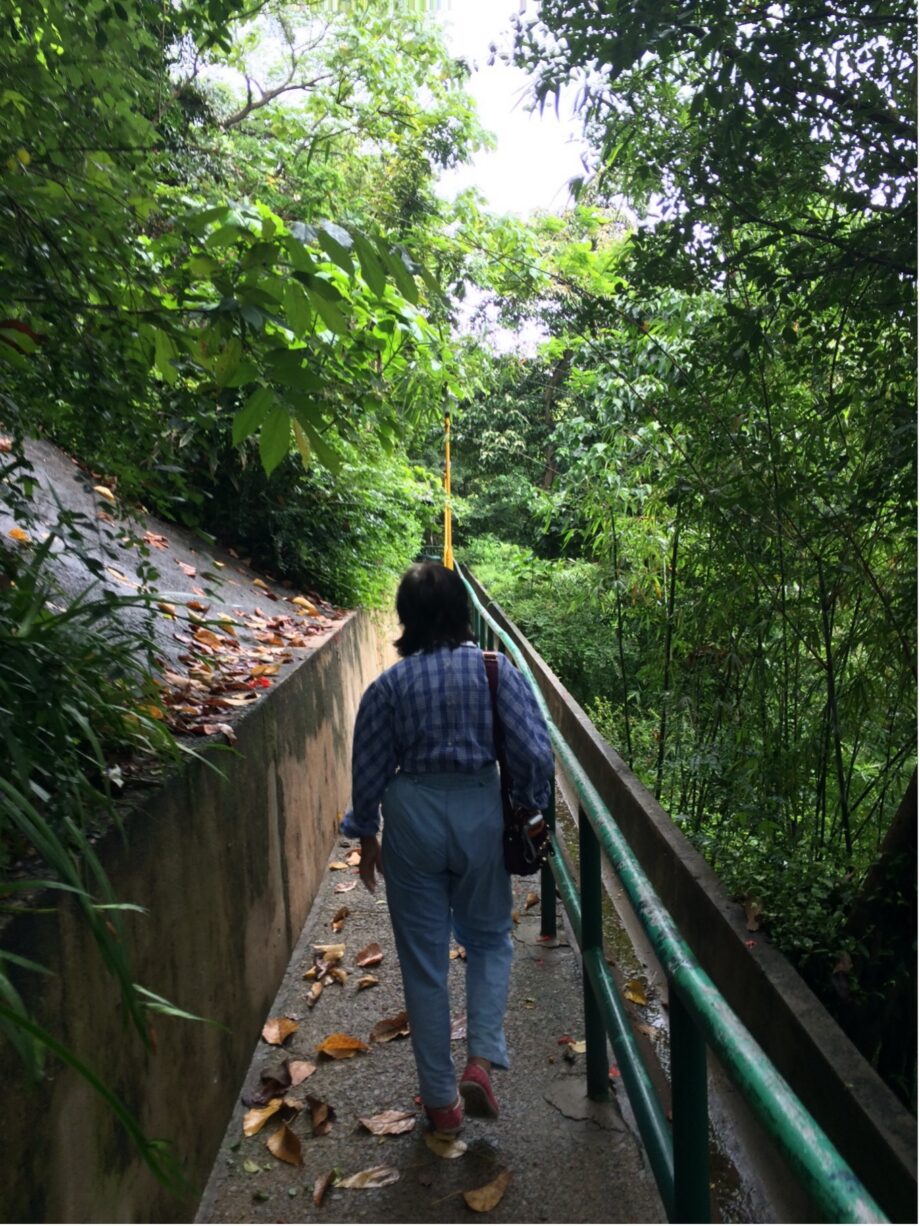
The orderliness of counting time. Each moment is numbered—you can point to it with hyperspecificity. Down to the millisecond. For example, you can say that on August 15, 2019, about six hours before you had to be at the airport, about twenty hours before you would land in Chicago, only to drive another six to upper Michigan, on that morning in Hong Kong, at about 8 a.m. local time, you realized your grandmother didn’t know that you were leaving her.
You had to fumble through a rushed goodbye. You walked with her to a restaurant for lunch, a hotel restaurant where families ate dim sum, and where you would privately decide to take the bill but chicken out once the two of you rose to follow the waitress to the register. You would wave goodbye to her until an undecided future moment. For the last time in a long time, perhaps ever, you would turn around before entering security to see her watching you. Her papery face crinkling. Waiting patiently for you to disappear.
*
If the moment sticks with you, it’s because you’ve figured out a way to make it mean something. Paradox: it was just another day, a tiny error. Paradox: it was every day, everything, a moment bigger on the inside. Afraid of parting and closure and distance between you and a figure already distant in terms of space (geography) and space (culture) and more space (language). Years later, you’re crying over a book where a daughter character struggles with the slow death of a distant father. When you explain why to a friend, you have to put it into words: I’m afraid my grandmother will die and I won’t be there.
11.
Another wondering you have: is it a paradox to crave catharsis but despise closure? On written work, common feedback: to stop giving away so much at the end, to loosen your control. Foucault: “The ship is the heterotopia par excellence. In civilizations without boats, dreams dry up, espionage takes the place of adventure, and police take the palace of pirates.”
*
The point of a paradox is that it can’t be easily resolved. The point of a heterotopia is how unfinalizable it is.
*
Although, ironically, when introducing and defining the heterotopia, Foucault neatly listed his six principles.
*
And you, in your efforts now to lose yourself, enter the other space of narrative and assemblage, stare out the window. Hesitant to finalize the unfinalizable. To perfect the puzzle.
Audrey Bauman is a Chinese American writer from Little Rock, Arkansas. A PhD candidate at the University of Utah, she also serves as Fiction Editor at Waxwing and Graphic & Arts Editor at Quarterly West. Her work has been supported by a residency with the Kimmel Harding Nelson Center for the Arts and her short fiction, nonfiction, and poetry have appeared in Hayden’s Ferry Review, Puerto del Sol, CRAFT, HAD, and elsewhere.