


Intruder
Leslie Michelle Nichols | Fiction
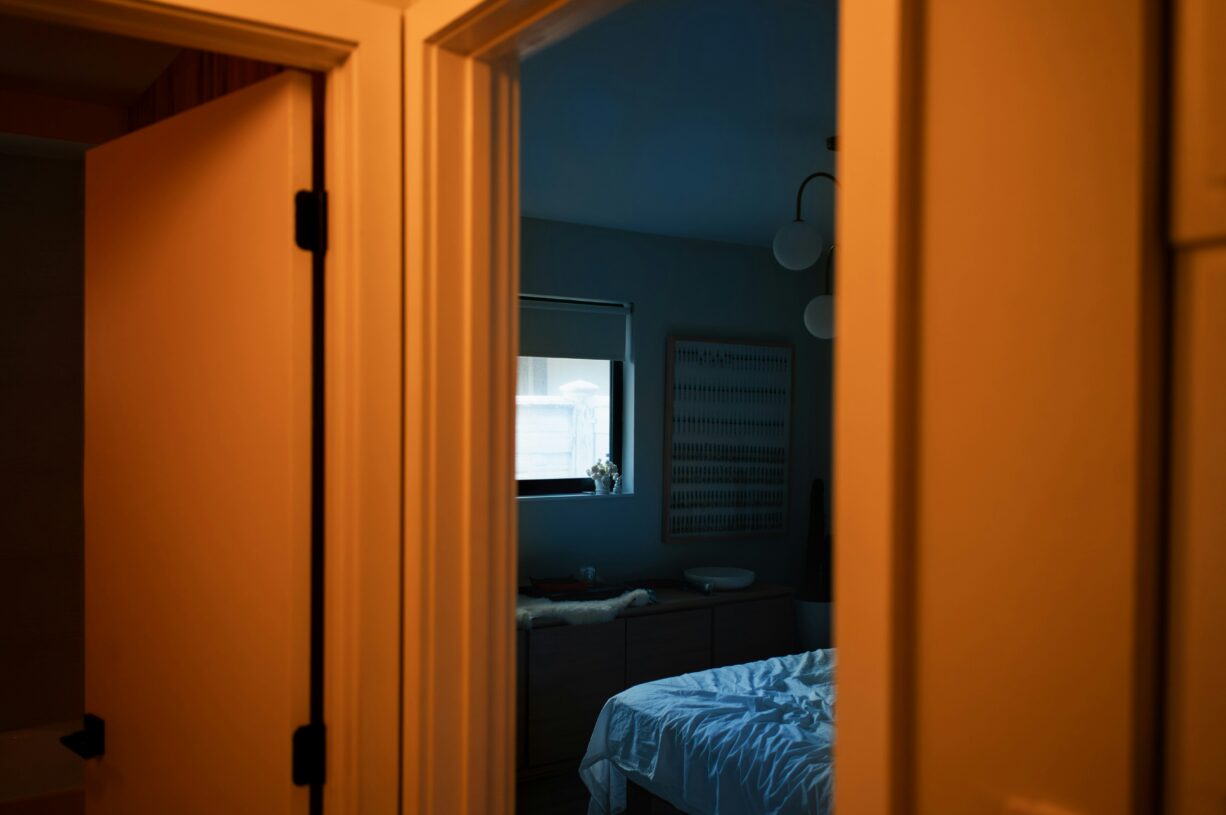
One morning before dawn, I saw a man standing in the doorway of my bedroom. I was thirteen. He stood in shadow, but I could see that he was a large man, tall and muscular with wild hair. I woke because I heard the loose board in the hallway shift, and I thought my mother had left her bath early, her skin already red and wrinkled. But then I saw the man. I closed my eyes tight, willing him away. If he were real, then I would have to accept that he had mastered the front door or the kitchen door or the door that inexplicably existed between my parents’ bedroom and the back porch. There was no good reason for this door—no purpose whatsoever other than to provide another way into the house. No one ever used it, not my mother, not my father, and certainly not me. But the door never locked. If you set the old-fashioned pin behind the door handle, it immediately clicked open in a mocking way. For this reason, I was convinced that the door was a fairy portal to someplace I didn’t want to be—the Amazon rainforest maybe, where spiders grew big as basketballs.
My father sometimes talked about fixing this door, maybe taking it out altogether, but nothing ever came of it. I was sure the intruder had entered the house through it, sure that he had crept past my snoring father to get to me, which was especially frightening because it meant that my father couldn’t protect me. It meant that the dog, Fred, who slept on a towel in the laundry room was useless and existed only, as my father claimed, to terrorize us. Once, Fred killed the barn cat, buried it, and then rediscovered it a week later when the cat was stiff and rotten. What he did with it after that was a mystery because he disappeared with it into a field and returned smelling like a skunk. No, it meant that Fred and my mother, too, who spent her days reading tarot cards could not be trusted to protect me either.
It meant that if the intruder had slipped past my father, Fred, and my mother—it meant that I wasn’t safe. Had maybe never been safe. I closed my eyes, telling myself that when I opened them, the man would be gone. He would have left the way he came—back out the fairy door—but when I opened my eyes again, he was still there.
I didn’t yell or scream. I didn’t look away either. I tried to rationalize that the man, so clearly not my father, was actually my father. People called my father Slim because he was thin, scary strong, but thin—with long legs that took steps two at a time. There was no stretch to the imagination that made the shadow man thin. He held his arms away from his body like they were too muscular to lay flat like normal arms. And there was no stretch to the imagination that made this man a woman, or specifically, my mother. My mother was shortish, plumpish, obviously female with breasts so large they embarrassed me.
I rose to a sitting position and wiped the drool off my chin. My hair clung to my face, and I could smell my own sour breath. I held out one last hope that I might just be seeing things. Why would someone be in my house anyway? I couldn’t think of any good reason for it. We had nothing of value except a pocket-watch collection my father kept in a safe in his closet. He opened the safe once a year to polish each watch with a dust cloth, and the task took him no longer than thirty minutes. There were only five watches inherited from a great uncle. Two of the watches didn’t even have chains. Only one was engraved—To Eddie, With Love, Lil. I didn’t know who Eddie or Lil were. Neither did my father. I doubted that any other living person would know either. No one would want those watches. No one. I grasped my elbows, dropped my chin to my chest.
Across the house, I heard my mother shift in the tub, splashing. She read true crime books every morning before she started her day. Then she slipped into bright leggings and oversized t-shirts that said things like Your Friendly Neighborhood Spider or My spidey sense is tingling. She really liked Spider-Man. She liked wearing Spider-Man shirts, especially to my school, and she couldn’t understand why the boys laughed about her spidey sense. She always looked down at her chest when they laughed, her large breasts stretching the words into funny shapes. She pronounced whatever words were there carefully, sounding them out syllable by syllable, trying to see what made the boys laugh.
My father preferred Batman, but the only merchandise he owned were tube socks with the bat signal embroidered on them. My father farmed a four-hundred-acre cotton farm, and he wore these socks when he worked Sundays. He said things like Holy moley, Batman, trying to make me laugh, but he never did. This was how my father embarrassed me. He never joked to anyone but me, and then he made puns. He wiggled his thick eyebrows so that I would laugh along with him, not at him, but nothing he said was funny. He didn’t try to make anyone else laugh, not even my mother. To see him walking across a field, his arms swinging, his eyes on his feet, most people thought him so devoted to his work that he never even took the time to say hello to a neighbor much less his own hired hand, but that wasn’t true. My father took time for me. Whenever he saw me at the end of a workday, he adopted a boxer’s stance, arms held up to guard his dirty face, and then he pretended to bob and weave, inviting me to jab at him. He danced around me in circles and tapped me on my shoulders so that I would respond. I never did that either.
I wondered what my father would do now if I screamed. Would he even wake up? He was completely deaf in his left ear, and if he slept on his right ear, he would hear nothing. What would my mother do? Would she take the time to wrap herself in a towel? Or would she turn the corner naked? What would the man do if I screamed? Would he run out the fairy door, or would he just stand where he was now, completely unconcerned with getting caught. I decided against screaming.
I said, “Hey,” to the man instead.
The man said hey back.
I hadn’t anticipated this. I thought very quickly about the best thing to do, but my brain was jumbled, ideas popping in and out of my head. I considered the window across the room. I considered leaping to it, but this was impossible because of the rocking chair piled high with dirty clothes. I imagined myself tripping over the chair and chipping a tooth on the windowsill. I imagined knocking myself unconscious so that the man could touch my hair without me knowing. This thought, someone touching my hair without me knowing scared me more than anything else. My copper hair. Like my mother’s. The prettiest thing about us. “Who are you?” I asked.
The man reached into my bedroom as if he knew exactly where the light switch was. He turned it on. It was Ben Simms, the school bus driver, the man I saw every weekday morning and afternoon. This didn’t comfort me. I didn’t like Ben. And I thought Ben didn’t like me. He wore the same Metallica concert shirt I remember him wearing the day before. His acid-washed jeans were light, not dark like I imagined an intruder’s should be, and one of his shoes was untied. One of his shoes was always untied. He had a full head of thick brown hair and a pair of thick glasses with white tape holding them together at the bridge. He watched me, blinked twice, then turned the light off again.
I wondered if he could smell me. I wouldn’t doubt it because I could smell myself. I smelled like broccoli. Burnt broccoli. My mother had burned dinner the night before, and the odor lingered in my hair. I pushed it back from my face and behind my ears. I watched Ben. In daylight, he was a slight man. Harmless. I was surprised to learn now that he was imposing—his muscles large and defined. On the bus, he never acknowledged me other than to open and close the bus door for me twice a day. He lived with his brother’s family on the outskirts of Beckettsville. My mother reported that she saw him often at the Thriftway, buying peanut butter and chocolate milk.
It occurred to me that I shouldn’t be scared. It occurred to me that Ben must be in love with me. It occurred to me that the Christie I saw in the mirror every morning—the skinny girl with beady grey eyes—was not the same Christie Ben saw. Something had changed, something I had missed. I wondered when it had changed. The month before? The week? Had I been slouching in my Snoopy t-shirt in social studies or hiding in the bathroom, my feet balanced on the walls during lunch time when this change happened? Was I talking back to my mother? Maybe it had happened while I slept? Maybe this was why Ben was here—to watch me change into a pretty person. Well, maybe not a pretty person, but a striking one.
I sat a little straighter in the bed. My legs stretched in front me, the nightgown hanging off my shoulder. I adjusted the sleeve carefully so as not to make any sudden moves. I covered the exposed skin. I watched Ben. Was this love? This fighter’s stance. These hands clenching and unclenching into fists. I was aware that the only way out of the room was through him, the bulk of him with his crazy hair. His broken glasses. Why were his glasses broken? Had someone hit him? Had someone had reason to? I wondered what would happen if I stood up. I was small. Five feet tall with one sock on. Ninety pounds. I wouldn’t even come to his shoulder. I was still afraid. I thought very hard about what to say next. I said, “Ben.”
He said, “Christie.” I didn’t even know that he knew my name. In his mouth, my name sounded like a vocabulary word. Something like Algae or fungi. “Your room smells like broccoli,” he said.
“It’s my mother,” I said. I wasn’t entirely sure why I needed to defend myself, but I said, “She cooks broccoli all the time.”
Ben sighed. “Georgiana,” he said. I was surprised that he said my mother’s name. It was always strange to hear her name because I didn’t think of her as a real person. I thought of her as my mother first, and then something else that wasn’t entirely female. She certainly didn’t look like other women. She might comb her hair. Or she might not. It all depended on her mood. It depended on the quality of her true crime novels and the daily tarot reading. It depended on whether she had eaten breakfast or skipped it because she had a bad dream the night before. There were just too many factors to consider, but there were two constants—the thin line of dark hair on her top lip and her glasses. Her glasses were thick like Ben’s and taped along the bridge and the left earpiece. They made her blue eyes very large. The mustache made her look unkempt, like her face was dirty, like she couldn’t remember to wash it.
Ben said her name again like he was saying abracadabra. Georgiana.
“What do you know about my mother?” I said, surprised by the smallness of my voice.
Ben didn’t answer immediately. He cracked the thumb knuckles of each hand. He said, “Your mother’s hair is like a new penny.”
I put my hand up to my own hair. My own hair like a new penny. I breathed in the broccoli smell, felt the coarse unruliness of it—always thick, always wet underneath with sweat. I imagined Ben standing over me while I slept. His broken glasses. His big hands. I saw those big hands take up a lock of my hair. I saw him hold it up to the hallway light.
“My hair is like a new penny,” I whispered.
“Maybe,” Ben said. He sounded doubtful.
In the bathroom, I heard my mother rise from the bathtub with loud splashing and the groan of the shower door as she pulled herself upward. She began to sing “Daydream Believer” by the Monkees. She had a good voice, and she sang enthusiastically. I knew she was wrapping a towel around herself before slathering her skin with lotion so that it wouldn’t sag. I knew she would wrap a hand towel around her hair next. Then she would leave the bathroom to get dressed. The bathroom door opened abruptly, and I heard her heavy footfalls. I knew the steam rolled out into the hallway after her. I knew she never thought to dry her feet, and the hallway floorboards were warped because of it.
She walked back to the guest room, where she had slept for the past six months. She didn’t close the door behind her. She wasn’t shy. I heard her shuffling around, mumbling items off the grocery list. “Dog food,” she said. “Toilet paper.” My father coughed, farting one long, plaintive note before turning over. I was embarrassed on his behalf, though I don’t think he would have cared if Ben heard him or not. My father didn’t care what people thought. If something someone said didn’t interest him, he simply didn’t pay attention. He turned his bad ear to them and smiled in a way that made him look dumb. But he wasn’t dumb. He just didn’t allow certain information into his head. If someone complained or gossiped, my father switched off, thought about other things like the yellow-breasted flycatcher he had seen learning to fly that morning. Or about ice cream. He loved ice cream, strawberry ice cream especially, and he would eat a dish of strawberry ice cream with every meal if he could. He had a tight little stomach paunch because of it. This stomach paunch peeked through the gaps in his snap-front work shirts.
His bedroom TV came on by itself as it did several times each day. I heard the theme song to Disney’s “Duck Tales” play much too loudly, but I knew my father wouldn’t hear it before the TV shut off again. There was no rhyme or reason to it. It just switched on and off several times a day playing the programs on Fox Channel 34 sometimes for a few seconds, sometimes for an hour. The TV shut itself off almost immediately.
I said in a small voice, “Help.” The television came back on and shut off again. My mother started singing “The Might Quinn.” I cleared my throat. “I need help,” I said.
I heard Fred’s nails on the kitchen floor. He whined for a moment, an excited, nervous whine, and then I heard him pad toward my room. I wondered why he hadn’t smelled Ben before, why there wasn’t barking or violence. I wasn’t sure how Fred would react to a stranger in the house. He had never guarded the house with much devotion before, but then there hadn’t been an intruder. This was still Fred’s home, and my parents and me, his people. I prepared for what would happen when Fred came around the corner and saw Ben. I prepared for him to take Ben violently by the pant leg. I prepared for Ben to fight back. I wondered if Ben might even be more dangerous than I thought. Surely he wouldn’t allow a dog to attack him. Surely he wouldn’t attack a dog either.
Then I saw Ben take out a sandwich baggy from the pocket of his jeans. It had bacon in it, greasy bacon I could only smell when it was free of the plastic. Fred’s tale thumped against the wall. When he appeared, he took the bacon from Ben’s open hand. Ben scratched him behind the left ear. In a low voice, he told Fred he was a good boy, and Fred sat with his ears lifted at attention. Fred was a mutt—a scruffy terrier mix—with wiry hairthat couldn’t be combed. He had a beard that struck sideways off his chin and extra toes on his front feet. Ben balanced a piece of bacon on Fred’s nose. Fred let him. He sat patiently, eyes trained on Ben, until Ben said OK. Then Fred licked his own nose and swallowed the bacon. I watched in disbelief as the dog turned over to show Ben his belly. A little stream of his pee arced onto the floor.
“You’ve been in this house before,” I said.
“Yep.”
“How many times?”
“Lots.”
“More than five?”
“Yeah.”
“More than ten?”
“No.”
“Why?”
“I want to touch your mother’s hair.”
My hands fell from my hair into my lap. I realized how stupid I must’ve looked, running my hands through my medusa head, tangles jutting out at weird angles.
“You can’t,” I said.
“Why not?”
“Only my father touches my mother’s hair,” I said. I knew I sounded childish. Lying. My father probably hadn’t touched my mother’s hair for a long time. A very long time. He didn’t like the tarot cards spread out on tables. He didn’t like the true crime novels. Books about murder. And bad people. The kinds of people who broke into people’s houses before dawn. My father was prudish that way. Boring. My mother had said as much without actually saying anything. She sighed. She sighed all the time, and once, she laid the cards out in a Celtic Cross, pulling the Knight of Pentacles to show him. The Knight of Pentacles was hardworking, but dull, but my mother didn’t say this. She sighed. She sighed like she had burned her finger in the dishwater. And my father blinked at the card. He took it away from her, turned it over like there might be more to it, and then he gave it back to her. He didn’t say anything. She didn’t say anything. She twisted a lock of copper hair around her finger. Her hair shone brighter than new pennies in direct sunlight. A color you couldn’t get out of a bottle.
My mother left the guest room. Her footfalls were cushioned now by sneakers. She sang, “When Quinn the Eskimo gets here, everybody’s gonna jump for joy.” I wanted to say, “Somebody’s in the house,” so that my mother would grab a can of Raid, so that my father would grasp the bat he kept by the bed. I wanted them to run to my room. I wanted them to save me. But I didn’t know what saving me meant. Beating Ben with the bat until he couldn’t run? Filling his mouth with pesticide. I was quiet. I wasn’t afraid that Ben would hurt me. I was afraid of what would happen when my parents saw him, when the three of them stood face to face. I was afraid my parents would cease to be the people I knew. They would be people of action. People who yelled and grunted and struck out with whatever they had in their hands to hurt someone they thought was hurting their child. I had no doubt that my father would slam the bat upside Ben’s head, or that my mother would blind him, but I didn’t want them to be those people. I didn’t want that image stuck in my brain. I didn’t want that image stuck in theirs.
I said, “You can touch my hair.”
Ben didn’t need to think about it. He said, “I don’t want to touch your hair.”
I found a lock of my hair and twirled it around a finger. It was wet. Sweaty. I pulled it tight so that my finger started to turn blue. “Why not?”
“I just don’t want to.”
“But it’s my mother’s hair.”
“It’s not.”
“It’s like a new penny.”
“It’s not,” Ben said again. He didn’t say it in a mean way, like he was grossed out, like he was a boy at school. He said it like I had offered him a coke, but he wasn’t thirsty. He was polite, apologetic almost.
I didn’t feel rejected or deflated. I didn’t even feel sad. I felt cold. Goose pimples rose on my arms. My hair stood on end. I said, “How’s it different?”
“It just is.”
“But my hair’s beautiful,” I said.
Ben paused a moment. He shook his head, cleared his throat. “It’s not.”
I said, “Touch my hair” before I knew the words were out of my mouth. I didn’t say it in a mean way either.
My mother called Fred. “Come here, you little turd,” she said. I could hear her opening a can of dog food. I could hear her scraping a fork against the inside, so the food dropped into Fred’s bowl. Fred lifted his nose, sniffed the air, and then he looked at Ben. It was like he needed permission. He watched Ben, his ears raised, his beard trembling on his chin. Ben gave him a nod, and Fred disappeared. My mother substituted his name for Quinn’s. She said, “When Fred the Eskimo gets here,” and then I heard the food bowl clang against the cabinets as Fred nosed it around the kitchen floor.
In my father’s room, the TV flashed on, the bright jingle of a commercial playing. It was a circus song. Very silly. A jokey, clownish voice said, “Y’all come out now, ya here.” The TV stayed on for the entire commercial before it shut off. In the pause that followed, my father said, “What?” The mattress shifted beneath him. The headboard hit the wall. He said,” What?” again, and I could hear him turn over. He sighed once and started snoring again as if he had never stopped.
“I don’t want to touch your hair,” Ben said. He ceased to fill the doorway now. He was shrinking, his shoulders not so big. His hair not so wild. I could smell the soap smell of him. I could smell laundry detergent.
“Touch my hair,” I said.
In the kitchen, my mother started a new song, one I didn’t recognize. It was a song about magic, and she said the word magic in a goofy voice like she was being funny on purpose, but her voice was even more lovely than it had been before. It was clear. Strong. It rose easily to a very high note that she held for an impossible length of time. Such a long time. The coffee maker started to percolate. Her toast popped out of the toaster. Still my mother held the note, and when she finally inhaled, Ben told me he didn’t want to touch my hair. He said he would never want to touch my hair. I wouldn’t say he was very small now, but he was harmless again. He was his daytime self. The man who couldn’t keep his shoes tied. Or afford new glasses. I told him to touch my hair. Again, he declined.
I watched him across the length of my room. He watched me. My cold feeling was giving way to anger. The goose pimples settled. My face reddened. I clenched my hands into tight fists. I took a very deep breath so that I would look bigger than what I was. Like a cat. Like the barn cat Fred had killed. A long-haired tabby that doubled in size when she was scared. I held my breath for as long as I could. I stared without blinking at Ben, summoned every ounce of meanness—every ounce of hate—to my eyes. I was big now. Impressive. Soon I would fill the room.
Ben said, “I’m going now.” He didn’t wait for me to answer. He disappeared into the shadow of the hallway. I didn’t hear his footfalls, but a moment later, I heard the fairy door open and close. My father snored. A morning news show flashed on the television. Somewhere a famous artist had died, an artist who secretly painted his neighbor’s wife naked. A woman named Helga. I touched my hair again. It was a mess of tangles, ugly, ugly tangles that didn’t shine like pennies. Or anything else. It was dull. Like me.
I shrank back into the bed, small again. Skinny. Even though Ben no longer stood in the doorway, I still felt like someone was watching me. Judging me. I pulled the comforter aside and set my bare foot on the floor. The carpet had been worn very thin, very soft. I scrunched my toes into it, deciding which parent I should tell, if I should tell them at all. But I don’t know how to start the conversation. I imagined waking my father, putting a hand on his shoulder and standing over him. He would wake with a start. He always did. His hair would stick out in little tufts over his bald spot, and he would wonder why I didn’t scream when I saw Ben. Or why I didn’t call for help. I didn’t know how to answer that question. I didn’t know how to handle his concern. He wouldn’t say anything. He would check the fairy door. He would check under my bed. My closet. He would carry the bat in one hand dragging it all over the house and into the yard, where he would scrutinize windows, his chest bare, wearing only boxer shorts.
No, I would tell my mother. I would stand over her as she drank her coffee, bending over the tarot cards she spread on the kitchen table. She would have a hungry look on her face as she read the cards in a ten-card spread, deliberating over upside-down cards and outcomes. Biting her bottom lip. Maybe the Tower would appear, the worst card in the deck. Maybe Death. The end of things—circumstances and people. I would tell her about Ben, and she would touch her hair, her hair like new pennies. She wouldn’t touch it because it was beautiful. She would touch it because it was a part of her, something to occupy her hands when she was scared.
I walked to the kitchen, pulling a blanket after me like I was a much smaller kid. Like it was a security blanket. I stood in the doorway. My mother was bent over her cards. Fred sat curled at her feet. He didn’t look happy to see me. He didn’t wag his tail or raise his ears as he did with Ben. He looked at me like Oh, it’s you. Then he scratched an ear with his back foot. My mother didn’t look up. She was reading a three-card spread—Past, Present, and Future—her eyes narrowed. She was thinking hard, her palms flat on the table. In the Past position was the Queen of Cups. In the middle was, the Magician, and in the last place was the Ace of Pentacles. A card of good luck. A windfall. It was a good reading, a positive one. Good things would come. The Queen of Cups was the card of true love. The Magician was a rock star, talented and greedy, but the Ace of Pentacles made the reading a good one. My mother wasn’t happy with it. She leaned close to the last card, stared at it like it might be a mistake. She tapped her finger on it, trying to piece the logic together. She couldn’t understand it. She pushed the three cards back into the deck. She would deal again, lay the cards out in a different spread. She hadn’t seen me.
I cleared my throat. She looked up at me, a smile on her face, her mustache dark on her top lip. She wasn’t ashamed that she had been caught reading cards. She waved at me like we were meeting after a long absence. She wore a t-shirt with Spider-Man’s face stretched wide across her chest, one eye very big. Her hair hung over her shoulder. It shone copper under the kitchen’s artificial light. She had combed it.
Leslie Michelle Nichols has appeared in descant, Juked, Louisiana Literature, PANK, Permafrost, storySouth, and Texas Review. She earned the Novel Writing Certificate from Stanford University and a Ph.D. from the University of Southern Mississippi’s Center for Writers. She lives in rural West Texas.