


Everything’s Fine at The Greenbrier!
L.C. Killingsworth | Essays, swamp pink Prize
Sunday, 3 September 2023
I am staring at an incinerator for human bodies, fantasizing about climbing in for a nap. But the cast iron door—a squeeze, but I’d fit, I think—is mounted far too high up, at chin level. Perhaps to discourage me from throwing myself in.
This place thinks of everything.
I’m deep underground in a secret government bunker that was constructed during the Cold War to hold Congress in the event of a nuclear attack. But, rather than burying it out in the desert like you might expect, they built it right under a bustling hotel, where it hid in plain sight, disguised as a conference hall. That is, until a reporter outed it in the 90s. Now the Bunker Tour is one of the many leisure activities available at The Greenbrier, America’s Resort™, where I am spending the long weekend. Since most of the other activities involve gambling, sports, and/or relaxing—none of which I’m capable of—I’ve ended up on this tour, staring the apocalypse in the eye. America’s Last Resort, I suppose.
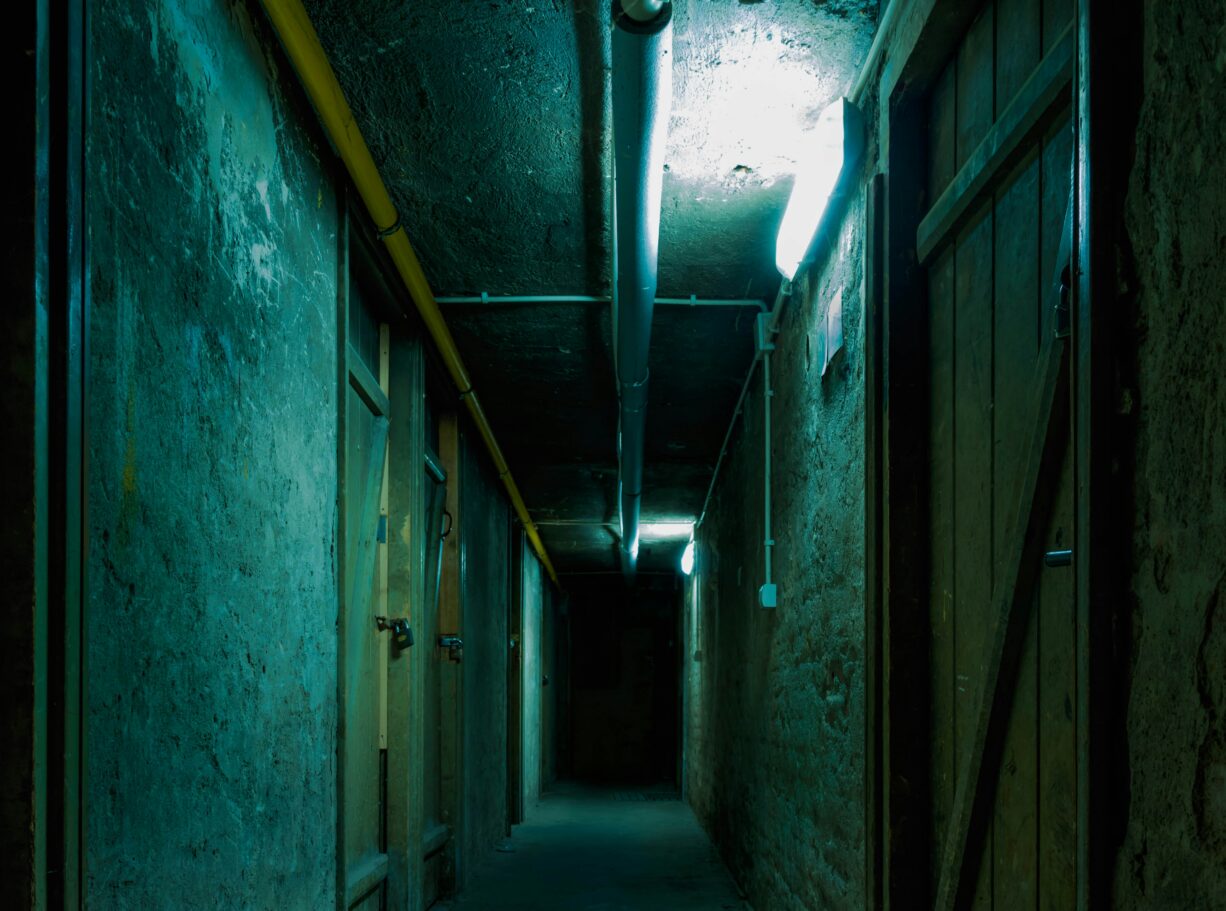
Aside from the corpse-sized oven, the room is a regular industrial basement: exposed pipes, concrete floor, greenish fluorescents. The tour group nods along, blasé—sure, I guess you’d need a place to chuck the bodies when the world ends—and shuffles out. But I linger behind.
In my current state, this room is a respite. Over the last few days in the hotel above, something in me has grown restless and belligerent, an id-like need that I cannot put my finger on, and restraining it has taxed me to the point where I can actually feel it in my body. It is heating up my skin, drawing the strength out of my muscles, wedging itself into the folds of my brain. But here in this plainly ominous room, it settles. Or at least, I stop fighting it. Wallowing in the end of the world feels appropriate. Comforting, even. Still, I can’t stay down here forever.
There are free cookies in the lobby at four.
*
Friday, 1 September 2023
We’ve been summoned to The Greenbrier for a family reunion. Not my family—reuniting would be very off-brand for us—but my husband, Gino’s. I adore them. They are everything my own people are not: boisterous, teasing, fun. Numerous. And they know how to spend a little money to have a good time, which is how we ended up here.
I’m looking forward to the weekend. Lately, I have been craving something: Beauty, I think. Or maybe order? Novelty? Nostalgia? I can’t quite tell, but the view from the car window suggests that whatever it is, I might find it here. We drive up to the hotel behind the languid clopping of a horse-drawn carriage. Each turn reveals another vista of Allegheny mountains, as stately and worn as fine antiques. The landscaping appears to have been done with Technicolor and a pair of tweezers. The flowers edge right up to the road and escort us, a firm hand on the shoulder, over the grounds.
My daughters kick and whimper in the backseat, turning up the volume of Pinkalicious. The tablet has been blaring at all of us for so long that they don’t even resist when I switch it off. “Look, we’re here,” I say. I watch their eyes refocus as they pull their attention out of the screen’s sinkhole.
“Pretty,” they breathe.
I like to read up, so I already know a few things. The Greenbrier is the former vacation home of every US President you forgot about: Fillmore, Pierce, Buchanan, Van Buren. Tyler, too. Restaurants require jackets. There’s way too much golf available. And normally, I am allergic to this sort of place, but something happened to me during the pandemic that I do not understand and cannot look directly at. For some reason, it is now making me want silver service and high tea. Bellhops with crisp little hats. Mints on pillows. The polite marble soundscape of a lobby without a single TV. Elegance will be good for me, I think.
But I am not yet aware of two very important facts. First, The Greenbrier was redecorated in 1946 by a woman named Dorothy Draper, whose decor remains intact. And second:
Dorothy Draper was a fucking lunatic.
*
The outside of the hotel looks classic at a distance, but strange close up, like a huge child’s drawing of the White House. 700 rooms’ worth of flat white wall. No shutters. No embellishments. No depth. But I brush it off, certain that beauty awaits within. It’s so fancy here, in fact, that the valet and bellhop turn out to be mandatory, a surprise that sends me and Gino into a panic: OH GOD our car is a gas station trash can! Do you have cash? Are Venmo tips a thing? Girls, throw your toys in this bag RIGHT NOW so that man over there can take it. Where is my wallet? NO HE WILL NOT STEAL YOUR TOYS HE’LL GIVE THEM BACK. No, not THAT bag, you’ll squish the—Holy shit he’s knocking on the window! HI SIR, ONE MOMENT PLEASE, CAN’T YOU SEE WE ARE BUSY BEING IDIOTS.
I extract the girls and abandon Gino to the valet. Under the portico, I brush the crumbs from my shirt while the girls twirl and hop, freed of their seatbelts. The day is sunny and fresh. I push the stale air from my lungs and breathe in the mountains. Yes, I think. This will heal me. I lead us to the wide white doors, expecting them to open into pure class.
But when I enter the foyer, I literally drop my bag. My eyeballs strain to the edge of their sockets. I cannot make sense of what I am seeing—it’s total visual cacophony. Every possible style is crammed in and shoved on top of each other. Chintz on plaid. Linen on velvet. Filigree on fat stripes. A light fixture that looks like a giant whisk, coming down to scramble my brain. And all of it in every mad palette you can imagine: Christmas colors, Easter colors, Crayola colors, Magic Eye poster colors. I am short-circuiting, trying to process this ocular violence. It’s like walking through the carnage-strewn battlefield of the Great War of Interior Design.
I try to catch someone’s eye—anyone’s—to share a knowing look. Wow, this is nuts, right? But everyone else is just calmly rolling their little wheelie bags across what appears to be a giant clipart gazebo stamped in the middle of the carpet. I scour the walls for an explanation: some historical plaque, a newspaper article. A memorial for the decorators who died in battle here. But none is provided.
My children throw themselves into a pair of grandma chairs, floral prints big enough to eat them alive. “Fancy!” they exclaim. But after the long car ride, they are rubber bands stretched to snap, and suddenly they’re flying up the staircase. I shake my attention loose and follow them to a lobby where an endless checkerboard floor dares me to play a game I do not understand. The game pieces are: Hot red wingbacks. Twiggy little tables. Couches covered with roses so aggressive they’ll prick you right in the ass. A truly confusing number of ottomans, appearing unpredictably, without regard to nearby chairs.
It’s also tea time, and doilies have sprouted everywhere. The girls spot a spread of desserts, and Lotta, who is seven but has the muscular density of a pit bull, attempts to point at a madeleine. Her finger squashes right through it. “WHAT’S THIS?”
“Yours now, I guess.” I’m too distracted by the valances to care. It looks like Scarlett O’Hara put all her worst dresses back up on the windows.
“WHAT’S THAT?” Lotta points a hole in a brownie.
Meanwhile, Lil, my bespectacled four-year-old, examines a vase of flowers as big as she is. She decides the arrangement is subpar and sets about fixing it.
I spot some of Gino’s family sitting on clawfoot settees that seem ready to run off at any moment. “Look! Your cousins!” I say, turning the girls in the right direction and giving them that little magic push that every parent uses. It works. They go tackle their cousins while I reset the flowers and put the maimed desserts on a plate.
When Gino arrives, still sloughing off the stress of the valet, I grab his arm with one hand and gesture broadly at the decor with the other. I try to keep my voice low, but cannot. “What is this about?!”
He knows what I mean but isn’t knocked off-kilter by it like I am. He looks around and shrugs. “I didn’t remember it like this.” Whatever childhood memories he had of The Greenbrier must have gotten categorized as a fever dream and discarded.
“But why would anyone do this?”
He shrugs again. “I have no idea.”
He guides me by the elbow to his family, where The Cousins (our generation) are busy preventing The Kids (the children of The Cousins) from smashing various expensive statuettes, while The Adults (the parents of The Cousins) drink tea, make fun of each other, and discuss dinner logistics. I hand my kids their cookies. They inhale them, then rub their crumby little faces on the upholstery like pleased cats. This is the best day of their lives.
Gino turns to one of his aunts to ask about the hotel. “Was it always like this?”
She looks around. “Like what?”
*
It’s nearly five o’clock, but none of our rooms are ready.
“We’re going to be late for dinner now,” Gino’s father says. Dinners are a big deal to the Orlandis—another reason I love them, my own family being prone to forgetting entirely about it, or leaving a pot simmering unattended on the stove, like you might set a bowl of kibble on the stoop for strays.
Lotta tugs my arm and peers around a corner. “Can I go to the bathroom?”
A spurt of adrenal rage floods my veins. My innards clench, my jaw clamps down, my nostrils fling themselves wide. I breathe through it, understanding that this reaction is not sane.
The thing about Lotta is that, if she sees a bathroom, she has to use it. This is an innate fact about her: She has blue eyes, she has flat feet, and she has to go to the bathroom. This has been true since she was three, when she discovered the power of the potty. All she had to do was declare “I need to go potty!” and cars would swerve off the road, baby sisters would be dropped on the floor, access would be granted to even the most derelict backrooms.
She has always abused this power. At first it was only a mild irritation. But then the pandemic hit. And on one random spring morning, just after she turned four, we had to sit her down, feed her Cheerios, and explain that the world didn’t want us anymore. Her daycare didn’t. Her grandparents didn’t. Her friends didn’t. All the parks, museums, and restaurants that gave her little life structure and joy—gone. Every single public bathroom closed its stall doors. Her entire universe looked her square in the eye and shouted with one voice: NO. To everything. All of it.
Why, she could not understand. All she knew was that she wanted to fight back. But she had only one weapon with any power. So, the potty morphed into a punishment. A rage. An insensible demand that could never be quelled, the purpose of which was only to feel her own pain more deeply, and to force others to feel it, too, deep in their bones and their teeth, as she did.
It became what is known, in my household, as The Potty Freakout.
Little Lotta would present herself to me. (Nearly always me. She wanted to punish me more than anyone.) “I need to go potty.”
I’d stop what I was doing, which typically required harnessing my boobs back up, or carrying the baby with me, still attached. “Okay! Let’s go.”
With my attention in hand, she’d make the first dare. “I don’t want to.”
“You don’t need to go potty?”
“I do need to go potty.”
“So, let’s go.”
“NO.”
At this point, many different things might happen, depending on what parenting blog I’d just read, whether I’d gotten to shower that week, how many Zoom meetings I’d died in that day, the last time I’d strung together two hours of sleep in a row, and my general proximity to the absolute brink. But whatever the tactic—praise, ignoring, distraction, threats, snuggles, vitamins, sticker charts, hypnosis, exorcism, ancient prayer dances—it did not matter. The end was always the same. For example, on a good day, I might go limp: Agree with anything. Insist on nothing. Love unconditionally. Etc.
“If you decide to go potty, that’s great. If you don’t, that’s great. It’s up to you.”
“But I need to go potty.”
“That’s your decision.”
“I want to go potty.”
“Okay.”
“NO.”
“Okey dokey.”
“BUT I HAVE TO GO!”
We’d go through rounds of this, each one lathering Lotta into more of a fury, until eventually she’d hand her body over to a violent, sobbing, wildly peeing potty demon. I’d have to wrap my arms and legs around her in a straitjacket hold just so she wouldn’t hurt herself, or me, or her sister, until whatever was possessing her finally loosened its grip. Because what she wanted, actually, had nothing to do with peeing. It had to do with pissing us all off. The Potty Freakout was an excuse to build a rage so intense that it forced our tears right out of their ducts. Because sometimes, after you cry, you feel better.
These days are mostly past us now. But still, Lotta uses bathrooms as a source of control: a place that is private and quiet, and that she must always be allowed to go to—whether she really needs to or not, whether it’s convenient or not. Her favorites are ones with some sort of novelty: paper towels that you get from a basket rather than an automatic dispenser, or stall doors that go all the way down to the floor. She’ll spend a not inconsiderable amount of time admiring these features, and I’ve learned to let her.
It isn’t easy. But still, I nod. “Sure, let’s find one.”
On our search, we walk through a bar with a plaid carpet (think: “movie theater cosplaying as Catholic schoolgirl”), down a chipped and dingy hallway, through an abandoned ballroom, until we end up in something called the Victorian Writing Room. I learn its name because a flock of older ladies passes through, and they declare it to each other: “The Victorian Writing Room!” they flutter, snapping photographs. However, it appears to be neither Victorian nor suitable for writing in. Its most prominent feature is a funhouse mirror over the mantel surrounded by approximately two hundred pounds of metal frame, shooting out candelabras like tentacles and mounted in a dominating fashion by a screeching brass eagle. I look bug-eyed, lost in it. Lotta knocks over a chair while I’m busy staring. She attempts to right it. Fails. Attempts again.The older ladies look at me askance, and I hustle Lotta out.
Finally, we find a bathroom, and Lotta asks me to wait outside. The door swings open to accept her, revealing a flash of powder room couches that perfectly match the wallpaper behind them, as if camouflaged for ambush. Lotta returns ten minutes later to report that the soap in there is pink and fantastically smelly. She insists that I sniff her hands, and I do.
It’s the clinical soap you find in doctors’ offices.
*
When the room is finally ready, a lanky, apologetic guide has to take us there, because it’s miles away and all Very Historic. Lotta decides to cartwheel rather than walk, as the halls are wide and sparsely populated. Lil asks Gino for a shoulder ride. Both will use these respective modes of transportation exclusively, for the entire long weekend.
We make our way down an endless hall wallpapered with what appears to be an alien circuit board; past a grand staircase to nowhere, Hawaiian Christmas-themed; through a vertiginous underground tunnel that slides me down its fat, tiled stripes; up a refracting, claustrophobic elevator; and into a branching corridor with a thousand matching doorways.
Twenty minutes later we finally arrive, exhausted, at the door of our suite, where Gino asks Lotta, “What do you think, could you find your way back?”
“Yes!” she says.
“Which way first?”
She points blindly. “That way!”
Lil shakes her head. “No, the other way, Lotta.”
I’m honestly not sure who is right.
Inside, the suite is enormous. Gino’s father and stepmother have rented it because they are too generous to us, and also because they appreciate a little luxury themselves. (His stepmother especially.) The four of us will stay here with them and Gino’s sister, a treasure who I’m pretty sure is better at taking care of my kids than I am. The aunts, uncles, and cousins are scattered across the rest of the hotel, miles from here. I’ll never learn where.
In the ostentatious living room, my daughters gravitate to the curtains, which are fringed with rainbow pom-pom tassels that would drive a cat positively insane. They yank on the tassels while I swat their hands away.
The guide gestures at the window. “The bunker is right below this suite. That’s the ventilation shaft out there,” he says, pointing to a little hut about fifty yards away.
There’s a baby grand piano in the corner. Lil composes an avant-garde concerto, Dissonance in C major, while Lotta measures the room in cartwheels. (Almost twenty; huge.) I do a quick scan of the available bedrooms to find the one that is least likely to give me a nervous breakdown. One bedroom is all primary colors: red furniture, yellow walls, blue carpet. It burns my retinas.
“Let’s put the girls in that one,” I whisper to Gino.
“Obviously,” he says. He is aware that the Primary Color Room would put me in a coma by the end of the weekend. And maybe him, too.
I tell him I need a minute and peel off to the bathroom. But even this room is weird. I find a telephone next to the toilet—which I unplug immediately, knowing that my children will make no end of “calls” on this thing—as well as a bidet. On the shelf with the towels, someone has placed a calligraphed, floral card:
Bidet Information
To use as a douche:
1. Straddle fixture …
I decide against it and unwrap one of the little soaps by the sink to wash my hands. But when I turn on the tap, the water absolutely explodes out, firehose-style. The soap flies out of my hands. The torrent sweeps it up the side of the basin and back onto the counter, where it slides away, a defeated hockey puck.
I’ve never had a weaponized sink before.
“HOLY SHIT!” I yelp, forgetting that my children are in earshot. “Why is everything here so MUCH?”
The children appear in the door. “Whathappenedwhathappened?!”
“Nothing, nothing,” I say, and turn them around, applying the Magic Push again. “Have you seen your room yet?”
They ping-pong down the hallway while I attempt to adjust the water flow to a manageable level. But a moment later, Lil yells, outraged: “WHERE IS THE BUNKER?!”
Gino follows them into the room. “Under the hotel, like the man said,” he explains patiently.
“YOU SAID THERE WOULD BE BUNKERS HERE!”
“There is one, but it’s not in our room.”
“YOU PROMISED A BUNKER!!!”
It takes Gino a minute, but he figures it out. “A bunker, not bunk beds, sweetie. They’re different things.”
Lotta, stressed by Lil’s yelling, asks again: “Can I use the bathroom?”
I breathe deep through my nose and nod.
A moment later, she asks through the door, “Can I use the funny toilet?”
“Sure?” I say, wondering what’s funny about the toilet. Maybe the phone.
Gino figures it out before I do. “No! Wait!” He leaps for the bathroom.
But he’s too late. I hear what sounds like a hurricane-force, Poseidonic sneeze, followed by a series of shrieks, bellows, and splatters. I run in to find Gino—and, somehow, the ceiling—soaked and dripping.
“Can we do it again?!” the girls ask. “Please? Please?”
“NO,” says Gino, toweling his face.
I look around and remember the water pressure.
“The bidet?”
“The bidet.”
A pause.
“It went up my nose.”
*
Dinner is all the way across the hotel, and getting there is slow going. Lotta has cartwheeled for miles and is worn down. Lil has decided she can only step on “plain spots” in the carpet, which don’t exist. And I must stop to read every sign, plaque, and newspaper clipping framed on the walls, trying to figure out what the hell is going on here.
Deep into our expedition, we find ourselves passing through a mini-mall for people with too much money: a pet store with bejeweled leashes, a golf pro shop, a matronly dress store that would really rather be called a boutique. And then, finally, a break in the case:
“They’re selling the crazy furniture!” I whisper to Gino, pointing to a store called Dorothy Draper Home. It’s overstuffed with colors, patterns tumbling everywhere.“Who in their right mind buys this stuff?”
A book display declares: Decorating is Fun! by Dorothy Draper.
Fun? I wonder. Is that what this is all supposed to be?
A lady peeks in behind us, approving. “Oooh, I like that chair pretty well!”
*
Saturday, 2 September 2023
Maybe a little fun is what I need. Today I’ll attempt to have it.
We start by going bowling with The Cousins and all our kids. The alley is tucked back in a part of the hotel that was added in 1912 to pipe in the healing waters of White Sulphur Springs. The original indoor swimming pool is still there, and I find myself longing to bathe in it as much as my girls do (swimming without sunscreen being, like, their little hearts’ dream). I could use some healing powers these days. For what malady, though, remains unclear. But the water is scuzzy and gray, and draining slowly. The pool will be closed all weekend.
Because the bowling alley is right next to the pool, it has a dank, wet air. It’s cramped and full of flashing arcade games that attract the kids like moths. I watch the girls while Gino gets the shoes. The dings and rat-a-tat-tats drill into my brain while the girls slap buttons and wiggle joysticks, shouting “I win!” at demo screens.
“I can start the game for them, if you want,” says one of my counterparts, Anna, another cousin’s wife. She holds up a plastic card that she’s loaded money onto.
“No, thanks,” I say. “They don’t care.” Lotta doesn’t understand games and Lil hates to lose, so there’s not really any point.
“Yes, please!” says Lotta, ignoring me.
“Okay,” says Anna, swiping the card.
“Thanks,” I say as the game comes to life. Lotta grabs the controller and shoves her avatar into the corner of the screen.
“AM I WINNING?” she asks.
“No, but I can show—”
She whacks my hand away. “I KNOW HOW TO DO IT.”
I watch her avatar run in place, attempting to flee offscreen, until it dies ninety seconds later having never fired a shot. Yes, I think. I know how you feel.
“Good job!” I say.
For the next hour, I observe Gino’s cousins and their kids Having Fun. The triumphant shouts when the last pin topples. The encouraging claps as toddlers push their balls down ramps. The easy flow of jokes and sports talk.
But it’s all behind a glass for me, because I am occupied with things like policing the ball return, where the children’s fingers seem destined to be mangled at any moment. And preventing Lil’s dramatic collapse at anything other than a perfect strike. And monitoring Lotta’s telltale signs of overwhelm, which only Gino and I can see: twirling in increasingly eccentric orbits, shouting “OH YEAH!” too close to people’s faces, the particular pinched flashes of teeth that we call “the enraged chipmunk.” To everyone else, she looks like a quirky kid having a great time. She’d even say she was, and I wish she were. But we know. Still, Gino’s always willing to let her push herself further than I am.
“We need to get her out of here,” I tell him. But I’m not really talking about her.
*
Afterwards, to recalibrate, we decide to dunk the kids in the outdoor pool. (We survived the pandemic solely on the strength of a sprinkler, two baths a day, an elaborate inflatable pool, and the occasional hose-directly-to-the-face. Our girls are Just Add Water!)
It feels good to be outside. Free of the mad decor and encircled by low green mountains, I can breathe again. And the pool takes advantage of the view, its infinity edge seemingly pouring off into the valley below. We swim in the horizon itself. I don’t suppose these are the healing waters of the springs nearby, but for the moment, for me and Lotta, they might as well be. Something lifts from my shoulders. I let myself play with the girls and their cousins, tickling and splashing and motoring them about.
“Can you watch him for a minute?” Anna asks, pointing to her son. He can swim on his own, though not well or for long, and she tells him to stay in the shallow end.
“Sure,” I say. We play catch. He’s a good kid; he’s careful to toss the ball gently to the littler ones. He never complains when they throw it wide. We keep at it until Lil and another cousin jump on my back and ask me to push them on their floats, which I do. Everyone is happy, finally.
I don’t know how long it is before the thought of the boy I’m meant to be watching pops up again, like a float resurfacing from deep water. Maybe two minutes. Maybe ten. But long enough to be dangerous, and the idea springs up violent and frightened. I scan the pool in a panic. I don’t see him anywhere. I get out and look down, under the water, for a still body. I turn the pool into a search grid in my mind, but there are too many children, and they move too fast. I can’t see anything. If people are talking to me, I do not hear them.
And then—there!—he’s sitting in a deck chair ten feet away, eating potato chips. I almost vomit with relief. And I am reminded again of what I have known for years, since the day Lotta was born:
If I relax too much, someone could die.
*
The rest of the day is a blur of activities. We take the girls for a “Princess Makeover.” We wander through an overpriced toy store. We get ice cream. We find strange empty spaces for the girls to cartwheel and twirl in: conference halls, ballrooms, an unlocked arthouse theater. We eat. We explore a lot of bathrooms. Each setting has something freshly odd that I cannot seem to ignore. A carpet that roils the floor under your feet. Wallpaper that makes distances impossible to judge. A jammed lock that traps you in a bathroom stall. Nearly all of it frayed and deteriorating in one way or another.
When we finally tumble into bed that night, Gino tells me his whole day has felt like watching one of those movies where the protagonist is haunted by a ghost nobody else can see.
“You’re trying to act normal,” he tells me, “but your eyes keep darting to the side, like you’re hearing something. It always feels like you’re about to whirl around to no one at all and yell, ‘WOULD YOU SHUT UP!?’”
He means, the hotel is talking to me. It is my Banquo. Or my Patrick Swayze. Though I do not yet understand what it is trying to say.
*
Sunday, 3 September 2023
The day begins with Lotta trying to choke herself on an apple. I cannot take the apple away because she needs to eat fruit. Her supersonic metabolism requires it, or it burns her sanity for fuel. We’ve been trying all morning to get her to eat this apple, but the hotel seems to be talking to her, too, and it’s hard to eat when the walls are yelling.
“Lotta, please don’t cartwheel while you eat.”
“I want to cartwheel.”
“Right, but you could choke.”
“I want to choke.” She stares at me, a dare.
I withdraw attention, hoping to de-escalate, knowing it will not work. I become fascinated with my cuticles.
“I WANT TO CHOKE.” She gets up in my face, takes a giant bite of apple, and proceeds to cartwheel.
“Well, I don’t want to watch you do that.” I get up to leave, my go-to Potty Freakout strategy. It’s not effective, but nothing else is either, and at least this isn’t technically child abuse.
“Am I going to choke?” she asks. “AM I GOING TO CHOKE?”
I’m at the door when I realize that I cannot actually leave. Because this is not a Potty Freakout. This is a Trying-To-Die-By-Choking Freakout, and the stakes are different.
“ARE YOU LEAVING?”
I turn around and sigh. “No.”
“BUT I’M GOING TO CHOKE.”
“Yes. And if you start choking, someone has to try to save you. So that you don’t die.” She pauses to consider the idea that she might actually not be able to breathe and, as a result, die. I examine my cuticles again.
“And you don’t want me to die.”
“No, I really don’t.”
“Okay.” She sits down and eats the apple.
*
We need Lotta to be on even ground today, because we have to hand her over to The Adults to be watched with the rest of The Kids while we and The Cousins go on a tour of the bunker. This babysitting is viewed as a herculean task by The Adults (not wrongly, if I’m honest), and will happen only this once, so we must take advantage. And deliver the children in a more or less sane condition.
I don’t know what to expect from the tour, but I do know that I’m looking forward to a few hours away from the girls. Once they are out of sight, the volume on everything typically turns down. And, in fact, as they disappear hand-in-hand with their grandparents around a madly striped corner, the animal alertness that has been pacing the perimeter of my mind finally sits back on its haunches, wary but still.
In its place, exhaustion takes over. But I barely notice, because when you are the parent of young children, you literally always have a cold, or are ruinously sleep-deprived, or both. Tired is my normal state.
Our guide, an older gentleman with a bum knee named Frank, meets us in a place called the Trellis Lobby. Everyone else chats while I just stare at the carpet, which looks like a six-year-old giant was given a pack of girly stickers and told to decorate some graph paper. The group guffaws, and I pull my attention back up. I missed the joke but smile like I didn’t.
Frank is quizzing us about our origins, expertly excavating nuggets of chitchat. (Let me guess, you two are sisters?) I have an admiring envy for people like him, who have found just the right kind of work for themselves and who will do it happily and well until they die.
He limps through the hotel, and we trail after him like ducklings for miles until we finally arrive at the bunker’s vault door. It’s thicker than I am and belongs on a bank heist movie set. Frank shows us photos of how the door used to be hidden: not closed but open, set back into a depression in the wall and wallpapered over, so the bunker could be used by the public as an exhibition hall. A hall that just happened to have one auditorium with exactly a hundred Senate-sized seats, and another with exactly 435 House of Representatives-sized seats. Also, a suspicious number of doors labeled “HIGH VOLTAGE.”
Inside, it couldn’t be more different from the rest of the hotel. We begin in a vast, square void that looks like an architecture student was given ten minutes to design a “large corporate person-receptacle.” Everything is painted primer white or covered in gray linoleum. There is zero furniture. It absolutely does not fuck around with weird carpets.
A sense of calm washes over me. My eyeballs finally relax.
But as my mind quiets, I notice for the first time that something is wrong with my body. I’m not just tired, I begin to realize. I am off, like each cell has been tipped slightly, spinning off its axis. My lungs feel smaller. I am the wrong temperature. My hands are far away. But I shake it off. The Cousins are cracking jokes about how everyone ordered the wrong food at dinner last night, including the worst gnocchi of any of our lives, except for Gino’s sister, because she’s not afraid to order the most expensive thing.
“The wagyu was great,” she brags.
“For $100, it better be,” says a cousin.
*
Frank walks around with a bag and demands our phones. He points at the conspicuous security cameras. “THEY ARE WATCHING,” he says. “Do NOT try to bring your phone.” And “they” are—according to Frank, anyway—a railroad company that uses some of the locked rooms here for server farms. This has the sheen of an obvious lie, but everyone else seems to buy it, and I’m too tired to pry.
As Frank guides us in and out of rooms, I notice that the first Southern gentleman in the line always gallantly holds open the door for the person behind him, usually his wife. But then, after his wife passes by, he must decide: Do I keep holding the door for this next person, too? And pride demands that he does. But once he’s held the door for that next person, suddenly he becomes the Group Doorman and is stuck holding the door for all thirty of us while his wife is carried off down the hall by the momentum of the group. What’s worse, every man who passes through this door feels a twinge of awkward guilt: I should be the one holding that door! And so now, for the rest of the tour, they’re all half occupied with jockeying for their turn as Group Doorman.
It is in this way that I become separated from Gino as we enter the communications room, where Frank shows us the backdrop they kept for congressional communications. On the surface, it is just a picture of the Capitol, which strikes me as strange enough because no one with any sense would think Congress is still at the Capitol during a nuclear attack. But then Frank reveals this bizarre 1960s technology where, depending on the camera’s filter, you can add snow, or flowers, or green leaves on the trees. “So it looks like you’re actually at the Capitol, no matter what time of year it is,” Frank explains.
I become briefly obsessed with wondering: Why bother with the illusion? Who could possibly be fooled by this when nuclear bombs are raining down on America? But no one else has these questions.
*
Of course, not all of the bunker was open to the public as a conference center. Frank takes us through one of the doors labeled “HIGH VOLTAGE” to see the rest of it. And for the first time this entire weekend, I am delighted to discover a place that looks exactly like it should. It’s like every secret bunker in every video game. Pipes running along the ceiling. Beige everything. Ominous, stenciled labels on the walls and doors. We see the machinery of it all: how the water gets filtered, how the air gets circulated. How the dead bodies would be disposed of. (And this is where I pause to consider a rather unconventional nap inside an incinerator, leaning against the plain cinder block wall while the strength drains from my legs.) But I must hustle to pass the latest Doorman before I make him wait too long.
Finally, Frank takes us to the back entrance, where Congress would have been ushered in. Another giant bank vault door swings open, at least a foot and a half thick, and Frank notes that even though it’s as heavy as a truck, it’s perfectly weighted so that one man can open it.
I can see every man in the group light up, eyeing it: Please God let me hold that badass door.
Next to it is a tunnel of decontamination showers, where even the most venerable senators would have to strip naked, hose off the radiation, and change into standard-issue uniform that I can only describe as Congress Pajamas before they trundle off to their little bunk bed in a big sad dorm. (Yes, bunk beds. But I will not mention this to Lil, as she would never trust me again.) I take comfort in the fact that every part of this feels right.
The end of the world should look like the end of the world.
*
After the tour, we all go to dinner at the main dining room, where the decorating theme is “all the chandeliers!” Lotta cartwheels there barefoot while I carry her shoes, which are too fancy for gymnastics. The shoes seem heavier than they should. So do my own feet.
One of Gino’s stepmother’s “cruise friends” also happens to be at this hotel, and she joins us with her very tan and wealthy boyfriend. On seeing this, all the other cousins abandon us for a different table. “I don’t know those people,” says Anna, bluntly. I feel the same and spend most of the dinner avoiding conversation by wandering off with the children while we wait too long for food. I’ve lost my ability to fake friendliness.
I end up on a loveseat outside yet another bathroom, waiting for Lotta while Lil curls up in my lap. She still fits perfectly. I bury my face in her hair, seeking the smell of her, which always grounds me. Only, I can’t smell it. I can’t smell anything, I realize.
*
Monday, 4 September 2023
I wake up having to pee. But, when I try to get up, my body does not respond to commands like sit up, stand, walk. It has been unplugged.
I lie there for a long time, debating the merits of wetting the bed. But eventually, the willful Southern woman in me grabs hold of the controls, and I marionette my own arms and legs to the bathroom. (Though I am afraid to wash my hands, both because of the verticality required, and also the water pressure, which I am sure will pin me to the basin in my weakened state.)
When I finally make it back to the bed, I poke Gino. “I don’t feel right,” I say. This does not begin to cover it. He places his hand on my forehead. The cool pressure is love. So is the furrow in his brow. He begins listing things he can bring me: medicine, water, food.
“Just sleep.”
We hear the padding of little feet in the hallway, and he’s gone.
*
I blink and the sun is in a different place. Things appear and disappear by my bed: ibuprofen, water, Lil’s leftover pasta. The disease is impish. It explores every corner of my body, just to set up shop in odd places, like my toes—one of which (just one) bloats a cartoonish purple. It rummages around in my guts. It squeezes my lungs. It slips through my mind. It hums in my skin.
It is intimate. It tells me, I see all of you.
It tells me, rest.
Sometimes I wake and see questions the virus has left in my phone for me, like little presents:
wtf greenbrier
dorothy draper DSM
when hospital covid toes
The internet unfurls haphazardly in front of me. I run across the video of that elderly Texas lawyer signing in as a horrified kitten on Zoom, unable to escape the filter. Apologies, judge. I’m not a cah-yut. Pictures of elbow bumps and those stickers on the floor that told you where to stand. A parade of Dorothy Draper’s mad hats and hairdos, like birds perched on the head, ready to shit. The fact that seven million people died of this disease—a number that blooms, too large to grasp.
Then a strange historical fact appears. It lodges itself in my fever. I cannot get it unstuck. From 1942 to 1946, it turns out, The Greenbrier was not a hotel at all.
It was a 2,000-bed military hospital.
*
I wonder how much pain walked through these doors. Could it be measured in pounds? Miles? Centuries? 24,148 crew-cut boys came through in all, and each carried the war in their own way. But if you ask these boys, now old men, about their memories of recovering here, their recollections are not dour. They’re lovely. They’ll tell you it was the Shangri-La for wounded soldiers. And perhaps that had to do with all the mountains, and the tennis courts, and the fresh, pretty nurses. But I suspect it also had to do with the space in between where they had been and where they were going. You can’t go straight from one to the other, and they didn’t have to. They got to stop and simply be hurt first.
I understand the pleasure of this now as I am forced to do nothing at all, my body an unresponsive puddle. I worry I shouldn’t enjoy it, but I do. I can finally rest. I stop judging myself a useless, impatient mother. Stop wondering whether I’ve gone insane, or everyone else has. Stop drowning in “fun.” The need that has been stalking me all this time, I realize, was not a need for fun. Or distraction, or escape, or pleasure. Quite the opposite. What I need is to look my pain in the eye and make it my friend.
When the war ended, the hospital began its transition back into a hotel. At that point, I think my instinct would have been to put a frame around the hospital signs: This hall was OR #3. This spa was Physical Therapy. This wing was Neurology.
Look at how far we’ve come.
Look at how lucky you are.
But The Greenbrier hired Dorothy Draper to redecorate. And, like the rest of America, she was over the war and decided she would rather wallpaper over the pain than look at it—and did so with unholy gusto. Still hear gunshots when a door slams? Just look over here at this wacky chintz! Grieving your sons? Not if these bizarre curtains have anything to do with it!
But still, the body remembers.
*
At one point, Lotta bursts in. Gino has given the girls permission to see me briefly, a kind of proof-of-life.
“Just don’t get too close, so you don’t get sick,” he says. Which means Lotta immediately rubs her face on mine and tries to stick her fingers in my mouth.
“I WANT TO GET SICK,” she says. Lotta thinks pain should never be shouldered alone. She also misses living inside of me, I think, and when I’m sick and she isn’t, it reminds her that our bodies are separate now, which enrages her. “I WANT TO KISS HER.”
She smooshes her face into mine again, while I try gently to push her away. But my arms do not work properly.
Eventually Gino herds them out to go buy overpriced figurines in some sort of elf hut. I don’t try to understand. Left behind in the darkness, I want to understand something else instead. It’s time now. I want to know: What is really wrong with me? Where has all my stillness gone?
The fever helps me pull back the layers. Together, we look. My children are not what is hurting me, not really. I can see that now. Not the potty freakouts, or the crust or tears or delirium, or the deep sour milk exhaustion of all these years. It is not the virus itself, either. It is not even the sudden precariousness of everything: schools, governments, the Pax Americana. No, I could have lived with all of this if I had felt some sort of purpose to it. If it was a part of something bigger.
There—a part of me just flinched. I feel my body draw into itself, protecting something. I force myself to uncurl. It hurts. But now I see it, laid bare: A new belief. One I never thought I would have, but I do. And it has sliced deep. It is so simple, this belief, and so rooted, and so ugly. Laying it open releases a cloud of pain.
I believe that nobody cares.
Is this why I have been wanting bellhops? Mints on my pillows? I wanted a stranger to take care of me?
Or not me—I’ve been indifferent, too, I don’t deserve it—but us. My family.
When I decided to have kids, I thought I was bringing them into something infinitely large. I thought we would be participating in the struggle of humanity together. But I did not realize that humanity could simply choose not to participate back. And now I see the wound this left: the incision where my family was cut out of that fabric. Where people decided masks were too annoying but it was fine if my daughter couldn’t go to school. Where restaurants opened back up but playgrounds didn’t. Where work continued on as my children sobbed just outside the Zoom frame. Where only my husband and I could be trusted to protect our children from this towering wave of everything. And so we remained walled in the bunker of our home, alone and alert, rationing the minutes of our lives until the word life had hardly any meaning left at all.
And now we’re just supposed to throw the door open and walk back out, into the cacophony of it all. Like none of it ever happened.
*
Tuesday, 5 September 2023
We have to leave today.
This feels equal parts necessary and impossible, as the illness and I are still close. I can stand, at least, but I am utterly unhelpful as Gino herds the children and bags. He calls for the bellhop before jumping in the shower. “It’ll take forever for him to get here,” he says. Based on our experiences of the service, we guess it’ll be approximately three hours.
But the bellhop arrives in a prompt four minutes. I suppose they’re eager to get rid of us. Gino peeks his head out of the bathroom, still towel-clad. “Oh god!” he exclaims. He delivers panicked orders while he hunts for pants. “Can you put my socks and my shoes and the phone charger in the bag?!” he says as he careens by, grabbing boxers, a toothbrush hanging limply from his mouth. I’m confused by this order but execute it dutifully, if slowly. I place his socks, shoes, and charger in the bag. The bellhop whisks it up while Gino grabs the rest of the suitcases from the girls’ room, where they have been unpacked again by the children “looking for something.” But, eventually, the cart is stacked high, Gino is clothed, and the bellhop departs, doing his best to pretend like this was all perfectly normal.
Gino breathes a sigh of relief, then looks around.
“Where are my shoes and socks?”
“In the bag,” I say, proud.
“What? WHY?!”
“You said to put your socks and shoes in the bag!”
“I said put my socks IN my shoes, and then the charger IN the bag.”
He wanted his socks in his shoes, rather than loose on the floor, so that we did not pack them accidentally. And now I’ve not only packed them accidentally, but also packed his shoes, which turn out to be the only pair he brought. So now, he must sprint barefoot down the hallway yelling after the bellhop, “WAIT! MY SHOEEEEES!” Which does not look particularly sane.
But then, I think, The Greenbrier is not in a position to judge.
*
Somehow we make it to the car, and now Gino drives us home past green, hilly meadows full of livestock and wildflowers. I melt into the seat and let the curved roads rock me. The girls, suspiciously quiet, watch the scenery, too. A tranquility has possessed us. A lightness. We listen to the cows low.
After a while, we pull into a rest area. Lotta, of course, explores the bathroom, but gingerly today. Painstakingly. When she comes back out, I gesture at a grassy expanse. “Go ahead and get your cartwheels out,” I say. “We’re going to be in the car for a long time.”
She dutifully plants her hands on the ground and kicks her feet up into the air. But when she lands, she pauses, still, before sitting down hard in the grass.
“My legs don’t feel like cartwheeling,” she says, baffled.
They are weighed down by the same virus that leadens my own blood, I realize.
I sit next to her on the grass and put my arm around her shoulder. All of the tension between us slackens. Sympathy wells up in its place. Or symbiosis. A simple, animal kind of closeness. Deeper, even, than love.
“That’s okay,” I say. I kiss the top of her head and smooth her wild hair. I press my hand against the heat rising from her skin. “We don’t have to cartwheel.”
L.C. Killingsworth is a memoirist and screenwriter who likes to write about sad things that are funny (and funny things that are sad). Her essays can be found in places like River Teeth, and her screenplays have won various awards and recognitions, including the NRDC Climate Storytelling Fellowship. She is the co-host of Seersucker Live, a literary reading series based in Savannah, GA.