


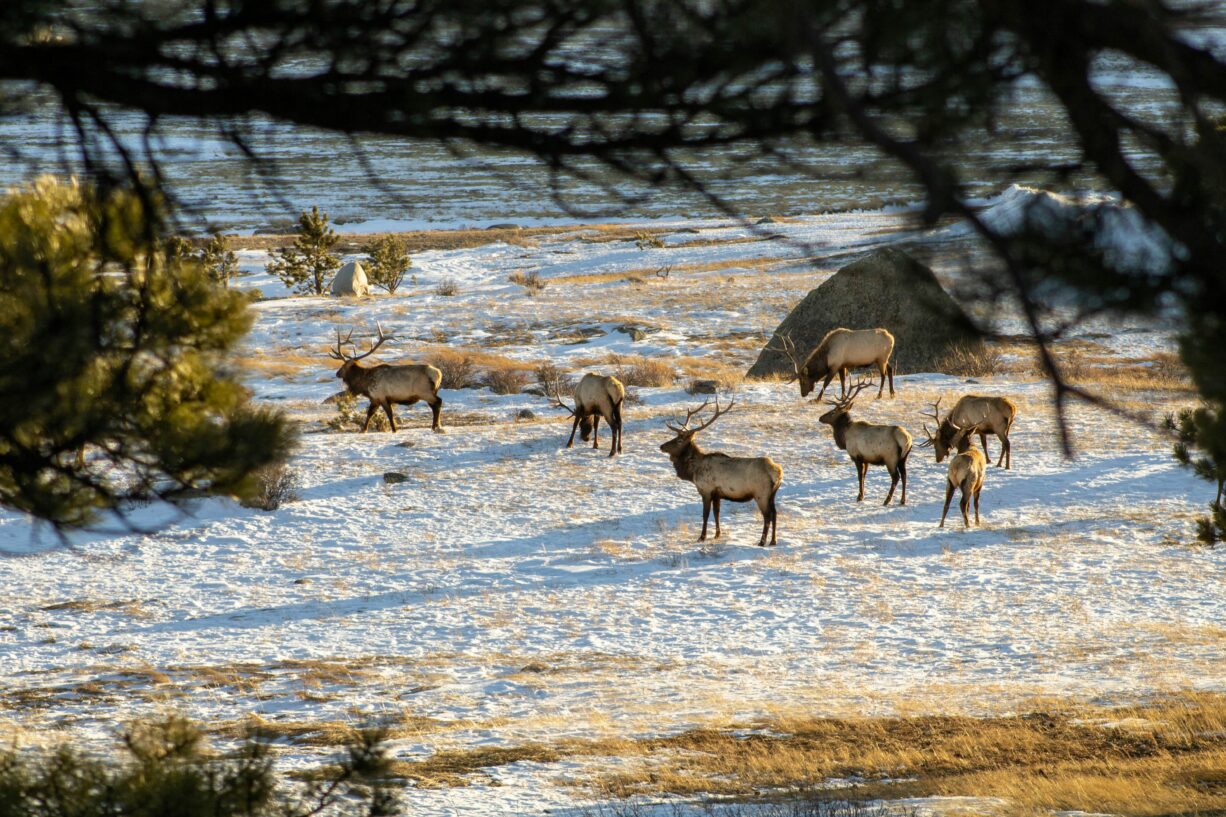
Elk
Lydi Conklin | Fiction
I am an elk. That’s what I say when anyone desires an explanation of how I absorb the signs and signals of the world around me. If someone has too many rules, my antlers go up. If someone wants me to set the table, I balk. I am a male elk, of course, so I walk alone through the forest, sifting what’s mine from what’s danger. I think my own way through. I make my own time. Not like female elk who crowd together and discuss ridiculous matters. For example, grass.
That’s why it’s a shame to be stuck here in this cabin at a highly prestigious artist retreat in northern Wyoming with a woman who doesn’t think deeply about the world around her. She wants to think deeply, she says she is an artist, but my antlers go up. A competitive juried process leashed our fates together in this rustic frontier-style log cabin, but I am certain the jury stumbled when it selected Corrine Lamar as one of its two fellows. Not that I am in a position to make such a judgment. Far be it from me to pass judgment on others who are scrambling the only way they know how up the incline of life.
I am sitting in the shared kitchen at the shoddy oak table serenely enjoying my supper when Corrine enters. I try wiping her from the scene with the downward sweep of my eyelids, but she persists, skinny and draped in loose, clashing patterns. The last sun of the day bounces off the copper pots and collects in the sink basin. I absorb the buttery light, focusing on the knotty white-painted pine surrounding Corrine. I envision her as a woman-shaped hole cut from the wall. An absence that fails to exert influence upon her environment.
“Jonathan,” she says, from beside the range top. “Have you finished your beans?”
“Well,” I say, and leave it at that. I perennially endeavor to eat dinner alone, forging my times erratically to throw her off. Sometimes I wait until the last wash of electric blue has faded from the night. Then I’ll be peacefully cooking and I hear her fussing behind the wall and my antlers go up. Corrine scrambles from the dark hole of her assigned studio the moment she smells food, like a jackal. I cannot abide that.
“I want to use this saucepan,” Corrine says. “If you’re done with these, uh, beans. Is that what they are?” Corinne tilts the pan, inserting her long nose dangerously close to my sustenance.
“I have claimed the full serving of beans I have allotted myself to consume,” I say. “But at this time I am still enjoying that serving.” I lift a fork, careful to scoop mostly franks because Corinne is a vegetarian. The repeated image of meat may one day inure her to it. Perhaps by the conclusion of these three weeks she will be scarfing franks from my leftover cans. “When I have completed this serving, I will store my remaining beans and you may at that time, and at that time only, utilize my saucepan.”
I do not say “my saucepan” by accident. For the moment the pan is indeed mine. For three weeks, Corrine and I are compelled to share the provided supplies. If Corinne wishes to utilize a saucepan which it’s my right to use, she must wait her turn. Whether she decides to wait out that period patiently, with an open heart, or ferociously, is up to her. We each manufacture the poison for our own soul.
She slumps against the counter, expelling an unappetizing sigh. I load my fork with beans and franks. I examine their gloss. Corinne makes a hubbub about obtaining certain vegetables, like kale. I look on with amusement at the concoctions she prepares, how carefully she spices them, how proudly she sets them up on the table next to me, as if hoping I’ll ask what she’s created, draw her out on the topic of, what? Some green puffs on green sludge? Some new grain that is alleged to feature protein? I’ll tell you what has protein, Corrine. Beans. Franks. In my Ford Ranger I have three cases of franks and beans from my homestead outside Rock Springs, and it is three cases of franks and beans I will eat. I do not go to town. There is no time. I require each hour to explore my work and my practice. I do not care for Sheridan, which is so sorry a city that I laugh when I see it. All the phony bluegrass cheer, the old-time fonts, the fat, sad people. What humans try to do with themselves and their lives is ultimately such a silly thing.
Today was the outset of the second week of the time that has been gifted to me, and, I am happy to report, my work progresses smoothly. I am currently engaged in translating my ideas about death to the page in the form of mark making. Most visual artists lack the grit necessary to explore a topic so rife with the grotesque. As an artist and mark-maker, I strive to explore the thorniest topics in human society.
I bite the beans. Corinne lifts her box of quinoa and slams it on the counter in a rhythmic pattern. I snort, not unlike an elk. I find it amusing that Corinne is so eager to eat the evening meal in my presence, though she knows, or would know if she had any foresight, that every night we arrive at this same impasse.
I chew the beans. Oil slips around my tongue. I hit a frank. There’s nothing like that salty fat flavor, especially before a vegetarian. I would cook my own baby to demonstrate how tender meat can be, if that were the only meat Corrine would accept. Ha, ha. Of course I wouldn’t. I love my son. Sometimes I think he is the only thing in this world that I do love.
My only wish is that I’d set my can in the fireplace to draw out the smoky flavor. Just like when I was camping with Luke and Boyden last summer at the dam. Luke and Boyden never asked when I would finish my beans. They know me as a man who takes time when time is his due.
I accept a slug of milk from my glass. Corinne screams inside her mouth. All I hear is a faint hum, but her cheeks swell with violence, and I smile. Some people haven’t yet learned to appreciate the signs and signals of the world around them. Some people have not yet learned to connect with the animal that lies within them, who can show them a path free of frustration and the trappings of human ill.
“Jonathan,” screams Corinne.
“Yes?” I use my most patient voice.
“You’ve been holding that spoon of beans for twenty-five minutes.”
I chuckle. Of course, she is incorrect. I have not even been enjoying this entire serving for fifteen minutes, so indeed it is not possible that I have been holding this specific spoonful for nearly twice that period.
“What is wrong with you?” she asks, her face a hysterical red. Really an amusing color, if you think about it, wrapping the skin of a human being.
“Would you permit me to speak at length on a pet subject?” I ask.
“No,” she yells. “No, I would not.”
“Corrine. Do you hold a fair quantity of rage inside your chest cavity?” I move my hand in a gentle spiral over the area indicated. Perhaps that shall aid her visualization of the phenomenon.
“Yes,” Corinne says. “I do, honestly. When I have to look at you all day.”
I put up my hands, flat against the air. “No need to tread that territory.” But I don’t mind. Rage is an emotion that can be managed through finesse. This kind of situation used to transpire with my wife, before we separated. I tend ninety acres of pasture and live on the property. Sometimes when I was out working, or strolling in thought, for longer than she’d prefer, and she remained in our homestead with the baby, she became irritable. Whenever I returned and saw she’d entered that state, I lifted my son, who is four months old, and pressed him to my chest. I breathed his aromas. I asked my wife, with my eyes, to settle her body and mind. I showed her I was enjoying my baby, that even if I was not available to aid in piddling day-to-day tasks such as diapers, I still had a great quantity of care and affection for my son. The bond between father and son is a force with which the mother should not interfere.
I picture Corrine as my wife. Even though my wife has much longer and sleeker hair, and a far more elegant neck, they have the same thickness of lip and sharpness of chin. When you regard Corrine with an open heart, she’s palatable. A poor man’s beauty, yes, but a beauty even so. “Has anyone ever used with you the term ‘hysteria’? This is a word with rich roots in the history of feminine mental health.”
Corinne screams and throws the box of quinoa. The blue cube lifts, as if sucked up on a draft. I watch it rise, and wonder if it will ever fall.
*
Corinne storms around the cabin, grumbling and acting younger than her twenty-odd years, but once I have cleared my beans she settles with me at the table. I enjoy my after-dinner sweet, a bowl of soft mints. Sometimes I close my eyes and focus on the easy, animal warmth of Corinne. The mints melt on my tongue, cooling my mouth. I suck the flavor from the sugar, holding back a groan.
“You look like the hostess at a restaurant,” Corinne says. “You look like you didn’t get a lunch break and now you have to eat the mints.” She sputters an easy laugh, the happiest I’ve seen her in days. Corrine was happy when she first arrived, I must admit, gripping the handles of two enormous suitcases and braying hello. She didn’t keep that promise of a friendly, easy-going spirit, however. I do not care for her demeaning my personal selection of dessert.
“You know what’s weird about you?” she asks, stirring a mixture that looks not unlike dog food.
I do not answer. I do not need some young woman from Brooklyn, New York recounting her observations about me, when she has no tool to penetrate the depths of my soul because I have not shown her but the vaguest opening. The sole treasure that belongs down the hole of my consciousness is my son Henry, ranking above my wife and my own health and my status as an artist of notable quality. I have protected him from Corrine’s acidity; have not even shown her a photograph, though of course she’s asked. I cringe to think of the misguided words she might choose to rain upon him. Cute, horrifying. Adorable, worse. He is a regal baby.
Sometimes when I think about Henry, I forget my wife has taken him to live in town. I expect to hear his chirp the moment I reenter my homestead.
“Oh my god,” Corrine says.
I ignore her, taking a green mint and then a pink mint individually on my tongue. In actuality there is no difference in flavor, but the feeling of the separate colors is distinct in my mind.
“No, really. Jonathan, look.”
Corrine has peeled back the curtain and is gazing out the window, her eyes full and heavy in her face. I take my time turning toward the pane, to prove that I am not so easily commanded. And then I drop my spoon. Mints bounce softly on the floor, splitting on my shoe.
“Are you kidding me?” Corrine asks, albeit rhetorically.
I do not concur with Corrine’s register of surprise, which is exaggerated in proportion to the situation at hand. There is a snowstorm outside, but snow is snow, I remind myself, even as I hold myself back from leaning too far toward the window and betraying my own astonishment. Just one of nature’s artistic touches over the surface of the earth. Even though it’s late April, snow is no reason to let the tendon in your neck snap up and your cheekbones stain red. The hysteria of women is one facet of this species that I confess I do not favor. Female elks, at least, are dowdy and calm. That was one reason I was so pleased to see the penis on the creature that emerged from my wife’s body. I often remain hopeful that the presence of a male elk will calm the female, showing her how a being may go through life with a level and reasonable perspective. But that technique only works in select scenarios. The technique did not often work on my wife, and failed most notably the day she left, two months ago. That day, no matter how frequently I patted the air and requested she hush, she only grew more volatile, until she snatched an armload of possessions and left in our sedan.
“Jesus Christ,” Corrine says. “What are we going to do?”
“Settle down,” I say. “This is not considered a heavy snow.”
“Are you kidding? Do you see those flakes? They’re enormous.” Corrine pushes her glasses up on her nose. “I needed to go to town tomorrow. I’m running low on greens.”
“Tomorrow this will be over.” I stand from the table, eager to demonstrate the foolishness of her reaction. “Come, Corrine, join me.” I put out my hand. I don’t favor touching her, but she requires a steady guide in her times of agitation.
“Why do you always talk like someone from the Middle Ages?”
“I’m not sure what you’re referring to.” I stroll out of the kitchen and down the dark hallway that leads to the front door. Corrine follows at a distance. With a grand gesture, I swing open the door. I spread out my hand, eyes closed, chest stuck out. “See? The storm is not as bad as you may have imagined.”
Corrine snorts, not at all like an elk. More like a jackal or coyote, some animal that feeds on the blood and meat that a true predator has procured.
“Look, you asshole. Look, if you’re not blind.”
I am glad my son is not here. I would not enjoy him absorbing the language of people such as Corrine. Sometimes I watch his skull and think about words filtering through the translucent membrane of his skin, leeching into his thoughts and polluting him before he’s old enough to heed my warnings. I felt at peace with him on our ninety acres, removed from influence. Now that he has moved to town I fear he’s at risk of the first troubled person who steps through my wife’s door, perhaps to sleep with her. The thought makes my spine gummy.
I open my eyes, if only to humor Corrine. I try not to breathe at the sight of the storm, which is more intensive than it seemed from behind the frosted glass of the kitchen window. I watch the stretched-out cattle ranch spreading into the foothills of the Bighorn Mountains. This Wyoming wilderness I have learned to love and foster, to appreciate as much as the noble quadrupeds that tread here: pronghorn antelope and bison and mule deer and wild horses. True, this is north country, and I must confess, I do not know its tricks as intimately. Around Rock Springs snow never comes as late as April, but the residency director warned us that in Johnson County it can snow in August. I did not believe her; she seemed high-spirited, quick to startle. But now I see she was correct, if only accidentally.
The pink scoria on top of the hills and the red clay road are blotted white. My outfit and Corrine’s tiny vehicle are smothered under foot-thick rinds of snowfall. Just an hour ago I was gazing at the cheatgrass as I designed a universal gravestone for mankind.
“We should call Joanie Rinehart,” Corrine says. “I’m going to call Joanie.”
But I’m certain before she lifts the receiver, even before that grim expression crosses her face, that she’ll have no luck. I know because I live in a rural area myself, seventy miles from Rock Springs. No one maintains landlines anymore. The moment there’s any kind of weather they’re the first utility down. In the middle of nowhere, you have nothing else, is the irony. I hate to rely on someone else’s decision-making, especially for purposes of communication. If I want to speak to my best friend Boyden Mitchell in Nebraska, let me speak to Boyden Mitchell, whether or not there’s a storm. There should be no restrictions whatsoever on men choosing to share wisdom and comfort each other. I hate to think of those wires swinging in the wind, decaying due to idiocy. I should make an art piece about that. That would have social capital and political relevance besides. I could christen it: “Sad Lines for Not Calling.”
“Do you think the Internet’s off, too?” But she doesn’t wait for my answer before she scurries to her room. I hear a resounding, “Fuck.” Corrine Lamar often acts as though she is performing her irritation for a room of curious people.
I take one last look into the whitening foothills, casing the landscape for predators even better than my brother the elk can manage, before I shut the door against the storm. I think of my brethren out there: the Black Angus and foxes, the magpies and spiders. And the elk, hunkered down in a hollow somewhere. Maybe the males will join the group tonight. Cows rising on shaky knees, cheering with hoarse brays as bulls descend from the foothills, proud and gorgeous and willing, for once, to share their evening.
“Let’s view the situation this way,” I say, smiling at Corrine as kindly as I can manage. “This is a chance to work free from distraction. You said yourself you have not managed to delve as completely into the work as you may have liked. An opportunity has presented itself.”
Corrine’s sleeves have fallen over her hands and she’s loosened her ponytail. Her hair hangs desperately over her ears. “We’re fucked. We don’t have enough food. And look how it’s still coming down.”
“I have franks and beans in the bed of my Ranger.” I’m excited to relate this piece of good news.
“I’m a vegetarian!” she screams, as though someone in the next county had inquired regarding her dietary preferences. “How many times do I have to tell you?”
I suppose that if a true starvation occurs, I am lucky to be stuck with an unreasonably picky eater. Even if the natural course of things had me on the road to dying first—hardly likely though that might be—still, it would make sense for efficiency’s sake for me to consume Corrine’s healthy body. Maybe with some beans on the side. Ha, ha. It’s funny to project into unlikely scenarios and weigh the impacts of various decisions.
Corrine wipes her brow. “I have a heart murmur. I can’t get upset.”
I nod patiently. I’m not sure what the precise effects of a heart murmur are, but when people share their physical ailments it’s best to nod gravely. People don’t want to feel better, or to see their injury is less dire than they had hoped. They merely want their pain acknowledged by a deep-feeling soul.
“Does your Internet work?” she asks.
“I have not tried it,” I say. “But if yours doesn’t function, mine will not either.”
“You have the stronger signal, though.” This is a point that Corrine has raised numerous times during the course of our stay. On each occasion where she tries to watch a television show or Skype with her boyfriend, I hear sighs rise from her studio like steam, as though she wants me to invite her into my personal studio space to titter with her friends. As though that wouldn’t distract me in the least. I personally believe that the facility with which I am permitted to watch educational and research-based videos is due not to the “stronger signal” of my Internet to which Corrine refers, but a different kind of “stronger signal” that emanates around me. The ease with which the Internet flows from my computer is indicative of my singularly powerful connection with the energies of the universe.
Checking my Internet is hopeless. If the wire’s down it’s down no matter how strong any signal. But still. I lead Corrine to my studio.
When I open the door, she gasps. She’s never been inside, because I have never extended an invitation.
“Jesus Christ,” she says. “You really are a madman, aren’t you?”
Drawings paper the wall from floor to ceiling, corners overlapping the boundaries of other drawings. Most of the drawings are abstract renderings of the concept of death, while others attempt to channel my energetic connection with the universe. A select few pieces foreground figurative elements—elk, ghosts, furry beasts weaving through clouds of charcoal dust. The room smells so strongly of fixative that I’m surprised I don’t pass out while working. Corrine moves along the walls of the studio, perusing the charcoal drawings and remarking on the astounding quality of the work at hand.
“Did you bring some of these from home?”
“In fact not.”
Corrine pauses at one of my favorite works: a collection of skeletons marked on the sternum with certain human labels. She cranes her neck, reading the curated text.
“‘Gay person’?” she reads. “‘Vegetarian’? ‘Atheist Soul’? What is this? Some kind of anti-liberal threat?”
“No, no,” I say, pointing back into the gray mists of the drawing. “Look there.”
She squints at the tiniest skeleton in the distance. “Oh so there’s one that says, ‘Average Person.’ That could still be a liberal.”
“I tried to represent a basic spectrum of human life.”
“It’s funny then, that you don’t see yourself within that.”
It’s true that when I close my eyes and place myself in that misty graveyard, which I picture as being located on the outskirts of some chaotic dingy city, I don’t envision myself lying upon that particular heap of bones. I see myself hovering in the air, observing the other souls who have come to rest. I’m not saying I’m in heaven. I don’t believe in the world being divided after death in so simplistic a manner. But there’s something out there, in the mists, for me. Some sensation of light and peace.
“Well,” Corrine says. “You’ve certainly done a lot more work than me.” She toes a knothole in the floorboards.
I don’t want her in my studio any longer. I don’t mind her noting the breadth of my work, but no individual piece is ready for scrutiny. “Do you want to check my Internet?”
“Yeah.” Corrine speaks with a certain heaviness, as though she no longer has faith that my computer will provide a happy ending to this evening. I never believed it would, but even so I am disappointed to see Corrine cut loose the hope she clung to moments earlier. She reminded me of my son, when I reach my strong arms out to him, and he knows he will gain a ride on the cool Wyoming breeze, in his father’s muscled hands.
Corrine goes to my computer, set upon the cherry stool in the only art-free corner of the room. I like to maintain a clear, cool head while I work on my art, beyond responsibilities and pleasures of the flesh. I like to become a brain and two capable hands.
She waves the cursor to activate the screen. She twitches in the chair, shoulders falling so they slope away from her neck. “Um, Jonathan? You have an email. About your baby.”
“Does the Internet work?” The snow showers the cabin even more thickly than before, clotting the skylights grey.
“No. It must have loaded before the storm.” She shuffles away from the device. I try to read Corrine’s flaccid blue eyes, try to gage what she may be thinking in that brain buried under all that greasy hair, but she’s become like a dog: no sign of interiority. This disturbs me, because typically I have unfettered access to a woman’s mind.
I step to the computer. The email surges at me in a jumble, as though the words were spilling off the screen and poking my face. I cannot understand the text as having translatable meaning, as though I have suddenly lost my language, have become as free from the world of human signs as a wild beast on the grassland. But then I see my wife’s name: Regina, on the sign off. And then my son’s: Henry, sprinkled through the text. I shake my head, my cheeks and nostrils flapping loosely against my skull.
“Are you all right?” Corrine asks.
I am relieved to look away from the screen, but Corrine’s darting eyes betray that she knows precisely what the email says. I can’t abide the fact that she’s able to read the email that I myself cannot.
I press my fingers deep into my eyelids, massaging the balls. Then I return my focus to the screen. My attention lasers in on the important words: Henry is sick. Fever. Hospital. Call me.
I rip away from the computer and dart into the hall. I take leaping steps like elk I have seen fleeing from the false dangers of cars and joggers. Except this is not a false danger, and imitating the elk feels hollow. How can I access that place of beauty and freedom when everything is falling apart? The walls disintegrate around me.
I already have the receiver of the landline to my ear, am already listening to the mocking dial tone before I remember the storm. I think next of emailing my wife but remember that Corrine said the email must have loaded earlier. But why should I trust her? The two of us have certainly been less than friends.
I hurry back to my studio and hit reply. The computer throws up a new window. That must be a good sign.
“Jonathan,” Corrine says.
I type without much sense of what I’m saying or how. I scan my wife’s email but I can’t focus much better, only enough to see that Henry’s fever is at one hundred and three. My fingers scramble over the keys.
“Hey.” Corrine places her hands on my shoulders. “That won’t work.”
For a moment Corrine’s hands feel almost like my wife’s, and I nearly lean back into them, but then I push away. My son is sick, terribly sick, and my wife is awaiting my call. This is the first time she has requested help in the two months since we’ve been separated. If I’m not available to reach her the one time she asks, she will never ask again. And my son. My poor, sick son. I would do anything to cradle him in my arms.
I jam my feet into my boots in the front hall, not even managing to squeeze my toes all the way into the ends of the shoes. Without putting on my coat, I stumble into the snow.
I have to reach my Ranger. I can see it there, just a few feet away. The keys jingle impatiently in my pocket.
I’m not two feet from the house and the world already feels different. The sky has clotted yet more densely with clouds bearing down, reflecting the brightness of the snow on their bellies. The snow is deeper than I thought—just above my knee and still falling—and it feels like thick water around my body. The residency director said one April it snowed thirty-eight inches in an hour. The residents had been on a supply run and were stuck in town for four days. If we were in town now I could call my wife. I could ride a propeller plane from the Sheridan County Airport.
I reach my car and shove my hand through the buildup on the door to locate the handle, but it’s buried. I can’t even gain access to my snowbrush, so I throw myself at the car, hugging lumps of snow and pulling them off. In a few moments I uncover the shiny black metal. This is what I can do for my family.
“Jonathan,” Corrine cries from the door.
I continue ripping down armloads of snow until I access the interior of the vehicle. Then I grab the snowbrush and sweep up high where I can’t reach. But the brush is not as efficient as my arms, so I toss it into a snowbank. The blue handle points up like an arrow.
“Jonathan, this is crazy. Come inside.”
I pretend not to hear. Corrine sounds distant, like a bird so high in a tree you can barely see it.
Soon the windows are clear, though the roof still bears a tower of snow. I get inside.
“Jonathan! Jesus Christ.”
I pull the car keys out of my pocket. My fingers are frozen so they’re hard to manipulate, but eventually I work the ignition. I’m surprised my truck works. I haven’t started it since I arrived and it’s not the most reliable outfit known to man. I shift into drive and hit the gas.
The back wheels spin. I pump the gas until the car lurches forward, crushing the snow down in twin tracks. Then I stop. I pump the gas again and lurch forward. This time the truck stops at an eight-foot drift. The heaps of snow on my roof slide forward and coat my windshield. I try the wipers and one snaps. That doesn’t matter. If I drive the snow will slide off with the velocity.
So I press forward, but my windshield remains white. Still, I am pretty sure I’m on the gravel road that leads out of here.
Corrine calls my name, but this time she’s closer. There she is, running alongside my truck. When she gets close she hammers her fists against the glass, so powerfully that snow cascades down.
I roll down the window. “Go inside. I am handling this.”
“No you aren’t,” Corrine cries. “You’re acting crazy! You can’t drive in this. Look ahead of you!”
“I can’t see ahead of me, Corrine.” I slap the windshield, which glows white.
“Jonathan, Jesus. Then don’t drive. You’re going to hurt yourself. Then where will your family be? They count on you, don’t they?”
“Yes, they do.” They count on me. I need to get there. I cannot have my son lying ill in a hospital without his father. I swipe at Corrine’s hands, unmooring them from the window, and press the gas. For a second, I shoot, white on all sides, and it seems as though I’ll fly to the hospital through a friendly cloud.
That’s when the airbag punches my chin. I wonder why they make airbags out of such coarse material. My vision darkens.
When I come to, there’s a tree angled toward me. The tree is a birch, and significantly skinnier than I anticipated, considering the level of impact. Now that my windshield has cleared I can see my Ranger was heading straight into a patch of forest. I’m lucky that my truck could not move very rapidly in this quantity of snow. Otherwise I might have hit the tree faster, or even run over this one to collide with a larger specimen.
“Jonathan.” Corrine wrenches open the door, and since I am not wearing a seat belt, I flop out and land at her feet. The snow invites me into its soft chill. My ear and nostrils dampen. Someone takes firm hold of my wrists and pulls. Corrine yanks me numerous times before she gets me to my feet.
“What’s wrong with you?” I can barely see her expression because it’s snowing harder. She guides me back into the cabin, swimming beside me through the flood of snow. In the foyer, she brushes me off. I feel limp. I should tell her to get off me, to stop handling me like a doll, running her hands between the snow and my work pants, my sturdy jacket, my hands, which she takes, one at a time, in hers, to knock the snow from between my fingers. As she grasps each new body part I’m on the point of telling her to stop, but there’s something I like in the way she brushes at me, as though I’m her son. Her touch isn’t sensual in the least but strictly practical—she wants me clean and dry and that’s it—and I respect that. She leads me back into the studio and pushes me onto the stool.
“Listen,” she says. “Look at this email. It’s not as bad as you think. Babies get fevers all the time.”
“No they don’t,” I cry. “How would you know? You don’t have a kid.”
Corinne’s skin shades purple. She takes a breath. “I volunteered in a NICU, Jonathan, not that you would ever ask.”
I snort. “Probably in high school.”
“So? I know. And look at your wife’s tone. She’s not panicking. She doesn’t need your help.”
I reread the email. Woken now by the cold, the words make perfect sense. My wife has written her sentences with appropriate punctuation. The email radiates calm. Henry’s fever had dropped by a degree at the time of writing. One degree—but still. That’s something. My breath slows and my head solidifies. I suddenly feel how frozen my feet and face are, how sore my neck is. I picture Henry stuck in a snarl of scratchy hospital blankets and my heart leaps again. I want to run back into the snow, I want to free him from his blankets and cool his fever against my chest, but I hold the stool. An elk would wait, I tell myself. An elk would wait.
I try to understand why I reacted as I did, why my Ranger now is damaged outside and a tree is dead that worked hard to grow in this dry plains landscape. This is the first email I have received from my wife since we separated. We’ve barely even had calls between us, because the first week we established a routine: I pick Henry up Friday, drop him Saturday. There’s no confusion about details. But this email is so much like a letter, with Dear Jonathan and Yours, Regina and all sorts of small talk interspersed and even a joke regarding Henry’s hearty nature. Though I know that’s just because the information takes the form of an email and not the form of her handing the baby to me on my front steps that used to be hers, too.
Corrine pats my back, hard, like a coach. “You okay, buddy?”
I nod, lips together. I’m on the verge of something. I feel like if I speak I will cry.
I don’t want Corrine to leave, but she does. I hear her go into her bedroom. It’s late, nearing the time both of us settle in for the night. I know this is routine. But I wanted her to stay, and keep talking, even though there’s nothing to talk about. Without Corinne, Henry’s blue face, smoothed of wrinkles, insists itself in my mind. There are Henry’s frozen claws, Henry’s slow dissolve of a whine.
I take down the skeleton drawing Corrine admired and position it on my drawing table. I select my densest piece of charcoal and sketch into the sky.
I sketch for a long time, though normally figures pour from me in quick, confident dashes. I’m not sure what type of creature I’m attempting until the form has emerged from the mist, and then I see the jackal, hovering. A rangy, powerful dog with Corrine’s bleary eyes. A dog with creamy fur and a handsome, strong frame. A dog with a friendly grin, that maybe, one day, I could come to respect.
Lydi Conklin has received a Stegner Fellowship, four Pushcart Prizes, a Rona Jaffe Foundation Writers’ Award, a Fulbright, and fellowships from MacDowell, Yaddo, Hedgebrook, Headlands, and elsewhere. Their fiction has appeared in The Paris Review, One Story, and VQR. They have drawn cartoons for The New Yorker and Narrative Magazine, and graphic fiction for The Believer, and the Steppenwolf Theater. They are a professor at Vanderbilt University. Their story collection, Rainbow Rainbow, was longlisted for the PEN/Robert W. Bingham Award and The Story Prize. Their novel, Songs of No Provenance, was longlisted for the Center for Fiction First Novel Prize.