


Changeling
Colleen Rosenfeld | Fiction
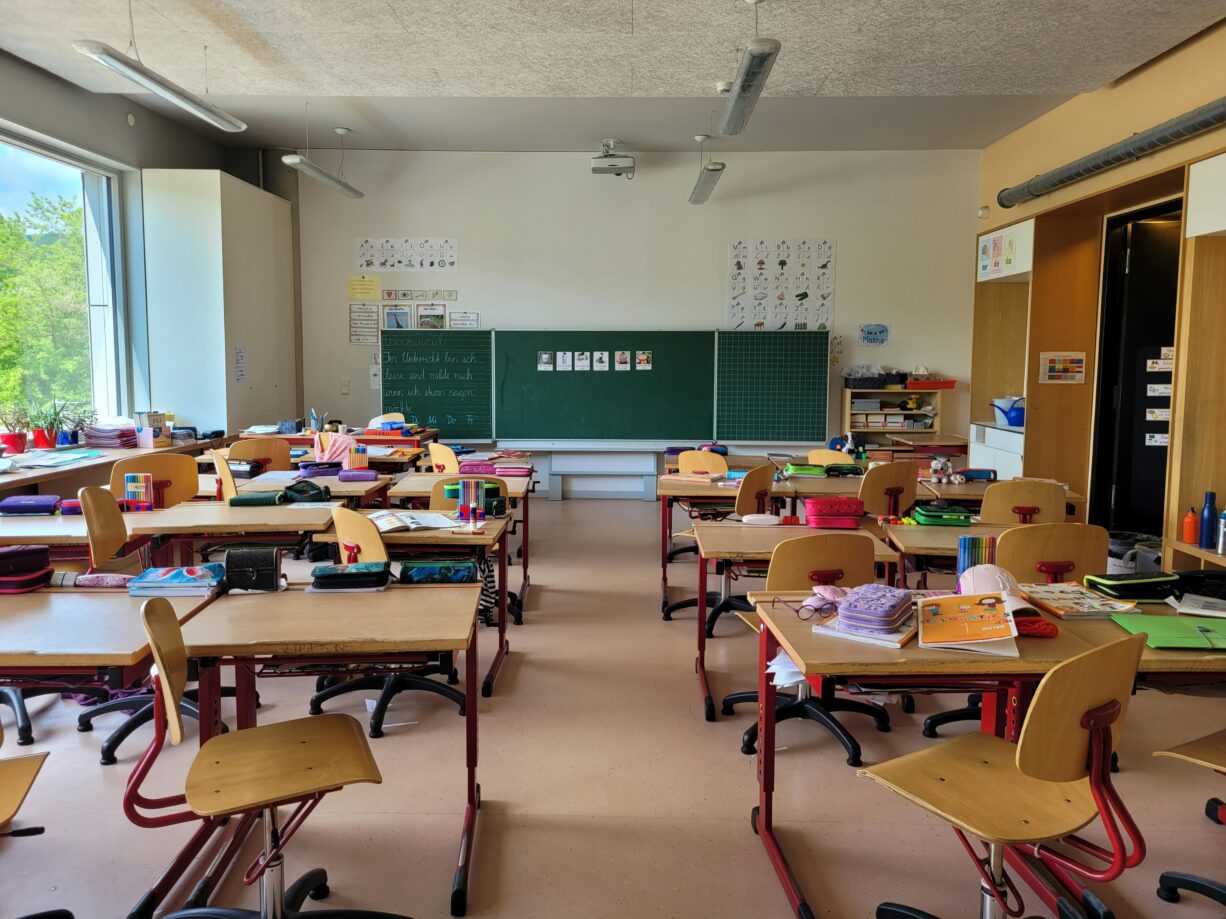
On any given day, Miranda hears the children before she sees them. The sounds they make as they hang their backpacks from hooks, as they huff and hustle and huddle into clusters, sometimes squealing, sometimes spraying secrets into one another’s ears. But she always waits until final bell to open the door. Even if she is prepared, she waits. Her lesson plans in order, art supplies organized, duplicates stacked in alternating orientations. Even the morning after a break, Miranda waits until the bell rings to open the door wide and kick down the stopper with her toe. Then, she stands to the side so each child might pass in turn.
Miranda expected every greeting that morning, every ‘Good Morning,’ every ‘Hi Miss.’ Every greeting except one. Not-John entered the room and asked, “How ya doin’, Miss?” like asking was nothing at all.
“Well,” she said with surprise, “How about that?” Miranda held her palm to her heart. She expected the child to pause, to smile. She expected him to display pride and glory. She waited for him to invite her applause. But he just kept walking. “How ya doin’?” and nothing at all, just walking, like Miranda had not for months been trying to coax him into speech. Like she had not been trying to get him to put tongue to teeth in a way that might produce something like speech.
As the child kept walking, perhaps because the child kept walking, Miranda noticed his new feet. Not new shoes, new feet. Feet that were now capable of something they had not been capable of before. She tracked the stride, the strut really, as not-John slid the front soles of his sneakers against the linoleum floor. Not-John walked like he was trying to scuff up her floor, like he was trying to leave a mark. Not-John dragged his feet hard and close in tight and repeated squeaks. So, Miranda said, “Jonathan Talbott, pick up your feet,” and saying that name, saying ‘Jonathan Talbott’ and meaning him, placed Miranda just outside herself. The words lifted Miranda up and dropped her down just to the side of her own self.
The child looked back and grinned, “Sorry, Miss.”
Miranda felt it in her stomach and only for a moment. An impossibility of being. She was occupying two discrete locations at one time. She was where she was and she was just to the left of where she was, all at the same time.
For the rest of the day, Miranda could not stop staring. She must not speak to not-John, so she avoided speaking to any one child in particular. All day long, she spoke only to all the children all together. “Friends,” she said, “that is not where we put our books when we are finished.” Friends, we do not do this and, friends, we do do that. “Friends,” she said, “let us be quiet.” They covered the lessons she had planned but everything she did and everything she said all day long was in the service of this one avoidance. Miranda put the world into soft focus so as not to stare with eyes glued and inappropriate.
There is one more thing Miranda remembers from that day. Between first and last bell, time moved differently. One minute did not pass and give way to the next in a succession of minutes. Instead, the minutes built, one on top of the other. They accrued and accumulated and stacked, each minute, every minute, one on top of the other, so that when the last bell rang it was not 2:45 alone but all the minutes of all the day since the first bell rang and it walked into her room, shoes squeaking. The time was heavy, too much for one minute to hold all on its own. “Jonathan Talbott,” she had said, “pick up your feet.”
*
That is how Miranda knows he is not-John. It is not in the way she knows the capital cities of all fifty states. It is not the kind of knowledge she can rattle off, in alphabetical order or reverse. To the tune of a well-known song. It is not the kind of knowledge she can rehearse or repeat. Knowing he is not-John is not the same as knowing the quadratic equation. Miranda cannot teach this knowledge to another person or to a room full of other persons. She cannot put the fact of his not being John to any use.
Miranda knows he is not-John in the way she has always known when she is lost. By the panic pulsing under her armpits, the clamminess of one hand rubbing inside another. The way her head floats just above her body. Saying he is John—calling him in from recess or referring to him in his absence, telling the other children, “John is sick today”—naming that creature John is like driving home from school along her usual route, taking this left, making that right, pausing at one intersection, proceeding through the next, lifting her foot off the gas before the final hill, and then cruising, coasting, rolling to a stop only to find herself in front of a house other than her own. Saying “John” and meaning him is like looking up from the wheel only to realize she has no idea where she is. This is not her home: the green trim, the interrupted facade. It is like looking through the window and seeing someone other than yourself living life in a house other than your own.
That is the way in which she knows he is not-John.
*
And so, Miranda has called a conference. There is something she would like to share with the Talbotts. While she waits, she gathers the composition books into a pile. She straightens their edges and knocks the stack against her desk until it is tidy, neat, until the stack is smooth. She squeezes a clip into place. She will have to read them tomorrow. Miranda cannot seem to focus.
She subtracts three minutes from the clock to determine the actual time. Mr. and Mrs. Talbott are late. She will wait a little longer, only a little longer. She imagines them arriving in different cars, from different directions. He, from an office; she, from a house. Miranda imagines the pair intersecting in the parking lot. He says, “There you are,” as if Mrs. Talbott were late. As if he had been waiting. Miranda watches Mrs. Talbott get out of the car like getting out of the car were a warning. She imagines them conferring in the parking lot, getting their stories straight.
“Shall we get on the same page?” he might ask, and she would reply, twisting her hand to reveal the underside of her wrist, “Quickly, then, we’re late.”
Miranda can almost hear their car doors stutter in sequence. They will be here soon.
*
Miranda phoned the Talbotts first, of course. When something is off with one of her children, she places a call. This is to the preference of everyone involved. On her way out one afternoon, she stopped by the office and requested the appropriate contact information.
“Talbott, you say?” the school secretary asked.
“Talbott,” Miranda confirmed.
Maybe this was a week after their return from break? Maybe two? After slipping her bags onto the passenger seat, Miranda dialed the first of three listed numbers and was surprised by the speed with which Mrs. Talbott answered the phone.
“Hello?” she said.
Miranda shifted into her seat and swung her legs inside but kept the car door open. Miranda was forever cracking windows, in her bedroom at night, or in the classroom as she waited for the bell, shoving windows open with the heel of her hand and saying, sometimes out loud, “There we go!”
“Hello?” Mrs. Talbott asked again, quickly, and Miranda grabbed the phone from where it was tucked beneath her ear. She spoke directly and announced herself.
“Miss Elkins!” Mrs. Talbott echoed brightly. “I thought you were someone selling something. How are you?” And then, before Miranda could answer, “Is there a problem?”
Miranda told Mrs. Talbott that she was just checking in. She was pleased to see that her son had progressed so far with his speech in such a short amount of time. She was just calling to check in at home and see if there was anything she should know, anything that might help her support Jonathan at school. Miranda placed her hand on her stomach to still the nausea.
“So kind of you to call,” Mrs. Talbott began.
Miranda had already decided that she would not, at least not yet, not during this first conversation, mention anything of what she had witnessed in recent weeks. She would leave it all out except, of course, for his talking, which in and of itself was remarkable, worthy of mention, cause for a call, but not an accusation exactly. Mrs. Talbott would not feel compelled to defend either herself or her son for speaking.
Here is what Miranda left out: The day that not-John tied Stacy Klein’s shoelaces together, which Stacy only realized when she stood and tried to walk but tripped and cried and not-John did not apologize, even when Miranda said, “Jonathan, apologize to Stacy,” while gripping the side of the girl’s desk until the dizziness passed. Not-John ran outside to recess without another word to either of them. Miranda apologized on his behalf.
“I’m so sorry,” she said, as she crouched onto the floor to help untie the knots in Stacy’s long laces. Stacy’s fingers were so small and soft, she could not get at the tight knots, so Miranda took over, breaking a nail and raising her finger to her mouth.
“Why’d he do that?” Stacy asked. Miranda did not know what to tell her.
Miranda also would not mention the morning she entered the classroom to find every single marker for the whiteboard missing its cap, ink dried out over night. She searched for the caps in every bin and every cubby. She lifted every lid of every desk. She peered inside. She could not find them anywhere but, later that same day, when she returned to the room after lunch, she found someone had arranged the missing caps into an elaborate pattern on her desk. Every last cap was displayed on the surface of her desk with the care and precision she reserved for plucking her eyebrows or setting a holiday table. It took her breath away. Her hands clutched the edge of her blouse. Though she could not tell you what this cryptic message meant, she knew it was a threat. She swept the lids into the waste basket. They dropped on top of the dried-out markers. They settled beside chewed gum and soiled tissue.
And Miranda would not tell Mrs. Talbott about the time she had caught not-John picking his nose and eating his discharge. She would not say that not-John saw her seeing but that, instead of blushing, ashamed, he had held her eye. He had looked at her like all the energy in his body was channeled into holding her eye, soiled finger lingering just below his nose. She would not tell Mrs. Talbott about how not-John taunted her with that finger while mouthing a single word. Cunt.
Instead, Miranda asked, “How’re things at home?”
“Well of course we are delighted Johnny has found his tongue,” Mrs. Talbott replied, “And you know, my mother always said it would be like this and I never believed her but she always said one day he would just start talking and then he would pour out sentences, paragraphs even, and I never believed her but there you have it.”
“So, it was sudden, then?” Miranda asked.
“That’s right,” Mrs. Talbott said, “He came down for breakfast in the morning and when I asked him what he would like, he didn’t point, he spoke, he said, ‘scrambled eggs’ and I couldn’t believe it, ‘scrambled?’ I asked, holding the carton and I was repeating, ‘scrambled?’ and he said ‘Yep’—like why was I acting so—”
“I thought maybe John had taken extra classes with Sarah? Over the break?” Miranda inhaled deeply to ward off the nausea she knew was coming. Like she could build a wall of air between herself and the sensation.
But Mrs. Talbott said, “No.” He had only worked with Sarah at the school, and they were on break when he began talking. Miranda, surprised, said she had never heard of anything like it before. Mrs. Talbott again offered the explanation that she had offered before: her mother always said.
After Miranda hung up, she started the car and backed out of her space, turning out of the parking lot. As she drove, Miranda was so distracted by this conversation, going over it in her mind, everything she had said and everything she had not said, everything Mrs. Talbott worked hard not to say when she was telling a story she had already told before. A story she had rehearsed and repeated. Mrs. Talbott’s explanation had spilled over the brim of her lips and Miranda, driving, distracted, missed her next turn. She would have to do a U-turn. She looked around to make sure she would not be seen.
Mrs. Talbott knew. Of course, she knew.
From the opposite direction, Miranda’s right turn became a left.
A mother must know. A mother just knows.
*
Miranda hears the Talbotts walking down the hall. Finally. Well, she hears footsteps and she attributes the steps that she hears to the Talbotts. Who else? Fifteen minutes late. Miranda knows the sounds and rhythms of the school as she knew the sounds and rhythms of her childhood home: the difference between her mother’s feet, loud and garish, and her father’s weighted step; the sound of the garage door opening, closing, mechanical; the sound of the refrigerator dropping ice below her pillow. Miranda used to lay in bed and try to hear something else. Something new. Something original. She would try to hear the foot of an intruder or the start of a fire or maybe a fall, maybe a serious fall. Miranda listened but those sounds never came and then, Miranda would lay in bed and shame herself. What if this was how it worked? How it all actually worked? What if, by listening for a broken window or a lightly unlatched door, Miranda could bring about the murder of her family? What if her ear could clear out space in the world for her own morbid fantasies? The lone survivor. There was no resolution to Miranda lying in bed and listening, straining to hear what did not exist. It became her routine. How she put herself to sleep. Listening for became the drive of her dreamlife, the looping and leaning and chasing but never catching, never arriving, only waking. Sometimes, being chased.
Miranda wipes the sweat from her hands and flaps her blouse to make air against her body. She is certain now that the Talbotts are walking down the hall. She can hear an increase in volume commensurate with the wealth of their shoes. She stands up and walks around to fidget with the chairs. She pulls them further apart. She pushes them closer together. Maybe she should not sit behind her desk after all. Maybe she should sit in front, or on top.
Miranda settles the chairs into an inconsequential arrangement and returns to her seat, feet falling down the hall. Feet coming closer. She wishes she had not put the composition books away. They could have been her cover. If the papers were out, she could have pretended that she was marking, that she did not even know they were eighteen minutes late, she had no idea, had not noticed. “Oh,” she could say, “is it time already?” She could have waited for their twinned shadows to fall across her desk and then said, as if startled, “Thank you for coming.” But she can tell from the sound of their steps that it is too late. It is too late to retrieve the notebooks from her bag. There is no time to settle into marking. Settling into marking would only look like pretending to settle into marking. She cannot pull it off. No way around, no alternative. Miranda will have to look like she has been waiting. Miranda will have to look like her own self.
A strong knock at the door saves her. She calls, “Come in!” The knock begins again, stronger, and she calls more loudly, “Come in!” She hurries across the room, clumsy, and she opens the door and says again, “Come in!” Miranda sounds exasperated. This is all to her disadvantage. By the time they enter, Miranda is dismayed.
Mrs. Talbott gasps, startled, “We thought maybe you forgot.”
The possibility of forgetting is an accusation. “No, no,” Miranda says, “I’ve been waiting.” Unnecessary exposures everywhere.
The Talbotts will never be able to hear what she has summoned them to hear. They will never be able to hear that their son is not-John.
*
Miranda is right. They cannot hear her. She approaches the topic from several different directions.
Miranda begins by thanking them. “Thank you for coming,” she says, and Mr. Talbott replies, “No, thank you. We’re sorry to be late.” He hopes they have not kept her long.
She gestures to the two chairs in front of her desk and adds, “I was just marking compositions.” And then, “I have some concerns I would like to share with you.” Their silence gives her room to proceed. “Your son,” she begins, because if she does not say the name, then she will not lose her bearings. She will not feel gravity turn in on itself or push through her pores, “Your son has not, I think, been himself lately.”
“Isn’t it remarkable.” Mrs. Talbott’s excessive grin. “He’s like a totally different boy.”
“Yes, like—”
“What we mean to say,” Mr. Talbott says, sitting forward with his large and leaning limbs, “is that John is really opening. He is really growing into himself. We are noticing…” Mr. Talbott pauses as if searching for a word Miranda knows he has already found, maybe even a word he has already said, to someone else in some other conversation, about the change in his son.
And so, Miranda tries a new approach. “I consulted with Sarah Little,” she says.
In truth, Miranda cornered Sarah Little in the breakroom one afternoon after a lesson in language arts. The children had been taking turns reading out loud from a story in their textbook. Their voices pinged off each other in a display of random affiliation and her classroom had transformed, air trapped inside, full of energy, frenetic, temperature rising, as one child yelled the name of the next, and the next. Every time someone yelled, “John!” he picked up just where he should, just as he should, but Miranda knew something was off. She knew, and then she saw. The boy’s book was upside down. He was reading the story—each and every time someone called the name “Johnny!”—but he twisted his tongue around the upside-down words. Not-John saw that she saw. Miranda averted her eyes, so she did not see him smile. She felt him smile.
“Sarah, the speech pathologist,” Miranda clarifies, and she begins to explain that Sarah had also seen a difference.
“He no longer works with Sarah,” Mrs. Talbott says. They did not wish for John to miss any more of his usual lessons, she explains.
The full truth is that Sarah Little declined Miranda’s invitation to join this conference. Cornered between the refrigerator and its open door in the breakroom, retrieving her yogurt from the middle shelf, Sarah had said, at first, “Of course I notice a difference! The kid is talking!” but as Miranda began to describe the behavior that she had witnessed, that she had tallied in her mind and transcribed into her notebook, as Miranda read to Sarah from her notebook, not wanting to forget anything, about the knuckle cracking and the snickering and the lip-licking and the growling and the mouth-breathing, as Miranda described for Sarah the details of that one afternoon in the parking lot, how the boy had followed her on his bicycle, followed her down the street so that Miranda could see him in her mirrors—so distracted she had been by his presence in her mirrors, that she drove through a stop sign and almost collided with another vehicle. But Sarah had just looked at Miranda and said, “I’m sorry, I don’t think I can be of any help.”
Then Sarah said, “Miranda, excuse me.”
And then, “Miranda, excuse me. You’re blocking my way.”
Miranda tries with the Talbotts one last time. From one final angle. Miranda looks Mr. Talbott in the eye and says, “I am seeing something different. I am seeing a boy who is not the same boy I knew before. I am seeing a boy who is mean. Not just a boy who teases but a boy who is mean. He divides the children. He turns them against one another. This pleases him. It is not simply that your son did not speak and now he speaks. If your son could have spoken before, he would not have said these things. He was one person and now he is another person. It is an entirely different boy.”
Mrs. Talbott rises from her chair. Miranda thinks maybe Mrs. Talbott will slap her. Features twist across her open face. Guiding his wife by the elbow, Mr. Talbott says, “You have given us a lot to think about.”
*
When Miranda looks back on the months that followed her conference with the Talbotts, she always divides events between those she expected and those she did not. When she tells the story at odd times and to a range of people, sometimes strangers, sometimes intimates, Miranda always says that the months that followed contained things she expected and things she did not.
Miranda expected the school to transfer not-John from her classroom. Everyone thinks maybe it is how the teacher runs her room. The meeting with the principal. His light reprimand. Her promise to communicate better with parents in the future. Miranda concluded that meeting with a resource request for a new set of whiteboard markers. But she was not expecting the affair. Any affair, at this time in her life, after being alone for so long, lonely, even, but especially an affair with Mr. Talbott or Jonathan, as she now called him. She had not even known he was in the classroom, had not even noticed his return, until he sat down beside her and turned his whole body toward her. Miranda understood that he was drawn to her knowledge. She understood that her knowledge radiated off her body like a heat signature, or pheromones. He could smell the truth of it on her.
Miranda and Jonathan met in hotel rooms, same and then different; her house, his house; evenings and afternoons; long weekends, longer weekends. Miranda appreciated how Jonathan’s desire authorized her knowledge. Each and every time they had sex it was like they were inhabiting that knowledge together, like they were repeating an experiment and getting the same results. It was not-John.
Only, Miranda could not ask Jonathan to say it aloud. To say it exactly. That was their limit. She could not ask Jonathan to affirm her knowledge in any way other than sex. They sometimes fought in short clauses with irregular pauses. John. Not-John. John. Not-John. He is. It is not. Miranda picked up Jonathan’s words and gave them back to him, new:
Please, I can’t take it anymore.
You can’t take it anymore? You can’t take it anymore?
Jonathan turned her statements into questions, Just know? Or sometimes, a parody, Oh, you just know. They heard themselves. They knew exactly what they sounded like. They echoed one another for effect. Sometimes, Miranda modeled her sentences off his facial expressions. Sometimes, she pushed too far. If Miranda did not choose her words well, she would break the calibration of their erotic antagonism. Jonathan was not always up for the fight, and she could not always tell the difference. He refused to know what she knew he knew. This refusal left him in a perpetual state of exhaustion. Miranda had to give him a break. She had to cut him some slack.
But sometimes, Miranda could not help herself. She would wait for Jonathan to come home. She would tell herself not to bring it up, not to mention what not-John had done or failed to do, where not-John had been or how not-John was not where he had said he would be. Miranda would feel the not-saying build in her body. If she did not say the words, if she did not speak the truth, the not-saying would expand inside her veins. Language would release from somewhere other than her mouth. “That is not-John!” she would say and wonder with what part of her body she had said it.
Miranda did not expect that Jonathan would move in with her after Mrs. Talbott learned of their affair or even that after he did, they would still prefer hotel rooms and parked cars. On their way to a movie or dinner. One day, Miranda sat in the passenger seat with sticky thighs, sweat pooling under her arms. She felt the pressure of her knowledge crawling up her forearms, rushing. She rolled down the window. She rolled it up again. She opened the glove compartment for no reason at all. She looked inside.
“What are you doing?” he asked.
The latch clicked hard as Miranda closed the compartment. She looked in the mirror on the underside of her visor. She tried not to see her enormous pores, her broken capillaries, the two stray hairs sprouting from her chin. Miranda tried not to see herself as she was.
Probably, he should not have asked her what was wrong. If he had not asked, she might have been able to still the pressure as it rose, she might have been able to resist her teasing reply, “Is anything wrong? Jonathan,” she said his name while stretching her palm across her face, her fingers draped dramatically across her eyeballs.
The lanes narrowed as they passed the school where they were building an extension. Jonathan merged slowly, asking about the construction. Miranda shrugged and they continued driving until Miranda shrieked and Jonathan slammed on his breaks in the middle of an intersection. “Jesus,” he said, extending a long arm across her body. “Jesus,” he said again, as he followed her gaze to the side of the road where not-John was leaning over the carcass of an unidentifiable animal.
Jonathan pulled over to the side of the road and leapt out of the car. Miranda followed behind him to where not-John was crouching on bent knees, weeping, peering over the slumped cadaver. Even then, when they were that close, they still could not tell what kind of creature it was. What kind it had been. Not-John’s bicycle lay on its side, wheel bent from the force of the collision. It could not have been long. People would not just drive by a boy on the side of the road bent over the corpse of a dead thing. “It’s lucky we were here,” Jonathan repeated several times at the scene and then again, after not-John was asleep, as they prepared themselves for bed that night. Jonathan said it again and again, introducing variations like, “Can you imagine if we had not been there?” Or “Thank God we were there.”
“I am just grateful we were there,” he said, again and again with other words.
“Yes,” Miranda replied each time with slight modification, “Lucky,” or “Thank God” but never: “Actually, we weren’t there, were we? We did not actually see what happened, did we?” Miranda did not tell Jonathan that when he raised the child from the ground and turned its face away from the carcass, in that moment of initial embrace, as Miranda stood by, teetering on the edge of their intimacy, she did not tell Jonathan that not-John opened its eyes and stared at her. Or that Miranda watched not-John’s face suppress a smile. Not-John did not smile. Not-John did not smirk. The corner of not-John’s lips remained uncurled. But Miranda saw every muscle in its face, every single muscle from forehead to chin, from one ear to the other, activate in the service of suppressing a smile. It was like someone turned on the machinery of the face. Flipped the switch.
Just knew? Yes, Miranda just knew.
*
Not-John’s unsmiling face was one piece of evidence among many that she filed into her notebook under appropriate heading, subdivision, and date. Miranda did not come to her decision lightly. She lay awake at night and reviewed the evidence. Oh, how she lay awake! Churning and chewing. In the absence of other sounds, she would think. Miranda made a decision. She would wait for the day she found not-John sitting on the curb outside their house.
Not-John had a key, of course. Not-John was old enough for a key, old enough to let itself in—key, lock, turn, push—but it seemed to prefer waiting outside. Hunched over its knees, not-John preferred to rake the sidewalk with a stick. Jonathan said it was because Miranda had never made him feel welcome in her home, but she thought it was on purpose to disturb her.
And so, Miranda would lie in bed listening and waiting and then, one day, instead of lifting her foot off the gas and gliding to a stop at the bottom of the hill, just outside her house, she would press her foot hard on the pedal. She would aim her car at the boy and press her foot all the way down. She could feel the pressure of the pedal under her calloused sole as she lay in bed, listening for an opening in the silence. The smallest opening. Who knew how many people Miranda might save by making this decision? Who knew? Her windows cracked, breeze rolling around in her ears, cheers in her ears, singing, Go! Go! Who knew how many people she might save?
Sometimes, as she lay awake, listening and waiting, Miranda could almost hear something else. Something small. Something startling. Like the sound of not-John’s shoes squeaking against the linoleum below. Or the sound of tires screeching outside her window. Which, she could not say.
Oh, she could not say!
Colleen Rosenfeld is professor of English at Pomona College. Her story, “The Skilled Anatomist” won the 2025 Halifax Prize from American Short Fiction, appearing in their summer 2025 issue. She is writing a collection of short stories tentatively entitled, Fetal Positions. Her literary criticism has appeared in Critical Inquiry, PMLA, ELH, and Modern Philology and she is the author of Indecorous Thinking: Figures of Speech in Early Modern Poetics (Fordham University Press, 2018).