


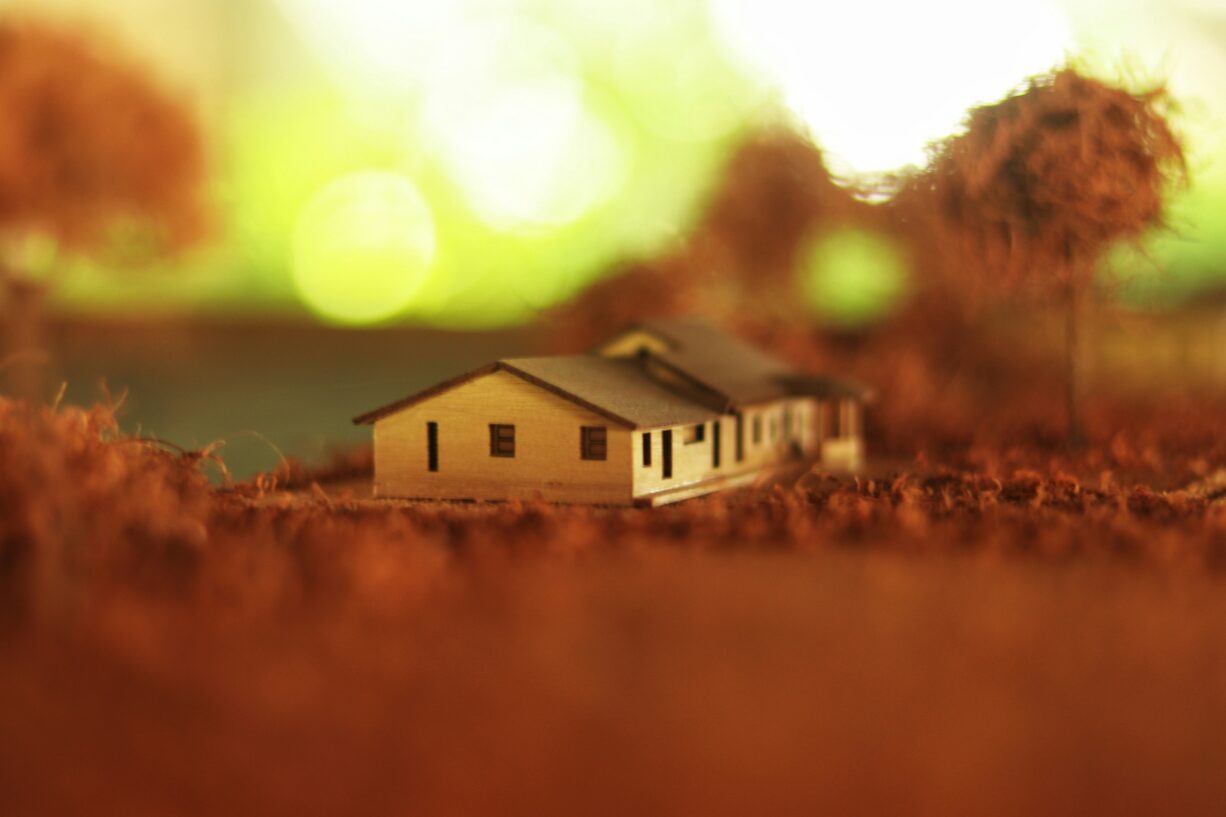
A Beautiful House
K Russell Breakstone | Fiction
Edgar lived in a beautiful house. The house had the look of a finely wrapped gift with its neat trim and painted shutters, and from it Edgar could easily walk to his son’s daycare. One day upon arrival at the daycare, he was told by Mr. Dance, the director, that his son had already been picked up by a man who looked very much like Edgar, and to whom his son Connor had run while calling out, “Daddy!” Edgar asked for information about this man, but the best that Mr. Dance could do was to provide a list of adults approved to pick up Connor. On the list were Edgar, his wife Beth, and Beth’s parents Arden and Frank. Edgar noticed that the address given for his son’s home was not the address at which Edgar lived. It was on a street in the opposite direction, just a few blocks away.
The sky was an odd green. An indecisive wind sometimes pushed against Edgar and sometimes pulled him forward. It rattled the leafless trees. Edgar walked past some houses with pumpkins and some houses with Christmas lights. He did not run. As long as he walked, he felt that the situation could be explained away as a simple mistake. Perhaps Beth had picked up their son. Perhaps the address was a mistake. To run would be to admit that this was an emergency. And so Edgar walked, very quickly. He soon approached a house painted like the sea. He saw his son in the front yard, digging out the old tomato plants with a man who looked just like him.
“Connor!” Edgar shouted.
“Daddy!” said Connor, and the other man stood.
“I don’t know you,” he said in Edgar’s voice.
Soon, Edgar’s wife came out and they all stepped to the porch to talk it over. Connor sat on the swinging bench and watched Beth’s phone, where another kid his age opened boxes of toys.
Edgar explained what had happened. But the other man shook his head and said, “You’ve got it wrong. I’m Edgar, this is my wife Beth, and Connor is our son. We’ve lived here since before he was born.”
Edgar frowned. He remembered moving in with Beth, how they’d spent the first summer tearing out all the blackberry vines and building by hand the planter boxes that stood in the front yard. But the house Edgar had woken in today was not the house in his memories.
“This isn’t my house,” he said.
Beth’s eyes were on him, and she asked him to turn around. “There’s something different about you,” she said. “You don’t have any freckles.”
There were other, subtle, differences. Edgar’s eyes were a brighter shade of honey than those of the man who lived in this house. He had no fillings and was missing a scar down his left calf. Even more oddly, his chest hair wasn’t hair at all but just dark squiggles like Sharpie marks against his olive skin.
Edgar found that he had backed up to the top of the porch stairs. He looked to Beth, who stood next to her husband with a hand in Connor’s hair. In her eyes was a deep and remorseless pity. It was the look she’d once given a live mouse stuck in a glue trap, before Edgar had wrapped it in a plastic bag and bashed it against the basement floor. He could hardly breathe. He loved this woman, to whom he was not married. Last night they had made love. He still felt the grip of her legs around his waist, he still felt the heat of her breath against his neck. But last night he had not been in this house or in her bed. He could not stop staring at her sky-blue eyes.
“I don’t understand,” Edgar said. “I should go home.”
It was a half-hour walk. The neighborhood in which Edgar’s house sat was not a nice neighborhood. It bordered a large, steep hill, and the houses were all slack-shouldered and listing. Some looked abandoned. Edgar passed a large bay window that had been covered in layers of newspaper. There were words painted across it: GET OUT OF MY MIND. The sidewalk was half-buried under muddy runoff from the hill, and the entire neighborhood had an oily cast to it, as if Edgar were walking through an old taupe photograph.
Edgar climbed the well-crafted steps of his home. He had no decorations, but the house needed none. It was a jewel on the dark band of the street. It was a painted egg, sitting on the ruffled nest of his white wooden porch. Inside, Edgar hurried to the bathroom and took off all his clothes. He looked closely at the false hairs on his chest. He could not scrape them off with his fingernail. Edgar studied his body. He thought his ears looked strange, a little pointed and without hanging lobes. His arms were well-shaped, his hands broad and handsome. He had a penis but lacked a butthole. And his feet, long and hairless, had no toenails, just hard shiny skin rounding out each toe.
Edgar put his clothes back on. He walked aimlessly around his house, letting the sunlight fade. He looked at the pictures on the walls. There was Edgar with Beth and an infant Connor at the pumpkin patch. He reached to take the picture down but it would not come off the wall. The frame itself was entirely attached to the drywall, as if glued. Edgar pulled hard. The wall behind stretched a little, but the photograph stayed where it was.
Edgar walked to the kitchen for a knife. He opened a drawer but all the silverware was stuck in place. So too were the cups and bowls in the cabinet, the pots and pans, and the blender, toaster, and microwave oven. Edgar flipped the lightswitch and the kitchen was lit by an aqueous blue glow.
Edgar went back to the picture on the wall. With one hand he pulled at the frame and with the other he scratched at the peach-colored drywall. He managed to carve a thin line with his fingernail. A trickle of something dark rose to the surface and a groan echoed through the entire house. The wall had give to it, not like a wall at all. And the smell that came from the cut was familiar. Edgar prodded at the photograph and the glass bent beneath his finger.
“It’s meat,” Edgar said.
He was suddenly hungry. Edgar returned to the kitchen. The refrigerator was well-stocked with sliced turkey and bottled beer, but just like in the rest of the house nothing could be removed. Edgar turned on the sink. Nothing came out. Edgar opened the cabinet door beneath and the pipes were all tangled, soft and purplish, wet with condensation and moving a little. Edgar became overwhelmed by a revulsion for the house. He stumbled out to the front porch and took in great lungfuls of air. His street was quiet with stale yellow light falling from the streetlamps. It was probably his son’s bedtime. Edgar felt at his pockets, but realized his cell phone belonged to the real Edgar. He could imagine all the pictures on it, his son framed by the green of a hiking trail, he and his wife receding into youth.
Edgar saw an older man walking down the street towards him. The man waved. He half-jogged through the yellow light and when he got closer he called out in a strange accent, “Hello! Hello! Can you help me?”
The old man had on a fleece vest and a large backpack. He had a very round head with light-colored hair and a closely-trimmed beard.
“I am a tourist, and I am lost,” the man said. “Please can you help me?”
Edgar waved the man onto the porch.
The old man sank down to the steps and rested his forearms on his knees. “Thank you sir,” he said with his funny voice. “Thank you.”
The man explained that he was from a small country in Eastern Europe. He was traveling across American, following a guidebook he’d lost on a bus. He’d gotten turned around and had been wandering for hours. His cell phone was dead and he had no idea where he was.
“Even if my phone worked, I would have no one to call,” the man said. “My wife died last year, we never had any children, and I am the last of my family.” He gave a little laugh. “If I vanished in this city no one would know or perhaps even care.”
Edgar invited the man inside. He told him he could use his computer to book a hotel. The old man was very thankful. He needed Edgar to help him to his feet, and together they walked into the living room. Edgar lowered the man onto the couch, and sat in an armchair. It was still dark in the house, just the blue glow bleeding in from the kitchen.
The old man looked around.
“You have a very beautiful house,” he said. “But where is your computer?”
Then the couch cushions parted and the old man fell between and down into a deep pit that had opened beneath him. Edgar shot from his seat and caught a glimpse of a long, gray tube, as wide as his armspan, descending into the darkness. A horrid and acidic wind pushed at his hair. Then the cushions smacked shut.
Edgar screamed. He stood and screamed. He ran for the front door but it wouldn’t open. He pressed the latch and pulled, he pulled with all the strength in him, but it had no effect.
The whole of the living room was now blue, and the light pulsed. Edgar turned. The kitchen light ebbed, then brightened again. He followed it. The faucet handle turned without his touch. A clear and viscous liquid came out. Edgar caught it in his palm. It tasted sweet and Edgar scooped handfuls of it until his stomach was swollen and his face sticky. He cleaned himself on a dishtowel that grew from a hook on the wall.
Edgar went and sat back down in his armchair. He spoke to where the old man had been sitting.
He said, “I am lost, too.”
He paused for a little while. His stomach felt warm with the liquid he had just drunken. He said, “I woke up this morning as a husband and a father. I worked for a company that processes medical claims.”
Edgar felt the fabric beneath him. It was firm, yet soft, and the chair was enormously comfortable. It fit his body as if made for him.
“I think I’m a monster,” he said. “Or this house is. And I’ve been created to feed it.”
Edgar sat and thought over his words. Outside, cars passed in the darkness. Somewhere fireworks were going off. A dog barked.
As Edgar slept in the armchair, the house’s nectar spread to every cell of his body. It repaired a muscle he had torn when running to Connor’s house. It soothed Edgar’s raging adrenal glands, and it seeped into his brain and went to work on his amygdala. The nectar isolated memories of Beth and Connor and ate away at their edges; it softened their emotional weight, and left them pale and wafer-thin. Edgar smiled in his sleep.
In the morning, Edgar explored the house. He discovered that the house looked most realistic close to the front door, where a stranger might enter. The pictures on the walls were highly detailed, and the carpets patterned with whorls and fleur-de-lis. But the further he ventured from the entrance, the more abstracted was the furniture, the decorations, even the dimensions of the rooms. He climbed stairs that lead to a strange, shapeless attic, full of objects that suggested furniture but looked more like deflated balloons. They were warm to the touch.
Edgar wasn’t sure what to do with his day. He felt twitchy, and knew just what the other Edgar would be doing, the rhythm of his schedule: the coffee, the traffic, clocking in and out, parking at home, walking to pick up his son. But today he could do anything.
The clothes in Edgar’s closet were not real clothes and could not be removed. Edgar sniffed at his shirt and didn’t notice an odor. In fact he could not remember ever sweating. He searched through the old man’s backpack and found a large amount of money hidden at the bottom. Edgar had some trouble remembering the old man’s face. He could recall the man’s final scream as he plummeted into the couch, but the events prior slipped through his mind like something live and slick-skinned.
Edgar walked out of his house into a mild fall day. Dry leaves cartwheeled by his feet. He decided to go shopping.
He used the old man’s transit pass to take a bus downtown. He bought jogging shorts and running shoes, realizing now he would have time to exercise. He bought a guitar, a really nice one. He thought of buying a phone, but couldn’t imagine who he would call.
Edgar bought a pumpkin spice latte from a chain coffee shop. He settled down to read an outdoor adventure magazine. All around him people spent the time of the day. They typed away on laptops, they spoke about their friends. A few people just sat there, letting steam rise from their drinks. Edgar thought of the other Edgar, how he was behind schedule on a big reorganization of files. Edgar wrapped his hands around his coffee and felt the heat slowly seep into his fingers. He took a long sip, but struggled to swallow. The taste of it made his stomach rebel. Edgar’s throat tightened and goosebumps rippled across his flesh. He poured the drink into the trash can and recycled the cup.
For the rest of the day Edgar walked around the city. He marveled at just how many people were out. The crowds were young and vibrant. They wore anything they wanted. Edgar caught himself staring at a woman in low-slung jeans, then remembered he was now single. He took a second look.
Edgar was hungry by the time he returned home, and once again the house provided him with its filling nectar. Edgar thought the viscous liquid not quite as sweet as it had tasted the night before. He wondered how long it would be before he had to feed the house again.
It turned out to be a few weeks. The sink began to dribble and sputter, the brew was thin and mostly tasteless.
Edgar took a walk around the block to think through his next steps. He found a man, obviously drunk, peeing against a tree. With the promise of beer and weed, the man followed Edgar home. This time the house didn’t even bother to trick the man into sitting. It simply absorbed his hand, which he had placed against the wall for balance. Then, inch by inch, the house pulled the man through whatever membrane was there that looked so much like painted drywall. The man screamed the whole time, he called out the name Edgar had given him and he cried and he begged, but just before his head vanished a look almost like understanding came to his eyes and Edgar thought his remaining arm and leg hung a little more peacefully before they, too, were pulled into the wall.
Edgar came to understand that the house drew to him lonely and isolated people. He fed the house a grifter collecting money for a fake charity. He fed the house a young woman spreading the word of an obscure religion. He fed the house a courier delivering food to the wrong address. And in the meantime he went out and did all the things he knew the other Edgar could not do. He joined a gym and toned his body. He took classes on foreign languages, on figure drawing, on cooking even though the taste of any other food made him vomit. And when he wasn’t busy he sat on his porch and played guitar, singing sad ballads to his quiet street.
In the evenings Edgar stayed out late. He went to bars and pretended to drink and met people. Sometimes he invited them back home.
One night Edgar was bought a drink by a woman whose braided hair was piled high atop her head in a complex spiral. Edgar thought she was very beautiful, her long exposed neck, the dark flash of her eyes. Edgar lied and said he was a writer. The woman, Naya, said she was a chemist. Neither drank as they talked and laughed. Naya brushed her fingertips against Edgar’s forearm.
Naya’s house sat in a double lot. Between it and the sidewalk was a large and vibrant garden. Empty brick warehouses walled in her home to either side; the whole street was post-industrial, a graveyard of box-like buildings. But even in the moonlight Edgar could see the care taken for this front yard. Banana trees lined a flagstone path, the branches of the beauty berry bushes bobbed with ripe fruit, and everywhere flowers stood with petals closed, like hands in prayer. Naya lead Edgar through the garden and up the stairs to her house. She glanced back at him only once, when he paused on a step to admire the handiwork of the porch railing, the gingerbread trim of the eaves.
“Come in,” she said.
Naya kicked off her shoes and sat on the edge of a finely-upholstered armchair. She had not turned on the lights, and dappled moonlight rippled on the flesh of her neck. She loosened her hair and watched Edgar.
Edgar touched the walls and felt their give. He asked Naya how often she fed her house. Edgar said that his house had the same layout, only the furniture was a little different.
“My couch is suede,” he said. “And my armchair is over there.”
With a sound like tearing paper, Naya began to cry. Edgar rushed to her, and held her, the both of them framed in the black glass of the living room window. Outside the trees moved a little in the breeze, and the moon sat in their branches like some nocturnal bird of prey.
Naya said she had never wanted to kill people. She grabbed at Edgar’s back and shoulders. She pressed her brimming eyes into the fabric of his shirt. She told him her story.
Naya had become aware of her strange situation five years ago. Her last memory of her other life had been a bad date with a man from work; Naya worried that she had woken in his house, and spent most of the first day trying to find her keys and her phone. Only when Naya stumbled to the lab where she worked did she realize the truth. Her fingerprints would not register on the timeclock, and when she saw herself walk through the door, she ran back home. Naya’s first victim was a woman who had come to her porch looking for packages to steal. When Naya invited her inside, the woman admitted she had walked five blocks to reach the house, and couldn’t explain why she hadn’t stopped or turned around. After the house ate the woman, Naya pieced things together. She figured that the house exuded pheromones or some kind of psychic signal to draw close its prey.
But this only lasted for the first year. “It must take a lot of energy for the house to attract its own victims,” Naya said. She and Edgar were sitting on the floor, facing each other. “Eventually the house needed me to find its food.”
Naya slowly learned to hunt. It was not natural to her; the other Naya had always been shy. The other Naya had dinner every weekend with her mother. She ran marathons, and wrote a newsletter for her favorite local band. She had no close friends. Dating was rare, and she’d only been in love once, with a professor in college. But hunger taught Naya quickly.
“People are desperate for connection,” Naya said. “It became easy. You buy someone a drink, you touch them, and they’ll follow you anywhere.”
Edgar laughed.
One night Naya found a man sleeping on a see-saw at the nearby playground. When she brought him home and he took off his bulky jacket, she realized he was only a boy. The house ate him anyways.
“After that, I tried to run away,” Naya said. The other Naya used to spend summers at her uncle’s cabin out on the coast. The uncle had died years ago, and no one lived there now. “The cabin is small, and tucked away into the sand dunes. It would be perfect,” Naya explained. She’d rented a car and tried to drive away, but it had been a month since she’d brought the boy home and she became dizzy with hunger. She nearly veered off the highway, then turned around at a gas station. The relief she felt was instantaneous. She drove back smiling and singing an old love song. “I think it’s the liquid the house feeds us,” Naya said. “It must be addictive. When I got home I was so weak I could only lie on the floor. I was hoping I’d starve to death. But the house fed me through the floorboards, through my skin. It wouldn’t let me die.”
The headlights of a passing car slid across the living room wall. Edgar saw it flash over a framed diploma. “Are you really a chemist?” he asked.
“The other Naya is,” Naya said.
“But you have her memories,” Edgar said. “Do you think you could make the house’s nectar?”
“I’ve thought of it,” Naya said. She lead Edgar to her bedroom, where she’d taped to the walls lists of symbols and equations. “I snuck into Naya’s lab one night. This is the chemical makeup of the liquid the house makes. It’s sugar, mostly, like hummingbird feeder, but there are some strange proteins and a few lipids I can’t identify.”
Edgar ran his hands over the numbers, the letters. “Why’d you stop?” he asked.
Naya said, “It took too much time. The house got hungrier after I tried to escape. It needs me to feed it more often, now. Finding people, covering my trail, it’s just too much.” She straightened the quilt on her bed. Edgar crossed the room to her.
“What if we work together?” he said. “I can feed the house, and you can focus on making the nectar.”
“What about your own house?” she asked. She stood very close to Edgar.
“If I stay here with you, we can split the nectar.”
Naya’s mouth twisted into a funny little smile. She took Edgar’s arms and draped them over her shoulders.
“I can’t tell if you’re a great guy, or just trying to get laid,” she said.
Edgar kissed away a tear from Naya’s cheekbone. “I don’t know what I am.”
That night, in bed, they both realized it was the first time for each of them. Nothing in their memories of their other lives matched the electric touch of each other’s fingers, the warm shock of a tongue. The taste of Naya’s kisses was exactly that of the house’s nectar. Naya cried out as Edgar entered her, and the walls of her house shuddered and the pipes moaned.
Over the next few months, Naya turned her kitchen into a laboratory. During the day Edgar worked, completing odd jobs for anyone who would pay in cash. At night he sat with Naya and they went over her notes together. Naya’s first few attempts were promising, but ultimately failures; though Edgar did not throw up after drinking them, his body took no sustenance, and he felt dizzy and hollow.
Naya’s house seemed entirely unaware of Edgar. He was able to explore it without fear of being digested. The house was more developed than his own. Naya told Edgar that the entire front garden had sprung up one night after the house had chewed through a former linebacker. There was a working washer and dryer in the basement, and the attic had been converted into a rec room.
Naya hid in her room each time Edgar brought back a lonely body. Edgar tried to lead them as far away from her as possible before the house opened one of its many orifices. After, he knocked at Naya’s door and told her it was over. Then, they drank their nectar and worked some more.
One night Edgar woke to an empty bed. He found Naya in the kitchen, naked and holding a beaker of liquid.
“I think I’ve done it,” she said.
It took some time to test the new formula, and then to produce enough to sustain them through the move. In the meantime, Edgar fed the house a remote worker. He fed the house a substitute teacher who had been suspended for pinching a child’s arm.
On a hot and cloudless Saturday, Edgar and Naya filled the trunk of a car with blue glass bottles. Naya slipped on a pair of cat-eye sunglasses and gave Edgar a long, lustful kiss. They passed by Edgar’s house on the way out of town. It was pale and slumpen. The roof sagged and the walls were striped by peeling paint.
“I feel a little bad,” Edgar said.
“Just drive, honey.”
The cabin on the coast was abandoned, just as Naya had said. They swept the house clear of trash and sand, then filled it with quirky furniture from antique shops, the kinds of things their houses would never have grown. A rattan love seat. A cable spool for a table. An iron firepit shaped like a smiling frog. At night they sat around the fire in their sandy backyard until shivers drove them inside, drove them beneath the covers. They made love like newlyweds, like teenagers. They had sex constantly. After, they would lie draped across the sheets or the chunky living room rug and drink mugs of clear and sweet nectar.
Naya became pregnant. She swelled quickly, her belly so large and firm that she knocked glassware from the counters. Edgar played his guitar to her stomach. He put his lips against her skin and said “good morning” in Spanish, French, all the languages he’d learned. He sat with Naya on their porch steps and etched a list of 26 names into the sand, one for each letter of the alphabet: Abigail, Bernard. But never Connor.
Naya asked Edgar if he ever thought about the people they’d fed to their houses. “I remember one woman got trapped beneath the couch,” she told Edgar. “She was only half-conscious as the house ate her, but she kept talking about this trip she’d gone on with her family. Over and over she went through the same details, the snowstorm in the cactus field, the pyramid at the lake. On the third day I realized she was just repeating the plot of a movie. I guess she was dreaming or something. It was horrible.”
Edgar shook his head. “I felt bad at first, but after getting to know people more…” He kissed Naya’s drumtight belly. “Do you remember how they treat each other? How they treat the world? They’re not human.” Naya ran her hands through his hair, clearing it of sand.
After only three months, Naya felt herself ready to give birth. She told Edgar to follow her to the backyard. Naya squatted down. She gripped the edge of their iron frog and screamed. Out of her came an egg the size and color of a large cantaloupe.
Edgar helped Naya stand. They looked a while at the egg. It was tapered at its top, and steaming.
Naya said they should leave the egg outside. With blankets and towels they wove it a nest. They split the nights, one of them resting with the egg. Edgar felt a great peace in placing his palm against its leathery shell. He thought he could feel something breathing inside. He woke covered in dew, wrapped around the egg.
One evening, Edgar called to Naya. The egg was hatching. Together they watched the eggshell warp, push outwards.
“It needs help!” Naya said.
They grabbed the shell, they pushed their fingers through its thick flesh. They peeled it away in long and pliable strips. The fog was heavy in the hills and the wind goosebumped their arms, their calves. The sky was a dizzying dark blue overhead, fading to yellow at the sunset.
In the nest, among the tangle of blankets and pasta-like curls of shell, sat a small and soft-walled house. Its door was no larger than a postage stamp. Its windows winked with reflected sunlight. The tiny shingles of its roof shivered in the damp wind.
Edgar held tightly to Naya’s hand, and she gripped his back. A flock of seabirds passed overhead. Their shadows were long and curved. Edgar and Naya looked at the house, and their own house was dark and darker still. They stood and stared until a calm blue glow lit the little windows of the house. Edgar then looked at Naya and he could just see in that blue aura that she, like him, was smiling.
K Russell Breakstone is a writer, artist, and teacher from the California Bay Area. His stories have been featured in Cherry Tree, JMWW, San Antonio Review, and other publications. He now lives in a somewhat beautiful house with his wife and son in Atlanta, Georgia.