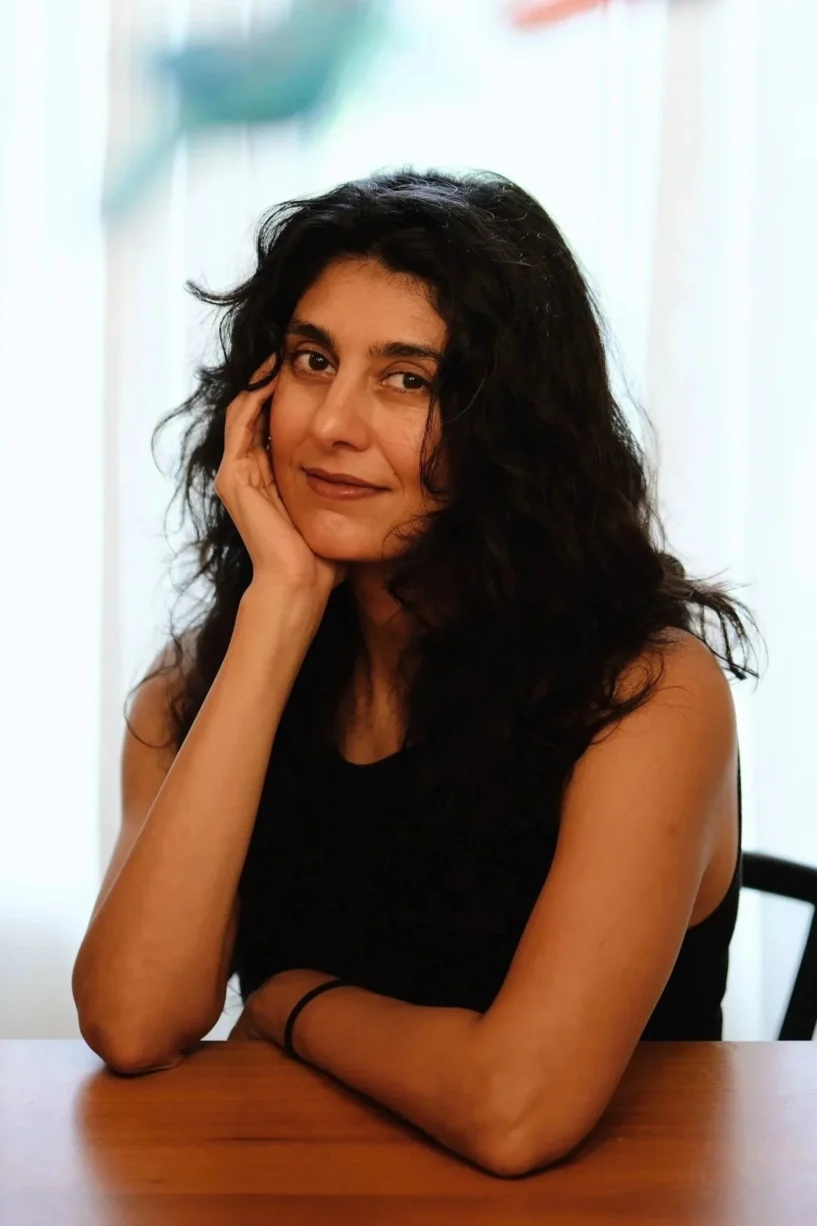



An Interview with Reena Shah
June 12, 2026 | blog, Interviews
Reena Shah’s novel Every Happiness is a dazzling debut that explores the ties between two women, Deepa and Ruchi, across decades, continents, and class divides. The two women first meet in Catholic school in India, but their connection is swift and rife with jealousy, unfamiliar intimacy, and suppressed desire. In their twenties, the two women move to the suburbs of Connecticut, and life in the United States is different than either women expects. When Ruchi discovers a dangerous secret about Deepa’s husband’s wealth, both women are forced to weigh the tangled bonds of their friendship with their lives, and their families’, in the burgeoning Indian American community.
Interviewed by Anjali Chanda, MFA ’27
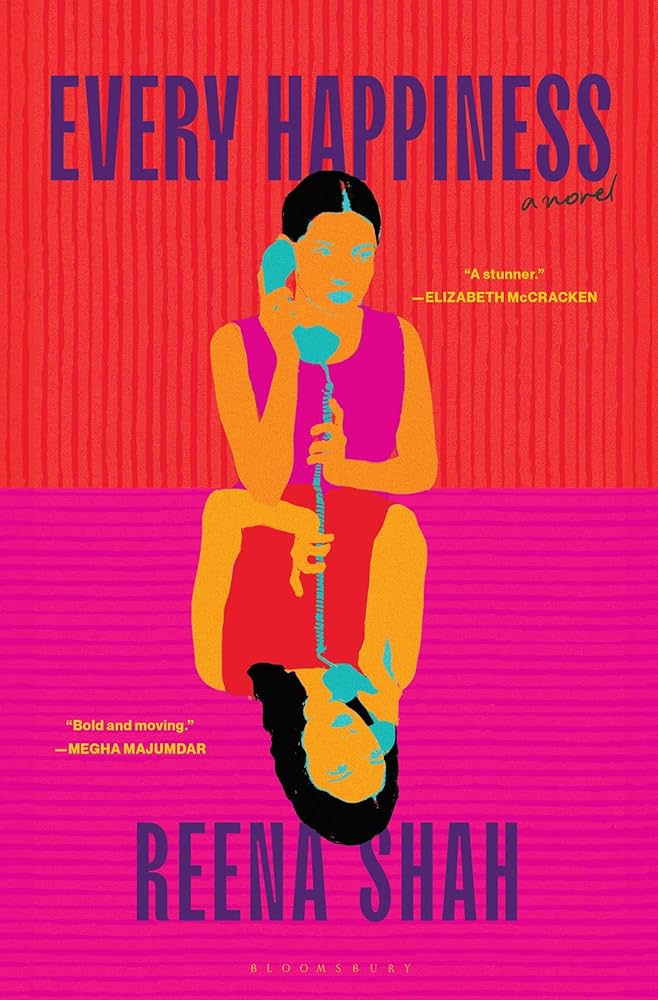
Where did you start with this novel? What was the inspiration behind this book?
The very first inspiration for what became Every Happiness was a boy I met while working in education in Mumbai over a decade ago. He was in second grade and had physical differences on his face, his hands. Everyone who talked about him mentioned that he was a stellar, ambitious student. I learned that his parents, who were from a conservative, under-resourced community, had to fight to keep him when she was told of his condition in utero. Years later, I kept picturing a character like this child, but one who wasn’t a good student or over achiever. He was more ill-tempered and brooding child. And from there I started thinking about his mother and the difficulties she might experience in parenting him, the mistakes she might make and the distance she might feel from him, even though she loved him fiercely. Years after I moved back to the United States, I wrote a story about this mother and son at a party on the Connecticut shore. The mother, who eventually became Ruchi, is consumed with envy for the more successful South Asian families with their high-achieving kids. At that point, Deepa, the party host, was more of a foil for Ruchi than a fully drawn character. It took me years to realize how important she was, how much depth and power she had.
Place is very impactful on Deepa and Ruchi’s life, with the book stretching from India to New England. Did place come first for you, or did the characters, and how do you see them influencing each other?
This is a great question. At first, the short story that the book grew out of took place in Mumbai. I was the first child in my family to be born in the United States, and Mumbai was a mythic, dream-like place for me. I loved visiting my grandparents for long stretches of time, especially because I hated school in Tolland, the small town in Connecticut where I lived until seventh grade. It was a relief to escape to a place where I felt special, where people looked like me. And yet, the story didn’t quite work set in Mumbai, and I’m still not sure why. I think I was avoiding writing about Connecticut as a place. I left Connecticut at seventeen for college and never returned to live there again. And yet, my imagination kept returning there and these characters kept showing up there. I finally stopped resisting it.
New England is a contentious place for me. It’s beautiful with its red barns and strawberry farms and rolling hills and leaf peeping. There’s a quality to the light that is both dark and golden like nowhere else I’ve found in the world. Suburban Connecticut was a lonely place to grow up as the child of immigrants in the 80s and 90s, and also a place of ambitions. Construction was everywhere. Every week it seemed a new mall was going up or a new subdivision. I think that loneliness is very present in the characters, as present as the beauty and new houses. It hurts especially to feel lonely in a place that’s beautiful and when you’re surrounded by seemingly nice things. For Ruchi, who doesn’t have access to those nice things, it’s especially acute. But For Deepa, who is more well-off in the States, the nice things are a trap.
The book starts with Deepa and Ruchi’s perspectives, but the chapters later are in their husbands’ and children’s voices. At what point did you know you wanted more perspectives than just Deepa and Ruchi, and how did that open up this story’s world?
It all comes back to that original story. I’m only seeing all this now, years after I finished writing the book. I wonder if it’s like this for all writers, that the intentionality we talk about in interviews is all in hindsight? In the process of writing, I’m just groping around in the dark.
That first story shifts into every character’s POV: Ruchi’s, Deepa’s, their children’s, their husbands’. It was part of what made the short story overstuffed. I was at a wonderful residency on Cuttyhunk Island off the coast of Massachusetts and the instructor kept saying that the story wasn’t a story, that I should write a linked collection. I resisted this advice at first, which is perhaps a theme with me. But the material wouldn’t leave me and eventually I wrote different scenes where different characters took center stage. I think this helped me understand and develop the tensions between characters. I discovered the secrets they kept from each other. I also moved freely in time because I wasn’t thinking of this project as a novel at first.
The female friendship here is so profound and complex, and it’s clear you have such a fantastic understanding of human intricacies. I’m curious where you draw inspiration from, whether it be other writers, friends, family members, etc.
Ruchi and Deepa probably include bits of all the important women who’ve been in my life, including family and friends, and myself. Images of my aunts and mother have shaped some scenes for sure, though I don’t think any character has a one-to-one correlation with any specific person in my life. They are composites, and they are also themselves in that after a few drafts, I took their lead in writing down what they would say or do in any given situation.
Jealousy and inadequacy are two important character traits of Deepa and Ruchi, but they manifest very differently for each of them. How do you go about crafting realistic characters, especially when they do unlikeable things?
I think their jealousies and inadequacies come out of insecurity and fear and not being comfortable or allowed to be comfortable with who they are. I didn’t set out to write about women who struggle with these emotions. But I think I’m interested in characters who misbehave and who have less than the purest, most guileless thoughts and feelings. I want to allow my characters this freedom on the page. All the characters feel pressure to be “good” daughters/sons/mothers/fathers/husbands/ wives/immigrants/children of immigrants. It’s a pressure cooker that they can’t help but push back on in ways that can be harmful to the people they love. Deepa especially so in how she plays with Ruchi’s feelings. But also Ruchi, who knows she’s marrying her husband under false pretenses and Moksh who knows he should be nicer to his mom and Anu who lies her partner later and knows she’s hurting her. And of course Sanjay, who commits a full on crime, which I don’t think is giving too much away. And yet, I’d say all these are acts of perceived self-preservation mixed with very, very messy love.
I love how you say you are generally grateful to be alive and writing. What parts of writing make you feel most alive? How has Every Happiness made you feel this way?
Strangely, writing makes me feel most alive when I’m furthest away from myself. It doesn’t happen every day. Not even every week. But when it does, it’s like I’m leaving my manias and anxieties and ticks to live inside someone else’s manias and anxieties and ticks. I have so much more empathy for my characters’ faults. I have compassion for their vulnerabilities and contradictions, which was definitely true while writing Every Happiness. I loved discovering how these characters experienced the world physically and sensorially. I’m an easily distractable person, so when writing is going well, I feel present. Which is odd because I’ve been accused of living more in my head than in the present when I’m in the middle of writing a story. But I feel attentive while writing, even if what I’m paying attention to is my imagination. Though writing is hard and full of failure and disappointment, and uncertainty, I’m grateful to live in the world as a writer.
What comes next?
I have a short story collection called Bad Neighbors coming out next year with Bloomsbury. I think the characters in all 12 stories are “coming-of-age” at every age, from 8 to 80. All the stories are also love stories in an expansive sense: romantic, filial, between siblings, between friends, resentful love, generous love, love that doesn’t show itself, and love that shows itself too strongly.
I’m now digging into a novel I’ve been toying around with in my head. It’s still just shadows right now. I’ve set up great expectations for myself this summer while I’m not teaching, which might be unwise, but guilt is a wonderful motivator for me. If I don’t have anything to show for myself in September, I’ll feel terrible.
Reena Shah is a writer, editor, and teacher. Her work has appeared in swamp pink, Lit Hub, Debutiful, Electric Literature, the Masters Review, Waxwing Magazine, Joyland, BBC, The Guardian, and National Geographic, among others. She is the recipient of a Steinbeck Fellowship, the Keene Prize in Literature from the University of Texas in Austin, a Fulbright Scholarship, and a Sustainable Arts Foundation Fellowship. Her debut novel, Every Happiness (Bloomsbury, 2026), has received starred reviews from Kirkus and Booklist and was an American Booksellers Association Indies Introduce and Indie Next selection. She is a fiction editor at The Rumpus, teaches at a public school in Brooklyn, and lives in Roosevelt Island with her family.