


The Dermatologist
Amy Haejung | Flash Fiction
I was drawing on a napkin when the dermatologist asked if the chair across from me was occupied. I shook my head, and he set down a small leather briefcase. The table lurched; my pen tore through the eye of the man across the room.
The dermatologist reached to steady the table. His hands were slender and pale, seemingly hairless. I didn’t know he was a dermatologist yet.
“Sorry about that,” he said.
“It’s fine.”
“I hope it wasn’t important.”
“It was a napkin,” I said, crumpling the maimed man in my fist. A few tables away his counterpart survived, whole and uncompacted, and sipped from his paper coffee cup.
The dermatologist leaned back in his chair and straightened his shirt cuffs. His face was strikingly smooth, with no apparent lines or blemishes. Under the café’s ceiling lights his skin looked almost translucent; I could see blue veins branching around his eye sockets. I wondered if under his clothes his organs might show through, like the cuts of meat wrapped in plastic at the grocery store, pristine and in orderly rows.
He folded his hands and stared back at me with humorless gray eyes. I smoothed out the napkin again and said, “I was just noticing that you have really clear skin.”
“It’s all the retinoids.”
“Retinoids?”
“They promote skin-cell turnover. I’m a dermatologist.”
I realized I could no longer hear the rain. The man from my drawing had gone, leaving his cup behind. The dermatologist seemed to be looking past me, but when I picked up my jacket he stood expectantly.
“Have you eaten yet?” he asked.
“I was on my way home from dinner when the rain started.”
“I have an umbrella. I’ll walk you to the station.”
“It’s not raining anymore. And I live a few blocks away.”
“It’s getting dark,” he said, then paused. “How long have you had that mole on your neck?”
*
The dermatologist walked me back to my apartment and twisted off his shoes at the door. When I came out of the bathroom he was running his fingers along the refrigerator, lingering over the notes and pictures pinned to the front. The narrowness of his shoulders comforted me.
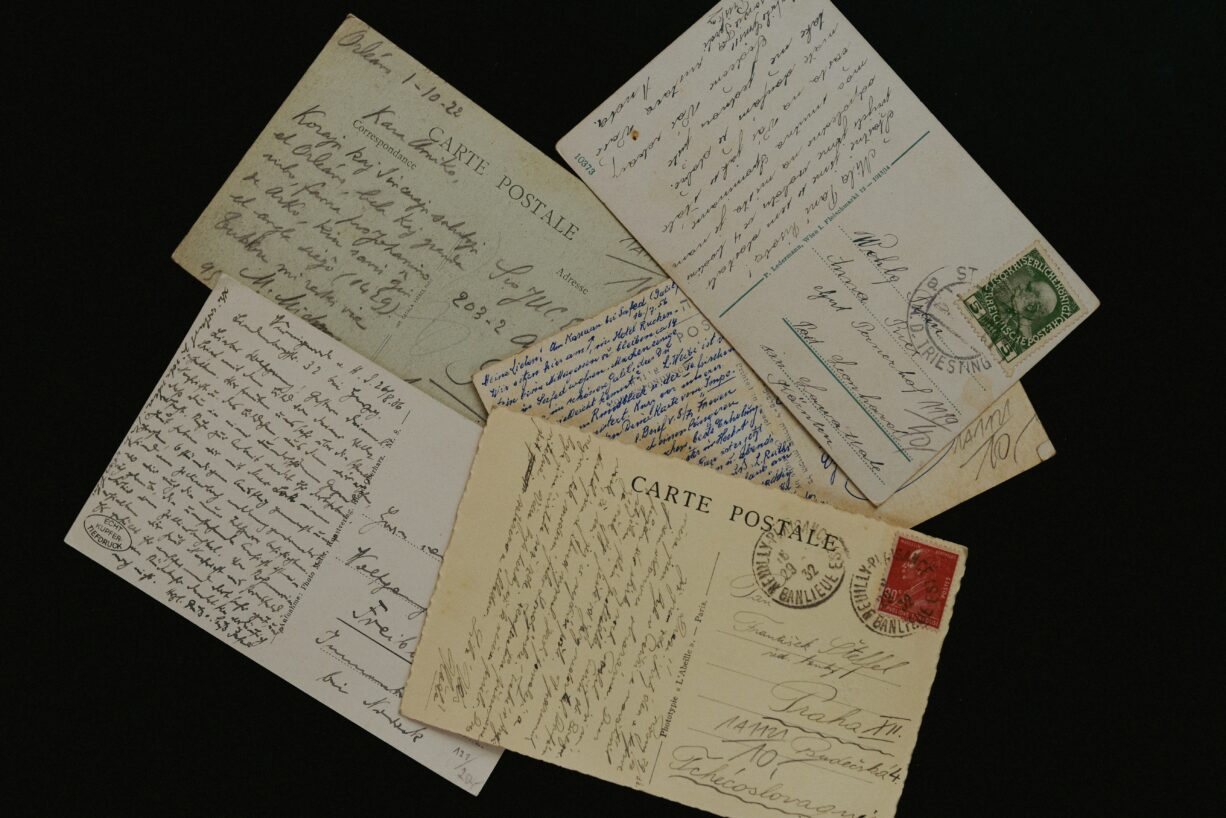
“Where did you get this postcard?”
It was a reproduction of a painting. In it, a woman huddled over a man, enveloping him so completely they seemed to merge into a singular fleshy mountain. The dermatologist traced the red spray of her hair with his thumb.
“My sister sent it to me. I think from a museum in Norway.”
He turned the card over. She had written one sentence: Thinking of you.
“Can I see that mole again? When was your last skin exam?”
I hung up our jackets and walked past the kitchen, then sat on the bed. The dermatologist folded up his sleeves meticulously, pulling out any wrinkles in the fabric. Then he retrieved from his briefcase an instrument that resembled an oddly bulky magnifying glass.
“Tell me about your medical history.”
“I have hormonal acne and hyperpigmentation, but I don’t like the feeling of sunscreen. I have bad cholesterol and my father died of an undiagnosed heart condition. Can you turn on the light?”
“I see. Is there anything else?” He pressed a button and the device shone with white light. I had meant the lamp on my nightstand. Dusk was dimming the room, but he didn’t seem to notice.
“It’s called a dermatoscope. It was very expensive,” he said. He knelt beside me and held the dermatoscope just above my collarbone, then squinted and adjusted its exterior rings. Two cool fingertips pressed against the pulse of my neck, drawing the skin taut. The dermatologist bent to look more closely and I found myself fixating on the waxy line of his scalp where his hair parted and fell.
When he pulled away I asked to hold the dermatoscope. It was heavier than I expected. Tiny LEDs lined the interior, in the sealed-off space between the lenses.
“I just remembered that when I was a kid, I went to see a dermatologist for this whitish mark on my shoulder,” I said. “My dad thought it was eczema or maybe vitiligo, but the dermatologist said it was something else. He told us it was nothing serious and would go away on its own in a few months to a year, but it was rare to see it in such a defined shape. He asked if he could take a picture of it for his website.”
Later Dad showed me the webpage, and there was my tanned shoulder with a pale arc, maybe four inches long, pointing toward my spine like the silhouette of a diver. Near it my small fist was closed tightly around a scrunched-up hospital gown. Under the picture: Asian female, nine years old.
I pulled my dress over my head and turned to face the wall. “It disappeared on its own, like he said it would, years ago. But it was right here.”
The dermatologist guided the scope over my back. Stray light darted around the room. The tips of his hair feathered across my skin as his shadow moved over mine.
“I can’t remember what it was called, but I want to see if the picture is still online. Do you know what it was? I think the name was two words—maybe Latin.”
“Has this changed in size or color at all?”
“I’m not even sure what it looked like anymore. So I want to find the picture,” I said. Had it really disappeared, or had it just sunk under the skin, migrated inside my body, where it now lay in wait for some inscrutable fatal purpose? Had we just missed the sign?
“Has this changed in size or color?” he asked again.
“I don’t think so. But does that sound familiar to you? I just want to know it was there.”
He nodded and sat beside me. Now that his face was so close to mine, the veins around his eyes looked startlingly vivid, like they could breach the surface of his skin.
“Is this a birthmark behind your right ear, under the hair?”
“I don’t know. I just want to know its name.”
“Have you always had this mark?”
His fingers inched along my scalp, pushing bits of my hair aside to expose the skin beneath. His intentness was soothing. I shut my eyes against the dermatoscope’s beam, and it occurred to me that I hadn’t slept through a night in weeks.
In the darkness I imagined my flesh parting cleanly, as with a scalpel, in hundreds of tiny incisions, then hundreds of luminous eyes blinking the skin open. They were gray and glassy like doll eyes. Then the pupils rolled slowly up until they faced inside. Their ruthless gazes irradiated everything in their paths, every shape and surface in my body, every pocket and corridor. I nearly cried with relief.
The rain had started again, a soft curtain of sound draping the room.
I remember opening my eyes at some point in the night to find myself lying on my stomach, cheek pressed into a pillow. The dermatologist was on his back next to me, staring at the ceiling. His lips moved and I heard his voice, as if from a distance, but the words were erased by the rain.
I reached out as if in a dream and rested my palm on his chest. As the shudders subsided I felt strong, steady beats.
I think he was asking, Was there something I could have done?
*
When I woke the next day it was almost noon. My dress had been folded into a neat rectangle and lay on the bed next to me. The dermatologist was gone, along with my sister’s postcard. In its place he had left a note with two words, carefully printed in capital letters: tinea versicolor.
These words watch over me now. I look at them when I wake up in the morning, when I make dinner after work. When I close my eyes at night, I pretend my skin is transparent and someone is picking through my blood vessels, scrutinizing my organs and soft tissue, naming things one by one.
Scapula, acromion, clavicle. Left atrium, left ventricle, aortic valve.
I do this until I fall asleep.
Amy Haejung lives in New York. They have received support from Kundiman, The Mastheads, and other organizations. They can be found at Amy Haejung.