


Juice Box
Marie Buck | Flash Fiction
She didn’t want a Diet Coke, or any of the other beverages that the kids had. There was a machine near the bathrooms, plus juice boxes that her aunt had brought. Her brother drank apple juice all the time and she drank only tap water. Bottled water wasn’t really a thing yet, in this time frame, and so she often had nothing to drink, or adults were somewhat put out whenever she needed something to drink, rather, since she refused all the child-oriented drinks on offer.
They had been in a very small museum, just an old converted house, learning about horseshoe crabs, which they now knew were very old. The horseshoe crab speaker spoke, and then they looked at some dead horseshoe crabs, and then they were done, and they ate raisins and Cheez-Its outside while her mother went inside and came back with two little cone-shaped paper cups of water for her. And then they walked to the beach.
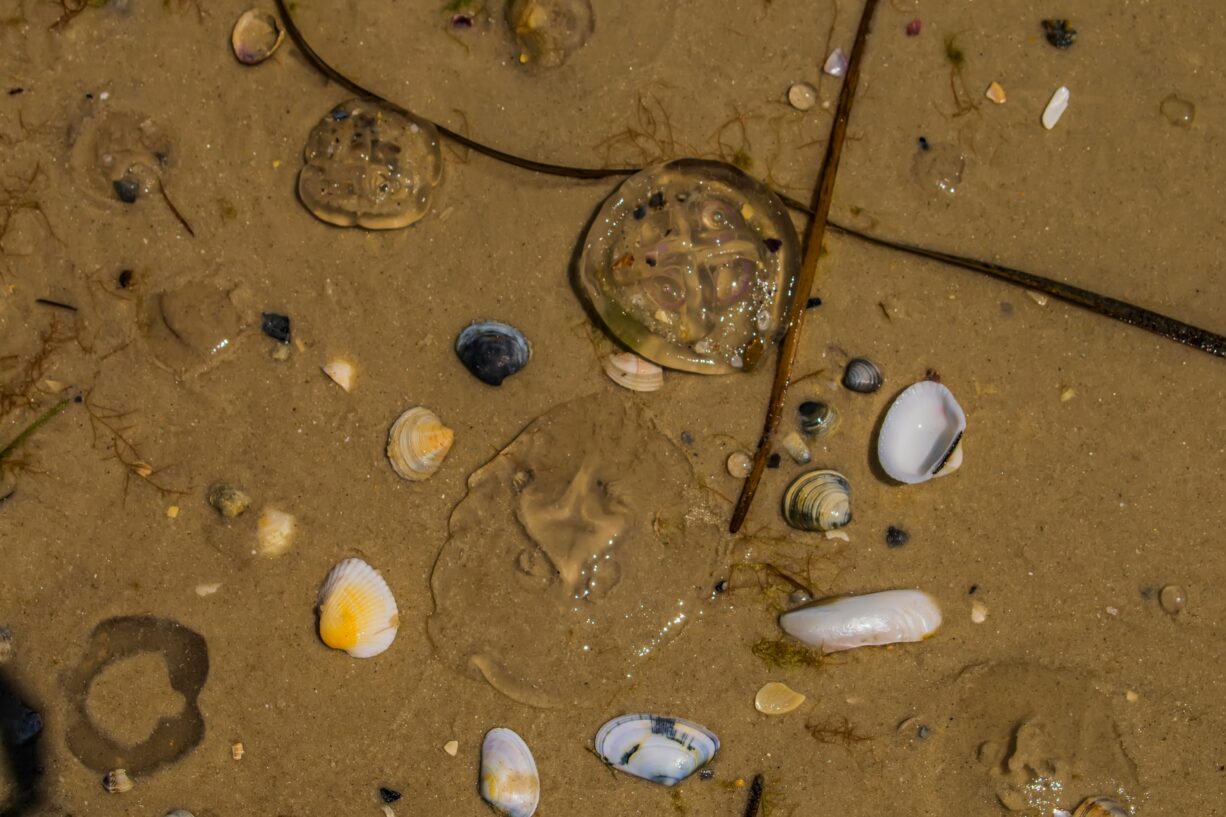
Her cousin had found jellyfish. He stood there poking one with a stick, and she kept her distance and sat directly on the sand reading a book from a series about girls who had slumber parties together. Sometimes when they came to this area, it was because a relative was in from out of town and everyone wanted to eat crabs. Other times, it had been to go to a church here. Sometimes her parents came to this beach church instead of their regular church. The priest at this church had a sort of gimmick: as he processed back down the aisle at the end of Mass, he gave a high five to every kid he could give a high-five to. If you wanted to high-five the priest, you just had to make sure you were in the part of the pew nearest the center aisle, and you’d get a high-five. She and her brother relished it every time. A few other times they had come for the beach. Once to get a prescription when the pharmacy near them didn’t have it. Once for a girl’s birthday, and she didn’t know or remember the girl anymore, really, just the old Victorian-style house, that the girl had had a cake with her own face on it, and that she had wanted to eat a piece of the cake with the girl’s face on it but had instead thrown up. She had a fever, it turned out, and then she was taken home.
When she looked over again, her cousin was using a stick to lift jellyfish from in between some large rocks out on the sand, one after the other, creating a giant gelatinous pile.
“Are they dead?” she asked him. He didn’t know, he replied, and she picked up a stick too. They both poked at the jellyfish with the sticks and they still could not tell if they were alive or not. She wondered if they needed to be alive in order to sting, even, or if it was more that if you touched them they hurt. Less them stinging on purpose and more that the tentacles just create that sensation. Her cousin poked at one, at the main part of its body, and nothing happened. They might be dead.
The previous night it had rained very very hard, and her father had stared out the front door for at least a half an hour saying “Mom should be home by now” and “Where’s your mom? I don’t like this rain” several times. Something bad was happening and she and her father were both in agreement about it. When her mother had come in from the rain she seemed surprised by the worry, irritated even, and just said that there had been a line at the store. Her brother had been playing with the cat, who became very active and bad at night, and that had been all the darkness and the storm had meant to her brother. And now he came over too, so that she and her cousin and her brother all prodded at the jellyfish with their sticks, prodding harder and then harder again when no reaction came until they started to pierce through and tear some of the jellyfish.
She took a break and drank from a juice box then, since there was nothing else to drink and the sun was beating down on them. She wondered if they would start coming to church in this town again, this town with the happy and funny priest. Every time they left the church, both of her parents said they liked the sermon and they liked this place. Then they would buy corn at a roadside market on the way home.
Her aunt had brought an inner tube that looked like a big tire. And so she took the inner tube and she got in the water and let it carry her for a bit. Their cat, at home, got bad every night and then they would say he had “turned.” He would start knocking books off of shelves or get up on the counters and try to push glasses off the table, and they’d say “he’s turned!” and laugh and then yell at the cat, who didn’t care, since he had turned and seemed to enjoy the attention of being admonished once he was in that state. If he was bad enough he would have to go in the other room. She liked that he never seemed to care, and when you let him out he was always still in his evil mood. The waves were carrying her out further, and then she looked at the orange buoy in the distance and started to paddle toward it. Now she was making progress, and she let the cat drift through her head, and the priest, from whom she wanted something but she wasn’t sure what. At the library, there was always a game about jellybeans, where you had to guess the number of jellybeans in a jar for the possibility of winning a prize, though, she thought, maybe the prize was also jellybeans, which she did not like. She wondered if there were jellyfish in the water, or regular fish, or sand dollars. What would the priest do, for instance, if you wanted to talk to him beyond the high-five? But not to confess, or even to ask religious questions, but just for more of the high-five. The seriousness of the sermon and then the jubilance of the high-five, the other little kids, sometimes just in jeans since it was a beach church.
And then her mother came, splashing and yelling, in her clothes, and the girl startled and saw how far she now was from the shore. The girl tried to be calm still, since she liked it; she liked this raft and the bay and the buoy she was paddling toward, and she still wanted to get to the buoy, though it was clear that that was not going to happen now and that she had perhaps badly underestimated how far out it was. And when her mom got to her, her mom was crying. It did not do much to try to make a case that it would still be good to try for the buoy, and it seemed to upset her mom even more. And so they went in, and the girl went to her brother and her cousin, and they all stabbed the jellyfish hatefully until it was time to go.
Marie Buck is the author of several poetry collections, including Spoilers, a collaboration with Matthew Walker (Golias Books, 2024), Unsolved Mysteries (Roof Books, 2020), and Portrait of Doom (Krupskaya, 2015). Her poetry, fiction, and scholarly writing have appeared in Post45, the Brooklyn Rail, the Poetry Project Newsletter, Peatsmoke, and Bruiser, among others. She grew up in upstate South Carolina and received an MFA in poetry writing at the University of Massachusetts, Amherst. She works as the managing editor of the scholarly journal Social Text and teaches writing at New York University as part-time faculty in the Liberal Studies program.