


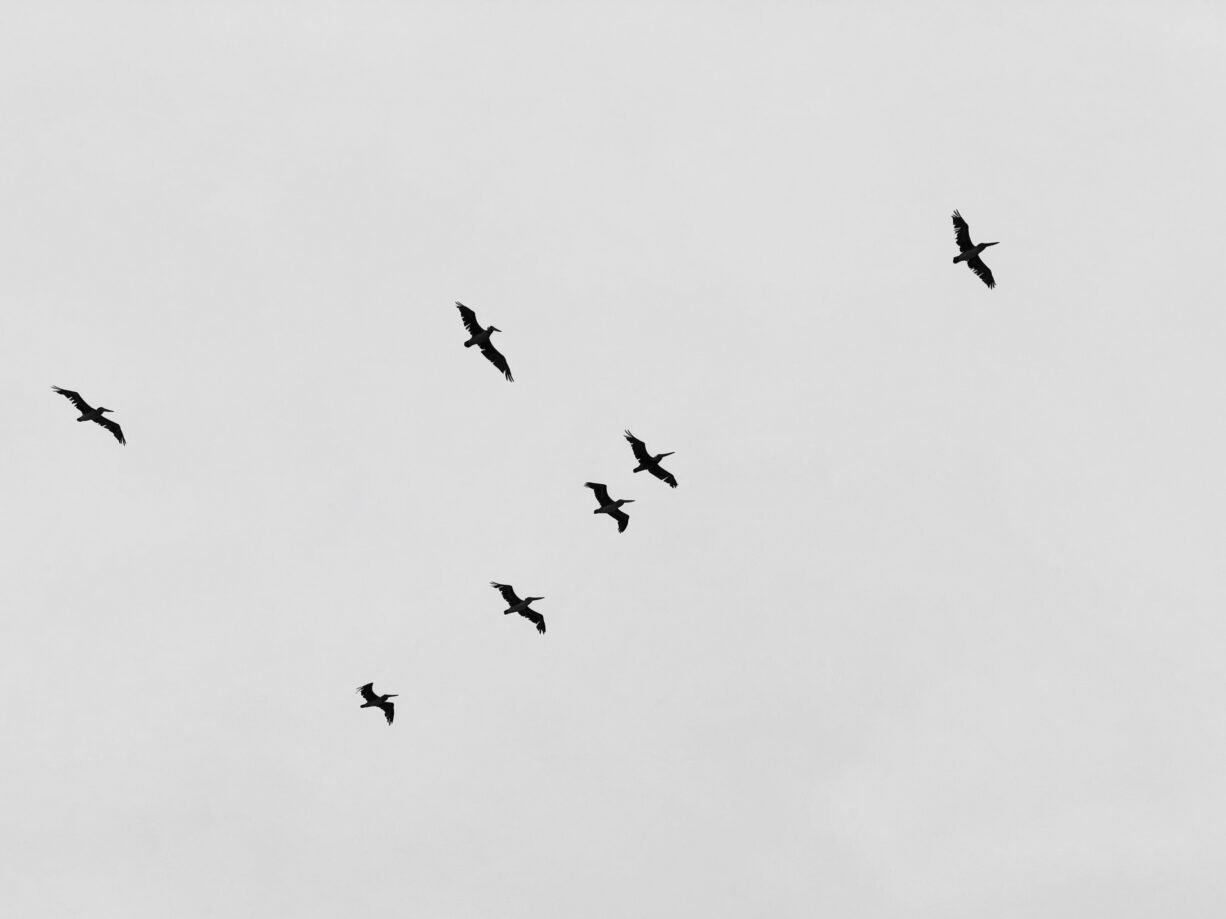
Ornithology
Jeffery Renard Allen | Fiction
—in memory of Charlie Parker, seventy years gone
“The beauty of mathematics only shows itself to more patient followers.”
—Maryam Mirzakhani
That morning before I left for work, my son James asked me, Can people fly?
He can, I said.
James was sitting cross-legged on the floor holding his ankles and looking up at Kenderick Lamar’s video “Alright” playing on the forty-inch flatscreen TV mounted on the wall.
He asked, How come he can fly but I can’t? I want to fly too.
You can, I said.
I can?
Yes.
Really?
Yes, I said. Don’t worry. I’ll show you how when the time comes, when you’re a little bit older.
How old?
You’ll know.
In that moment, everything was between us, but I did not say more, the secret weighing inside my body, pressing down on my pelvic bone when I moved.
James was seven years old. (That had been an eventful age for me.) Each weekend, I helped him with his homework, reading chapter books together—he read above his grade level—followed by the slow routine of copying out letters and numbers. James chewing on the end of his pencil. We fished in the creeks with live bait—he had no fear of worms—played basketball on the court in the apartment complex where I lived—this is the way you arc a jump shot—and played catch with a baseball (an anachronism in our community) in the park.
I dropped him off at school with a promise that I would pick him up from there on Friday, then I continued on to the Kroger where I unloaded delivery trucks, stocked shelves, butchered and wrapped meat in the deli, and bagged groceries, a natural mastermind at getting things done in a timely fashion. Back then, I led the same kind of life as other people. (All nests are the same.) Pulling a nine to five, dressing in the same uniform each day, putting in overtime for a few extra dollars whenever I could, complying to the company’s rules, which meant allowing myself to be monitored and scrutinized. Aware that my real life was happening somewhere far away, happening without me.
I did not fit in, could not fit in, for how could I map my life for the everyday, knowing what I knew? My days and nights had coalesced into a stream of forgetting memories that seemed too implausible for a supermarket. (Places of antiquity have lost their usefulness to those who live in the present, who live for the moment, the here and now, with eyes focused on the future.)
A customer ordered a honey-smoked ham, so I slipped my hands into plastic gloves and set about maneuvering the cutlery, showing off my training, shaping, trimming, easy-peasy, pounds of pig meat destined to be. Impatient, the customer made a gesture—a sigh? grunt? sucked teeth?—that broke my concentration, and I straightened up slightly and wiped my forehead with the part of my wrist exposed above the glove, and in that moment an impulse to move tugged at me, an impulse I knew well. At the end of my shift I climbed into my car and set off for home, only to drive past my turn off and continue onto the highway where dark austere trees lined both sides of the road in the evening light. I could see the clear crenellated shapes of mountains in the distance, jagged structures that seemed more or less alike.
Nightfall brought a rough-and tumble drive through the dark, the car swinging up and down steep hills, road noise filling the vehicle like a viscous fluid, half-drowning out the music. I leaned in to listen, my seatbelt cutting into my shoulder and the rumblings of the invisible mountains pushing low frequencies through the windows, demanding my attention. I pulled over to the shoulder of the road and cut the engine, my eyes full of muted blues layered against a neon sky. Out into the cool night, quickly down the highway stretching a thousand thousand miles over the circumference of the earth, the smell of grass mixing with the loamy scent of rich soil marking the interplay between earth and sky, my mind swinging back and forth inside my head, sparking a sense of half-understanding at the edge of my consciousness.
Wanting to feel the shape of the road beneath my bare feet, I stopped walking and removed my socks and shoes. Experienced the power of gravity. (That too.) Then on again, goosestepping down the road, causing the darkness to break underneath me with each step. An elephant pounding the night back into the earth where it belonged.
Walking in all times at once, the wind a living thing on my skin. I saw myself standing on the skin of a breathing planet, a view that spilled out in all directions. Experienced the turning of the earth on a human scale. Then the ground under me disappeared and the world drained away, became sky, until it was just me and stars dazzling the darkness. (The world is made of light.) I threw my mind far out, so far that I cradled the entire cosmos inside my skull, the big questions sliding in and out.
A rushing sound across the landscape scoured my brain clean. The sun shot up like a flare slanting through the sky, crackling warmth down upon me. I resumed walking, my most pressing problem whether to crick my neck up at the morning swallows or watch the black road beneath my feet. The swallows decided for me. With great fanfare they fluttered down and settled on branches poking out of trunks like giant fingers orchestrating their movements. Their commotion made a dry shuffling sound in the vegetation that stood in tangled clumps between the road and the mountains. I drank in the clean air. The time of that other world seemed no longer real.
Buddy, what’s going on?
Two cops in a black-and-white squad car were now following alongside me. I stared ahead, watching them from the corner of my eye, and walked even faster with a tightening feeling in my chest. Difficult to slow my breathing with my primitive lungs.
We just want to help.
I felt fear travelling through my nervous system, clearing the way for adrenalin that started pumping every muscle of my body, propelling me forward.
The cops exited the squad car and followed along beside me, trying to persuade me to stop and talk to them, their words moving along the surface of my bare arms. They asked for my name. Asked where I had come from. Where I was going. How I was feeling. More questions.
I heard a voice chirping in the air above me, Hold your tongue. Don’t tell them anything.
Then one cop shouted at me, the iciness in his voice shocking the breath from my lungs. Buddy, I need you to stop walking and produce some identification.
The urge to bolt. A migratory impulse. I looked around me trying to decide which way to run, but there was no clear path of escape, only an ocean of grey-green grasses and the mountains in the distance. Before I could act, they were on me, four arms and four hands having their way with my body. Soon, they had me flat on my chest on the pavement with a knee wedged into my back, my face hovering an inch above the greasy tarmac, and my hands pinned against my buttocks allowing handcuffs to snap tight around my wrists. Then they tugged and pulled and lifted and angled me into a sitting position, with my hands cuffed behind my back.
One cop aimed his chin at the walkie talkie thingy attached to his chest and spoke into it, saying something about an EDP. Crackling noise: someone spoke back to him. It went on that way for a few minutes, man having a conversation with gadget.
At one point I heard the other cop say, Partner, who knows the working of a rat’s mind.
I tried to snap free of the handcuffs and take to the air. No doing.
With either cop holding me by an elbow, they jerked me to my feet, then one cop held me while the other pulled open the back door of the squad car, indicating that I should get it. I ducked under the hood and placed myself on the seat as best I could since the space was too narrow and cramped for me to sit completely upright, the painful handcuffs compounding my discomfort.
Motion through dozens of city streets pieced together by grey buildings with iron bars lacing the windows and birds flying through the gaps between one structure and the next. I looked out the window at the passing brick and steel constructions and could feel cold dampness coming off each one. In the blur of movement my tongue could not form words to ask where they were taking me. No memory of exiting the squad car—geography was lost—only an elevator whining with pain as it struggled to rise floor after floor.
During the intake the nurse looked at me from behind her desk with a face of chubby cuteness, her blue scrubs made of the finest cotton I had ever seen. Black braids formed a nest on top of her head that threatened to topple over whenever she looked down at the forms stacked on the desk before her. She introduced herself as Mrs. Camarillo. Pen in hand, she asked me many questions, ready to record my answers, but what was the point of complaining about what my life had become? The world had marked me. Being human was a disappointment.
Once in the ward I systematically examined the faces and bodies of the other patients. (Was it sweat or tears that made their faces shine?) Their agitated eyes returned my gaze. They bumped into one another, arguing about what plagued them. (I listened to every word.) A man walked up to me and said, The devil is the most beautiful creature that God created.
One woman lay on the floor with her ear to the ground listening to something beneath the white tiles. An older man played an air saxophone. He kept throwing his head back on his long snake-like neck to gather breath, his fingers moving over invisible valves.
Too much noise in the ward, noise that made it hard for me to hold my thoughts together. Seeking space, I moved swiftly among the other patients, but this did not bring me any relief. Something told me to edge myself up against a wall to keep out of the way of their endless movement and so I stood, watching words tumble from mouths that never stopped moving. I had no idea how to hold the details of what I witnessed. No great satisfaction in watching someone suffer. I felt exposed to what I saw, discomfited by it, and crawled away toward the memory of my son. Thought about our closeness to each other, in touch, smell, and breathing. In this place the possibility of returning home seemed unlikely. Could not imagine it.
My first night in the hospital, I lay awake for a long time, wired with exhaustion and emotion.
I soon came to understand that the infestations inside the hospital were the same as outside. My misfortune to find myself trapped inside a living museum. The other patients seemingly oblivious to both the old dusty dead things—books, chess set, board games, playing cards, magazines—laying about and the ghosts who haunted this place, trapped. Some of the dead looked uncannily alive, and the sight of them momentarily overpowered me, making it possible for me to believe that the living were more powerful than I remembered them to be.
*
The psychiatrist was a strikingly tall and bulky figure whose height and mass made her desk appear small. When she spoke the features on her face moved independently of one another as if each were under the stringed-control of a puppet master. For all that, she appeared to be composed and resolute, a young woman (late twenties) who wore makeup to look older, and her quiet voice and casualness of approach made it impossible to imagine her ever blowing her cool and getting angry.
She asked, Can you tell me what’s going on? The day darkening in the window behind her.
She parted her lips, revealing her compact front teeth.
If you could tell me, it would help me get you home as soon as possible.
I sat before her dumfounded by the compassion blossoming in her eyes. Make no mistake, that she should succeed in gaining my trust was important to her, but I was at a loss to help her for it seemed an effort to simply open my mouth. The intensity of the privacy between us was severe, pressing on my face and body. She widened her eyes when I shifted in my chair.
Even if I could have spoken, nothing I said would have been of any consequence to her. What she did not know, I preserved the entire history of my species inside my head. What could she (they) do with facts about beings who no longer existed? (Well, we exist in diminished numbers.) About life forms who bear the ordeal of traveling across the world disguised as members of the human race.
*
The music therapist was a slender Asian woman, her voice soft and compassionate but the look in her eyes tough and vigorous. She led us in a rendition of “Billie Jean,” her voice quickly lost in the multitude, a dozen voices piling up on top of one another, a soaring tower of sound, the low murmur of my own voice barely audible. When the song subsided, the therapist started clapping, causing everyone to join in. The silence that followed seemed shockingly stark.
*
Once a day, we lined up before a small window next to the nurses’ station to receive our meds dispensed in tiny creased paper cups.
We ate our meals on paper plates embossed with bright tiny birds (humming?), their fat bellies larger than their wings.
For one hour each day, we were allowed to go out into an enclosed yard to get fresh air and sunshine and to smoke cigarettes. A high chain-link fence surrounded the yard with overgrown hedges reaching for the sky on the other side. I sat on the grass at a distance from my fellow patients watching them blow grey plumes into the air. Time was being stolen from me.
Despite the medications, each night I would lay awake for a few hours with my future life (post-hospital) weighing heavily on my mind, trying to put words to all the questions churning inside me. During the day, I would sit in my favorite chair in the common room, which was strategically positioned in one corner, a safe place where I out of the way of being accosted or confronted. From there I could study the other patients while remaining on guard against the dreams, hallucinations, and fantasies infecting the air. No longer trusting the ground, I would keep my legs cradled inside the chair.
I would sit there pretending to nap, the fluorescent lights pressing against my closed eyes, my mind opened outwards in a state of instinctive attention, listening to the hum of the magnetic field, hearing breathing come back to me through the walls in rhythm with my own breath, and remembering my past life. Time would pass, a minute, a millennium. (Numbers started to feel insufficient.) And I would feel lacerated by everything that I imagined going on in that life that I had left behind.
I was sitting thus one evening, flinching at the sight of ghosts, distracted, agitated by the cacophony of footsteps and other noise bouncing nonstop off the floor, walls, and ceiling, trying to distinguish between the sounds of an argument and the sounds of comradery, of low laughter and shared sighs, of howls of despair and yelps of contentment, each sound thudding into my body, causing me to stiffen my shoulders in an effort to zone out and return to my senses. Sitting thus, I heard a voice cut through the clamor and call out to me from some undetermined location: Remember who you are! Don’t get sucked into their world!
The night spoke in dreams that took me wandering far below the surface of the earth to an underworld populated with millions of skeletons that I could not identify. Nevertheless, I spent some time examining the random jumble of bones, touching them, looking at them. I blew dirt from what appeared to be the thigh bone of the smallest dwarf who had ever lived, a huff of breath that rushed into my face and ears. I let my heart beat once, twice, before sucking in a lungful of dark air. *Then, stuck fast to my body, I started to rise, up up up and back to the world of dirt, brick, cement, concrete, and disinfectant.
*
The next afternoon in the yard, I looked up and saw clear bright trails in the sky, evidence of migration. A flock with purpose ingrained, with geography grooved into their minds. Each season of their circular lives filled with both familiar places and a rhythmic sense of circular motion. There and back again. Ancient man believed that birds transformed into an entirely different species with the changing of the seasons. Because the meds were now doing what they were supposed to, I could easily cast my mind back through time and nest myself inside the skull of the ancients and recreate their fears, dreams, and prophecies. Still, I had much to learn, and despite using all my powers of concentration, I still waited in doubt and ignorance to fully understand these primitive beings as I lacked the ability to fathom the functioning of their bodies and tongues that were so unlike my own. (Sometimes my arms and lungs ached for flight.) I would lose myself in wondering who these others were.
*
Two (three?) weeks in, I was sitting in my favorite chair one evening, minding my own business when a news flash interrupted the sit-com on the television. Multi-platinum rapper Crow Bill had died from an apparent heart attack. Footage of a body-bagged corpse being slid into the back of a coroner’s vehicle. On house arrest, the rapper started laughing uncontrollably at a stand-up comic on television, then lost his breath, never to regain it. The newscaster spoke intimately about the life of Crow Bill, born DeShawn Davis in poverty to a single mother. His gang affiliations. His battles with substance abuse (opiates, codeine syrup, Ecstasy, alcohol), obesity, and depression. His charitable activities. His championing of younger hip hop artists. His willingness to voice his political views and risk endorsement deals, awards, and canceled concerts.
I sensed my existence in the mind of the dead man—his confinement, his resignation, his abandonment. The identification brought no comfort. My life was becoming anything they wanted it to be. In an attempt to batten down the rising fear, I thought about my son, only of him, bent all of my thought around the idea of him, and the agony almost broke me, releasing a strange violence that started to well up inside me. It was then that I heard it: an explosive thud rattling the window in the common room. I looked up and saw a bloodied corpse lying on the ground outside. A bird. A swallow. Thick blood matting its feathers. Although dead the sound of its impact against tempered glass still echoed through the common room, transmitting knowledge to me like an electric shock: it had crashed headfirst into the window in a desperate attempt to break the glass and free me.
I found it impossible to move, so I continued to sit in the chair, feet above the floor, and look on in silence. Free but not free, I felt emptied, as though nothing remained of myself.
*
During yard break the next day, I walked under the trees, flickering amid patches of light and shade, thinking about the swallow, the failed escape plan, its noble sacrifice. The bird my last link to a world I had abandoned, turned my back on, betrayed. Only one way to redeem myself, by not being afraid of anything.
The sky became overcast, then turbulent with the sound of jet planes zooming overhead. Cautiously, I looked skywards and saw the air above reddened and alive with swooping waves of swallows a hundred feet above us, a thousand feet. The other patients stopped whatever they were doing and craned their necks up, animated, pointing fingers, oohing and ahhing and jumping up and down in excitement. I continued to watch the swallows quietly, holding my breath, and could feel in return their warm breath falling down on my uplifted face.
Then I saw one swallow land in the yard only a few feet away from me. The bird stood motionless making no sound, only looking at me with green eyes while the wind ruffled its feathers. It started to move towards me on slender legs and in a matter of seconds leaped onto my outstretched hand and climbed my arm until it reached my shoulder, its beak near my ear. It began to chirp the purest of sounds.
Concentrating, I locked onto the structure of the swallows’ tune. After a while I could whistle the song perfectly, and the swallow was pleased, almost beside itself, rocking from side to side on my shoulder with its claws penetrating my skin.
Then the swallow flew back to the spot on the grass where it had landed and darted a hurried glance at me. I knew instinctively that it wanted me to follow. It took to the sky and I gave myself space to run and set off behind it, soon to be taken into air, wings spread in slow flight, just above the extended hands of other patients assembled in the yard who looked up at me in astonishment.
As I rose higher, I kept the lead swallow in sight, alert to its sudden shifts in direction. The wind bore us well above the sun-coated mountains, a memory of a time before this one. I closed my ears to the sounds of the collapsing world miles beneath me. Never turning, never looking back. The higher we flew the greater the challenge. Once in the rarified atmosphere we struggled against the constraints of gravity and suffered through air dense with carbon. Then the wind started blowing from the opposite direction with such force that our wings were being buffeted, blown backwards. We adjusted, we persisted, unbridled to place, unbridled to time. The earth small light and blue and touchingly alone beneath us, present past and future vanishing in the flight home.
Jeffery Renard Allen is the award-winning author of six books of fiction and poetry, including the celebrated novel Song of the Shank, which was a front-page review in both The New York Times Book Review and The San Francisco Chronicle. Allen’s other accolades include The Chicago Tribune’s Heartland Prize for Fiction, The Chicago Public Library’s Twenty-First Century Award, the Ernest J. Gaines Award for Literary Excellence, a grant from Creative Capital, a Whiting Writers’ Award, a Guggenheim fellowship, a NYFA grant, residencies at the Bellagio Center, Jan Michalski Foundation, Ucross, The Hermitage, VCCA, Monson Arts, and Jentel Arts, and fellowships at The Center for Scholars and Writers, and the Schomburg Center for Research in Black Culture. He was a finalist for both the PEN/Faulkner Award and the Carnegie Medal for Excellence in Fiction. Allen is the Africa Editor for The Evergreen Review. His latest books are the short story collection Fat Time and the memoir An Unspeakable Hope, the latter co-authored with Leon Ford. Allen is at work on several projects, including a novel called The Promise, a memoir in four volumes entitled Mother-Wit, a book of poems called No Borders, and the short story collection Try Me. Allen makes his home in Johannesburg and New York. Find out more about him at Jeffery Renard Allen.