


Friendly People
Sarah Juma | Fiction
A few months ago, before we exchanged hot and humid Lagos for grey and wet Seattle, the husband fell asleep to a playlist he’d curated of male immigration influencers mandating what-not-to-do the moment one’s Nigerian foot touched foreign soil. His earphones were still intact when I found him limp, but I noticed his ear canals were red from the barrage of pointed instructions, and so I carefully took them out. I kissed him on one ear, as if to say good night. But if I am not in his dreams, as he often implies I am not, then I hope it’s not a good night.
The influencers said nothing about where to find bitterleaf for his favorite soup, or equally pungent substitutes I might find at the vanilla grocers. Nothing about dousing homesickness or where to set up your first bank account, or why it should be a credit union and not a bank. The night I kissed his ear without thinking twice, he’d fallen asleep on the fourth video in a five-part series—each episode an hour long—where a man was telling his fifty thousand followers how to stop their wives’ wings from growing too big. This closed caption said so right there on the screen.
Give your wife money when she asks: always when it’s for the household, sleep on it for at least a week if it’s just for herself. Women over there have freedoms, he warned. A friend of mine took his wife from Nigeria to the Netherlands for his Ph.D., and she always kept late nights—though he knew she’d taken a job as a nanny—and he was condemned to a tedious routine of greige colored oatmeal for breakfast when she was still fast asleep and wouldn’t cook, and he didn’t know what shelf the sugar was kept on, and she called the police to report him for locking her out one day when she forgot her keys, and the neighbors heard her banging on the door. They arrested him. Can you imagine?
I found myself entertained by this anecdote. It felt like my best friend Ladidi had come into my home and plopped herself on the couch next to me to feed me gossip, like she did only on weekends.
Ehh, so he and his wife fought?
Yes, they beat each other. And both slept in jail.
The husband has followed his influencers’ manuals to a tee. He doesn’t speak to me much, but we do have morning regimen of holding hands in prayer to ask that he does not lose his job; these software giants are going through their assembly lines like a scythe through a cornfield; and it doesn’t matter that they’ve gone through bureaucratic hell, towers of jargoned paperwork, to import people like the husband, on an H-1B.
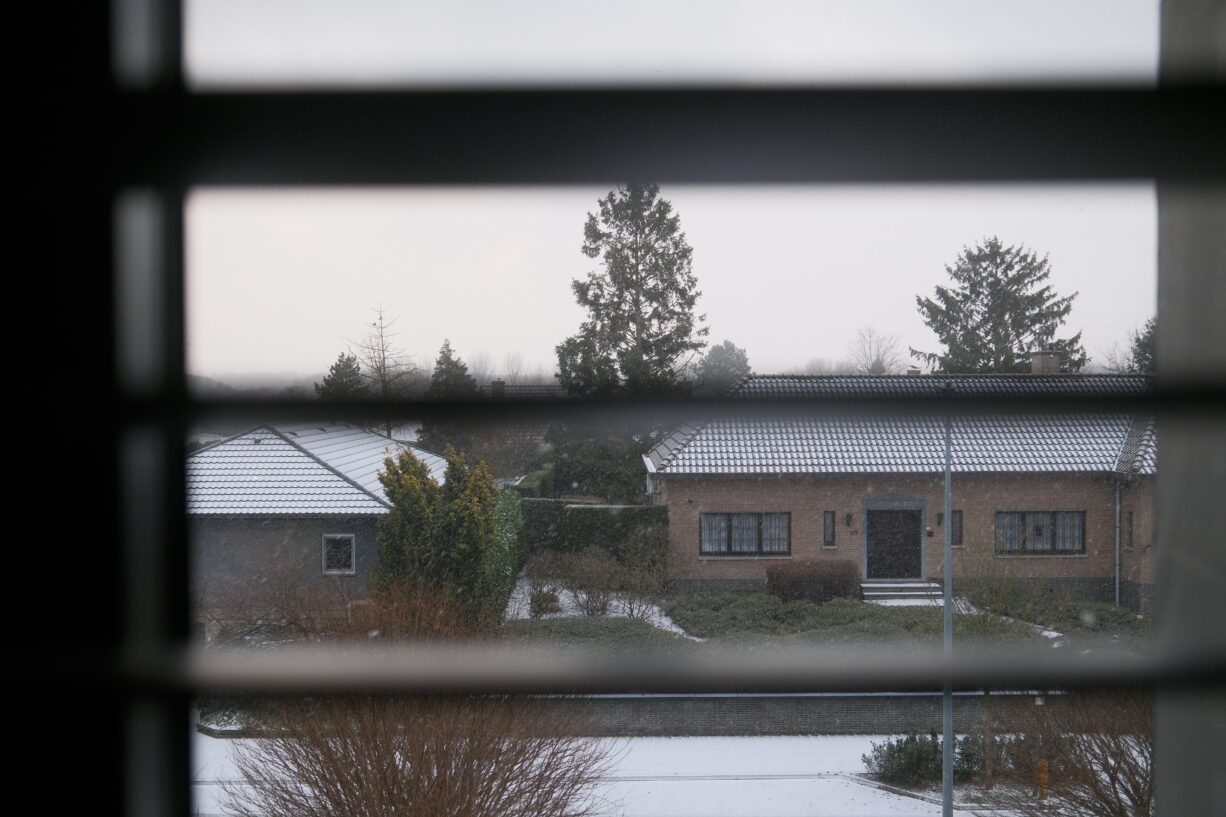
There’s a half-bedroom he’s sentenced me to do my own thing. The ceiling slopes downward on both sides, creating a triangle your head would most certainly touch even when you’re 5’2″ like me. There is only one window.
He sentenced me there because he brings the coding home and says he can’t concentrate when I’m around. Apparently, when I walk past in the tie-dye boubou, my silhouette calls out to him and then he blinks, and misses a colon, and a syntax error threatens to implode his whole day.
An empty nester couple at our new church gifted us furniture. Of these, I took a barstool upstairs and I sit on it everyday to oversee our corner of the street and the woods behind us. I watch rain batter spruce trees in the backyard. Even from our third-floor window, they shoot up, piercing holes through the sky—there’s no tree as tall as these in Nigeria. To ask if I have no other hobbies outside nature-watching would be not to know how red the husband’s eyes can get when he asks where I was—five minutes past the ETA I’d given—the day I hopped on a bus to the outskirts. Google told me that an ethnic market named Ochendo Superstores had stockfish and frozen ponmo.
“No soup is worth me not knowing your location. There will never be one!”
I’ve run through a year’s worth of Nigerian Youtube movies in one week. When he received the first wi-fi billing statement, he grovelled under his breath and knew better than to call my name, because once upon a time he’d needed my hotspot to take the Zoom interview, where the hiring team fell so in love that he was worth the unbridled hassle of visa sponsorship.
When I was a banker in Lagos, the husband was out of work for eighteen months. He’d given a startup three devoted years for which the founders promised “stock options” and deferred wages, while it was rumored that they’d burned all the cash in the Cayman Islands.
When this Washington-based breakthrough came, he called me after he’d told his mother. And her brother. I was in the bank’s parking lot about to drive my 2022 Honda CR-V—to a meeting where I signed off on the transfer of millions without asking anyone’s permission—and I fell to my knees. I sold this car for our joint account when we needed proof of funds. The same model now sits in the driveway across the street, in a glossy burgundy hue. My baby was silver.
Someone rear-ended this CR-V, but fled the scene before the adults in the room could wake up to the bang. It was three in the morning. I was only awake because the husband had been tossing, and when he tosses I cannot sleep in our full-size bed, so I go to my office.
I pressed my face to the glass and watched a dark sedan reverse frantically, unsure of its left and right, tires squealing as it sped away. In the morning, the owners stood in their robes examining the damage—a deep dent in the rear panel and broken tail lights.
I dressed carefully before crossing the street. Conservative blouse, no makeup, wedding ring prominent—my own influencers have told me this is how one blends into the suburbs.
The woman who answered the door had kind eyes and blonde hair pulled back in a ponytail with graying roots.
“So sorry to bother you,” I began, “but I witnessed what happened last night.”
Her face brightened with relief. “Goodness, really? We don’t have a Ring cam. And cops said without witnesses, they can’t—”
—I described the sedan: metallic brown, copper if you will. Likely a Toyota Camry, possibly an Avalon—I know this silhouette too well from its abundance in the employee parking lot at the bank back home. License plates ending in 18.
“This is incredibly helpful,” the husband said, taking down every detail I could remember. “Insurance was gonna give us hell, ” he dashed into the house with the notes.
“I actually owned that exact model back in Nigeria,” I said, gesturing toward their damaged Honda with a smile. I hadn’t realized that my eyes broke contact, veering off to search for memories of me in a driver’s seat.
Something shifted in the woman’s expression. “And what do you have now? It’s a reliable machine,” she patted down the car’s back, soothing the injuries from last night’s bodily harm.
“No car,” I threw my hands up. But then I was quickly unsure if I’d just come across as a beggar.
“You must miss having your own,” she quipped. “Well, if it’s not too much of a walk, we’d love to have you by later in the week.” The husband jogged back out with a smile you couldn’t shrink, saying a police friend had already found something with my information. And for that, they would keep coaxing me to accept their thanks—my first proper American dinner.
*
Sarah’s dining room smelled like lemon oil and fresh pinecones. She’d set the table with cloth napkins folded into perfect triangles, real silverware that caught the overhead light, red wine glasses despite the fact that we were eating salmon. The kind of table setting I’d seen on film, and knew the rules for, but never owned.
“This is beautiful,” I said, meaning the presentation more than the food, because the buttery sauce around the asparagus was something you could lick off, while the vegetable itself waged war on your teeth.
“Doug caught the salmon himself last weekend. We have a little boat on Lake Washington.” She poured wine into my glass without asking if I wanted any. “Do you and your husband fish?”
I almost laughed. The husband’s idea of outdoor recreation was walking from the parking garage to his office building. Though lately he’d been talking about bonding activities with his colleagues—something about learning American bro culture. And Top Golf. And touchdowns.
“Not really. We’re still adjusting to all the options here.”
“I imagine it’s quite different from Nigeria…”
The way she said Nigeria—carefully, with the upward inflection, like she was handling something delicate. But there was something else too, her voice warmed when I spoke. When we were opening our new bank accounts downtown, the officer adopted this same tone with me—careful respect for my education, my English, my ability to navigate their world, but only after he learned my background. Other customers needed translations to fill forms. Hand-holding. Unmet minimum deposits.
“In some ways.” I sipped the wine. It was dry, very tannic. “We have rivers all over. And in Lagos, we were right on the Atlantic, but I won’t say fishing is really a pastime. It’s more for survival. Sometimes business.”
“And what kind of business did you do back home—”
“—Corporate banking. I had my own car. My own schedule,” I interjected, sensing that he’d thought small of me. The “own schedule” part of it was a flagrant lie too. I never left the bank earlier than 9 p.m.
Sarah set down her fork. “Right, you mentioned that.” She gestured toward the window where their damaged SUV sat. “Why don’t you drive your husband’s car? You’re stuck in that apartment all day?!”
The question loomed above us. I could have said I didn’t know the roads well enough, or that parking downtown intimidated me, or that we couldn’t afford the insurance for two drivers. All true enough. Instead, I found myself studying the tablecloth’s patterns—pastel plaid with geometric lines that seemed to cage the table in order.
“He needs it for work,” I uttered.
“Even weekends?”
I nodded, though this wasn’t entirely accurate. Saturdays, he played video games. Sundays, we went to church together, but he drove because he said I would look nervous behind the wheel in American traffic.
Sarah refilled my wine glass. “You could put your foot down, you know. It’s your marriage too.”
The salmon had gone cold on my plate. I cut it into smaller pieces, buying time. Foot down? Dependent visa holders needed to be careful about establishing too much independence, in case it raised questions. If I drove his car, there were officers who would glean one’s complexion through their windshield and bring them to a brutal stop. And they wouldn’t be heard from for days. Until they called requesting legal help from detention.
“Marriage is about compromise,” I said, the words feeling rehearsed even to me.
Sarah’s smile tightened slightly. “Of course. But compromise should go both ways…” she paused, swirling wine in her glass. “Anyways, if he doesn’t appreciate you enough, we do,” she teased, trying to get me to laugh.
“You know, we had a neighbor, same building as yours, before you moved in. Sweet Sri Lankan woman, very observant. Helped us catch someone who was stealing packages from porches. Unfortunately, she moved away suddenly.” The way she said “moved away” with furrowed brows implied there was more to the story. “We really mourned the move, so imagine our pleasant surprise, getting someone as thoughtful! So important to have neighbors who really see what’s happening the community. Safety first, you know?”
Back home, I returned to my post at the window. The Android phone the husband bought me has an impressive zoom function. He hadn’t considered this when he treated himself to the newest iPhone but refused to upgrade mine, even for my birthday. “Save the money for something practical,” he’d said, echoing the immigration influencer’s advice about not spoiling wives.
The irony wasn’t lost on me when I discovered just how practical surveillance could be. After all, the first time I’d felt welcomed—not in the paternalistic way our church members had said “these newcomers from Africa need help anyway we can offer it”—and truly validated, came on the back of my window observations.
The elderly man walked his Labrador at precisely 7:30 each morning; I assumed he was a widower. The teenage girl and her boyfriend snuck up a sisal rope ladder into a maple treehouse where cigarette smoke always billowed through the windows; don’t play with your life o, you’re young, you’ll need those lungs. But it was the newlywed couple in the house diagonal from ours who captivated me one evening when they forgot to close their bedroom curtains.
They moved with a hunger I’d forgotten existed. She arched beneath him, her mouth open in what looked like a silent cry, and he responded with his hands in her hair, pulling gently until her throat exposed itself to his mouth. My own throat constricted watching them. The Android’s camera captured every detail when I zoomed in—the way her fingers pressed into his shoulders, leaving marks I could see even from my third-floor vantage point.
I set the phone aside but kept watching. They switched positions with fluid communication that suggested practice, a shared vocabulary of pleasure I’d never learned. The husband touched me like he was checking items off a list. Efficient. Predictable. These two were starving.
When the husband reached for me later that night, I surprised him by moving the way I’d seen her move. The arch, the exposed throat, the way she’d gripped his hair. The husband’s hands stilled on my waist.
“What was that?”
I guided his hands to different places, showed him a rhythm that wasn’t mechanical. He followed, uncertain but willing. When we finished, he didn’t roll over and fall asleep immediately. Instead he traced my collarbones with his fintertips.
“Where did you learn that?” he asked, his voice unusually soft with perhaps genuine wonder.
I wouldn’t tell him. The secret felt like a stolen piece of meat scalding my palms.
My attention eventually drifted to the ground floor of the multi-family building three doors down. A man, about forty years old, lived there with his wife and young daughter. By his complexion and height, I guessed Gambian or Senegalese. His daughter looked about seven, with intricate braids and a backpack covered in American cartoon characters.
Twice a week, always on Tuesday and Thursday evenings, teenagers with heavy backpacks would slip through his back door. They reminded me of myself at seventeen, when the husband would visit my parents’ compound after school. He was already working in IT then, several years out of university, and I thought his attention made me special. On Valentine’s Day in my final year, I wore a dress he gifted me under my uniform until the bell rang—while the boys in my class scrawled platitudes in Hallmark cards.
The way the man checked over his shoulder before letting them in, the furtive quality of their meetings. These teenagers carried themselves differently, though. Something about the weight of their backpacks, the way they hunched under the straps, made my stomach clench. I began timing these visits, noting patterns. The same three boys and one girl, rotating on different days. Always carrying those overstuffed bags.
I mentioned it to Sarah during our second coffee, when she stopped by with homemade cookies. I think I was missing Ladidi too much. Because she would instantly put her hands on her waist, lean in and say something provocative, sotto voce and matter-of-factly like “Do you know I heard those children help him sell drugs?” though it was a question. And though she hadn’t really heard it from anyone.
“The Senegalese family?” Sarah wrinkled her nose. “We’ve never really talked to them. Language barrier, you know?”
I nodded, though I knew this wasn’t entirely accurate. I’d heard the man speak English to the mail carrier. Even from that far above. But maybe it was just enough to collect a parcel and too broken for Sarah. She didn’t seem to know French either.
“What kind of things are you seeing?”
I described the teenagers, the secretive meetings, the man’s nervous behavior. Sarah’s eyes widened with the kind of interest that made my skin tingle. This was different from polite dinner conversation. This felt important.
“Maybe you should document it.”
She was right. If something inappropriate was happening with those children, someone needed to know. I began recording the encounters on my phone, the zoom function capturing clear footage of faces and license plates. In one week, I documented four separate incidents. In one recording, the man leaned his forehead against one of the boys’ as he was leaving—an intimate gesture that lingered, as if they were sharing something profound and private.
The recordings felt like evidence of something important. I sent them to Sarah, who immediately added me to a group chat with five other neighborhood women. They praised my thoroughness, called me observant, dedicated. I was exactly the kind of neighbor they needed. One of them said she lost sleep from the disturbing video of the foreheads touching, and that she would identify these teenagers to get their clueless parents involved. Another said she would “get started, thanks for this.” There was no further context, but I felt the warm glow of belonging. Of usefulness.
One evening, following a scent trail that had become familiar—sweet, cloying, artificial caramel—I found myself three blocks from our apartment, standing across from a low-slung building with tinted windows and a neon sign advertising “Gentleman’s Club.” The husband’s car sat in the parking lot, distinctive with its Nigerian flag air freshener hanging from the rearview mirror.
I watched from behind a bus stop shelter as men in business casual filtered in and out. Some I recognized from the church parking lot. Married men with children, men who’d agree with their pastors about family values on Sundays. The husband emerged after what felt like hours, adjusting his collar, that cloying caramel sugar scent probably embedded in his clothes.
I rushed home before him, and when he returned, he went straight to the bathroom without greeting me. The shower ran longer than usual. I was deep in conversation with the neighborhood group chat when he finally emerged, towel around his waist, avoiding eye contact.
“How was your team building?” I asked, not looking up from my phone.
“Downtown. You know.” He pulled on clothes with his back to me.
The brevity felt like a door slamming shut. I could have confronted him about thinking he could wash off not just the scent, but the muscle memory of a titillating lap dance. Oh the hypocrisy of policing my movements while he paid strangers to touch him; I did so for free. Instead, I turned back to the group chat where my vigilance had more purpose. Tap-tap-tap-tap-tap. No recess for my fingers. In the days that followed, we circled each other like strangers sharing a hotel room. Polite enough. Curt. Upholding the fiction that nothing had shifted.
Two weeks later, when the husband came back from a work retreat—this time a real one whose itinerary I saw after digging with my newfound Poirot skills— he moved through our apartment like someone recovering from surgery. Everything required extra time: setting down his laptop bag, removing his jacket, even sitting on the bed. He left his shoes on, which he never did. And the legs just dangled from the edge of the bed. I noticed him staring at his reflection in our dark television screen on the dresser.
“How did it go?” I asked, not looking up from my phone.
He was quiet for so long I thought he hadn’t heard me. When he finally spoke, his voice sounded filtered through a barrier. “They’re keeping me. For now.”
Relief—selfish relief—flooded my chest. I set my phone down and turned to face him properly. “That’s wonderful news.”
“Is it?” He looked at me then, and something in his expression made me recalibrate. “They lined us up like products on a shelf. ‘Consider ourselves lucky to still be employed, to be part of our family,'” he mimicked an HR Valley Girl’s corporate-speak with rolled eyes, “but obviously they mean, ‘don’t get too comfortable.'”
The husband never talked like this. Even during his worst days unemployed in Lagos, he’d maintained pragmatic optimism, this belief that hard work and competence would eventually pay off and never be threatened. But now he looked deflated, smaller somehow.
He stood up and walked to the window, as if mimicking my routine. “You know what’s so funny? One of the guys next to me, he works on a different floor, his chest was going gbim-gbim-gbim-gbim I could hear it,” the husband laughed. “So I said, ‘guy how far now? Hope no problem.’ He was even Nigerian sef, so he told me was laid off somewhere else, doing cybersecurity, four months ago. If it happened again, then he’ll know it’s a curse from village people—”
“—Or he’s not married to a good luck charm like you,” I cut in, trying to get him to pull me, because I did miss the touch all this time he’d been away.
“You don’t know how hard it is when they lay you off.” He stared out the window of our master, which did not have a view quite as nice as my private one, “one of his friends, his former colleague, is apparently our neighbor sef, but not Nigerian. Gambian.” I felt a chill fizz through my kneecaps. The realization that someone had confirmed what I could have discovered myself if I’d simply walked across the street with a plate of chin-chin, introduced myself like neighbors do. I’d know they spoke English and not French. They would tell me how long it’s been since they left Serrekunda, or Banjul, for Washington State, and I’d tell them to come over to try my jollof rice, and we would compare whose was better, even though their people had invented it. But I’d loved the framing from my window too much to forsake.
“Ohh, I never knew that.”
“Yeah, but what the guy is going through right now… Let’s just thank God. In fact, on Sunday, we’re first. We’ll help them unstack the chairs.”
My phone buzzed with a message from the group chat. Sarah’s name appeared on the screen, but I didn’t open it. My stomach knotted itself.
“So what happened?” I asked, though part of me already knew. “You said he’s going through a lot, right now?”
“They were laid off together. But that one hasn’t been able to find another job. And you know how the visa is. Sixty days to find something in another company or…” he demonstrated slicing his own head off with a thumb. And those who call it dramatic will never know when home doesn’t feel like home. When a departure flight is not that many degrees removed from a ticket to hell. “But they counseled him, if he can lay low, and collect wages under the table without paper trail, ehe. He won’t be the first. Many have done it before us—”
“—Why would anyone even take that risk?”
“Don’t say that o! It can be us. It can be us like mad! See all these expenses,” he pointed round the room. I did not want to look, my eyes fixated on the window, though the apartment building where they lived was out of view.
“It’s not like he was even a bad person from what the guy told me. He was helping in a car wash by day, then in the evening he taught some kids SAT maths and collected cash. The guy is even a genius back at home. From nowhere, someone just reported him. Imagine.”
Imagine.
The husband turned from the window to look at me directly. “I don’t know if they said he was helping the children cheat or something. But the guy was discreet. Very discreet.”
My throat felt like it was closing. “Maybe… maybe he should have followed the rules.”
“Which rules?” The husband’s voice had an edge I’d never heard before, sharp enough to cut. “That you can’t try to survive when survival becomes illegal?! Corporate America go just discard person, them and their family suppose disappear? Just like that?!”
My mind blocked the imagery of him being picked up, of the little girl grasping onto the bottom of his djellaba for dear life, and his cap falling off in a struggle with those masked immigration enforcers whose muscles, twice the size of his, swallowed him whole. And for a split second, I thought, maybe the little girl was kept in a sequester of her own. And maybe she asked a million questions about where her father was.
To the husband, I wanted to explain about the suspicious activity, about protecting children, about doing what any responsible community member would do; but he was going to scold me about an idle mind, “yadda-yadda devil’s workshop.” As if he knew scripture in and out. What’s that thing about wives—these girls you bring from home—growing wings in America again? And the depths they can descend to when these limbs spread out to full wingspan? Aha.
I instead picked up my phone, seeking comfort in the group chat where my actions were praised, where I was valued. I was going to type, we made a horrible mistake. In caps.
Before I could put thumb to keypad, my phone buzzed. I glanced down despite myself.
Update: Predator removed from neighborhood. Children are safe again. Thank you all for staying vigilant!
The words swam in front of my eyes. Predator. Children are safe. The casual celebration of a family’s destruction, reduced to a simple victory message. And what if he did teach trigonometry, and then bookend those lessons with other things? When the husband and I first met on an excursion to his workplace, he told me my future was brighter than my peers’ from the way I asked such informed questions about risk.
The next afternoon, Sarah knocked on my door with a bottle of wine and a casserole dish covered in foil.
“Thank you celebration!” she said, pushing past me into the apartment. “The neighborhood association wants to thank you personally. You’ve been such an asset to our community safety efforts.”
She set the wine on my counter and turned to survey the apartment—taking in the small space, the sparse furniture, the window that had become my observatory.
“This is cozy,” she said, though her tone suggested otherwise.
“It’s temporary.”
“Of course.” She walked to the window and looked down at the building where the Gambian family used to live. “It’s amazing how much you can see from here. I’m jealous.” She turned back to me with that practiced smile. “You know, we’ve been discussing the next situation that needs attention. There’s a landscaper who’s been doing several houses down the street. Hispanic man. Something feels off… how much time he spends in people’s yards when they’re not home. And odd quirks…”
I knew the man she meant. I’d seen him working; there was a rhythmic way he held shears to the pink weigela shrubs in the yard of the first house down the street and tamed them into brilliance. Several neighbors had hired him after seeing his work, and this probably—simply—explained his presence on multiple properties.
“I’ve noticed him too,” I heard myself saying.
“I thought you might have. Your eye for detail is remarkable.” Sarah’s smile widened. “Maybe we could document? Same as before? Just staying safe, you never know.”
I nodded with a gulp of air down my throat—swallowing the correction I never gave and would not utter. Even to the husband.
The group chat was already buzzing with messages about the new target, photos of him in action, speculation about his immigration status. This was a familiar routine—collective paranoia that would crescendo.
I watch through my window as the landlord shows Boubacar’s apartment to a new family. Yes, his name was Boubacar, I learned through a local paper that covered his detention.
The papers were on the outdoor shelf of a local grocer Sarah introduced me to. She told me where to find the ingredients for the butter sauce she cooks asparagus in. The husband’s palate has started to appreciate such, so there is less pressure to find ugwu and uziza.
This new family is a man, his wife and their young daughter. She looked about the same age as Boubacar’s daughter. Seven or eight. I assume they are Indian. This time I will ask.
The landlord gestures expansively toward the windows, probably explaining about natural light, square footage, proximity to good schools. The man nods without verbal retort while his wife asks questions I can’t hear through the glass, every step they take.
The apartment had been scrubbed clean, repainted. No trace remained of the family who’d been torn from it. Just fresh space for others to build something that looked like home.
I turn away from the window and find the group chat still open on my glowing screen: Looks like we have new neighbors, vigilant sisters! Who’s going to share the deets?
I feel their eyes settle on me through the screen: who else but her?
They are right.
Sarah Juma is a Nigerian-born writer & filmmaker whose prose also appears or is forthcoming in Bellevue Literary Review, SmokeLong Quarterly, Vestal Review, Chestnut Review, and elsewhere. She is an alumna of the Tin House Workshop and a member of the British Academy of Film and Television Arts (BAFTA) North America. She is currently working on her debut novel.