


The Hole
Chris Bentley | Fiction
The grandfather was the first person in the family to notice the existence of the hole in the back yard near the children’s trampoline. The hole was located under one of the trampoline’s eight metal legs, and that leg was now lower than the other seven legs and the trampoline listed slightly to one side as if it were a large insect settling itself to rest or perhaps spawn upon the ground before scuttling away. The grandfather didn’t speak to his daughter about the hole as he was afraid that she would become angry with him, or simply dismiss him outright, and his son-in-law was in Atlanta for his work, although they didn’t usually directly speak to each other. But, he found the hole interesting to watch and contemplate from his upstairs bedroom window, as it appeared to grow wider and longer and deeper with each day, and it eventually began to take on the shape of an irregular rectangle, a fissure of sorts connecting the everyday world above the hole and the unknown world lurking beneath it. He wondered what had caused the hole to form to begin with, and when it might cease growing, or would it continue to increase in size eventually enveloping the entire back yard and house? What was occurring underground in the back yard beneath the grass and shrubs and trees and scattered children’s toys? Something unknown was happening there. Each morning when he woke up, he’d ease himself over to the back window of his room and look out at the back yard and the hole. He found it fascinating to watch its daily progression, and he hoped that it would grow larger. He wanted to see how it would develop and how big it would become. Soon it appeared to him as if something were slowly devouring the entire trampoline and pulling it into the earth. He wondered when someone else in the house would notice what was happening.
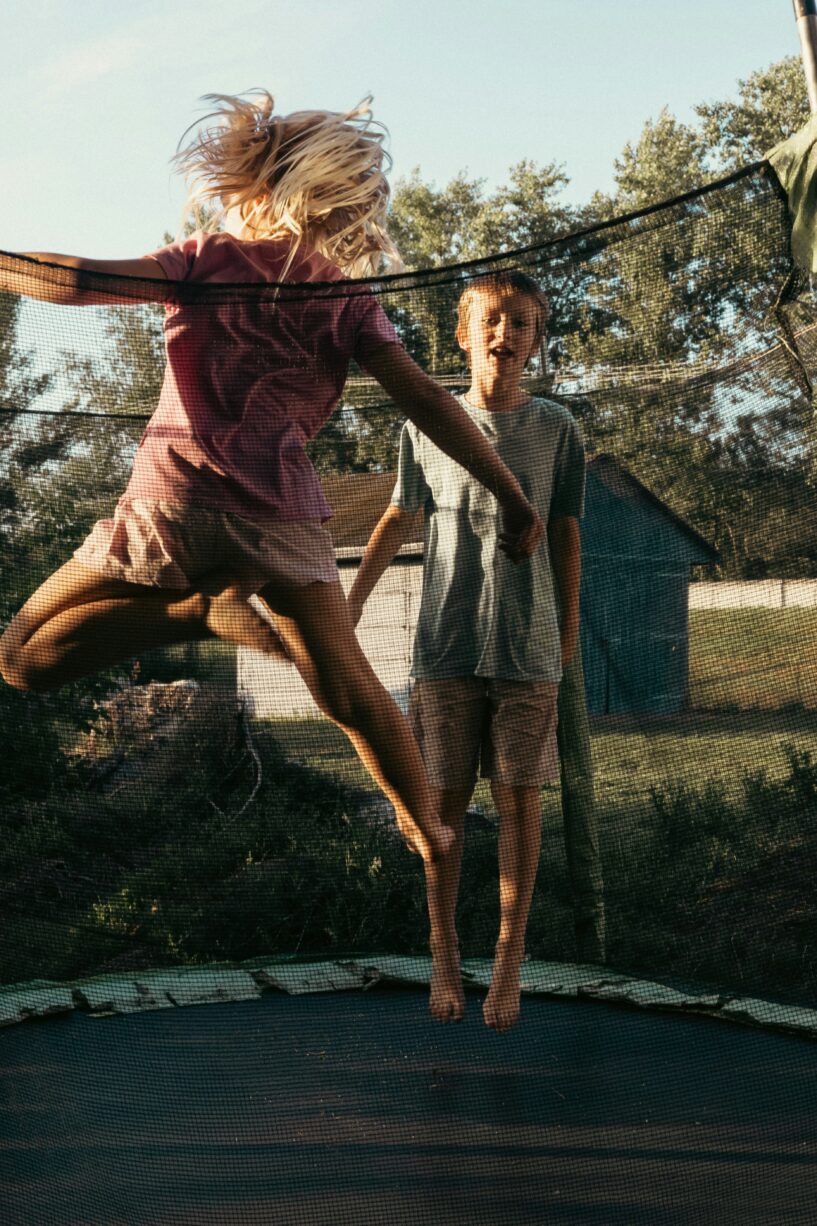
The children noticed the hole one day when they went out after school to jump on the trampoline. As they bounced up and down on the unlevel surface they drifted in the direction of the hole and they had to adjust their jumps to compensate. It seemed to him, viewing them from above as if they were moving figures within a diorama, that the hole was drawing them towards it. After a while, the children stopped jumping and stepped off the trampoline and went over and looked down at the hole. They said something to each other and the girl shook her head. The boy then backed off and took a running jump across the hole. He made the leap and then turned around and jumped across the hole again. The girl then did the same. The grandfather remembered when he was a child and he would play like this with the kids in his neighborhood after school and on Saturdays. They would spend hours outdoors, away from their parents roving about the neighborhood exploring and playing games and running about. The children jumped across the hole several more times and then the boy sat on the ground and lowered himself into the hole. The girl seemed to be afraid at first, but then she dropped herself down into the hole with her brother. All the grandfather could now see were their necks and heads. The children stood there for a few minutes peering at the world from ground level. Occasionally one of them would dip their head down to look at the bottom of the hole, and disappear from his view.
He then heard his daughter yell something out the kitchen window to the children and he saw her rush from the deck into the back yard. Today was the day that she worked from home.
“Get out of there,” she yelled at the children.
The children turned at her voice and climbed out of the hole. The girl had difficulty getting out and his daughter reached down and pulled her by the arms to the surface.
“What are you doing?” his daughter asked the children.
“We were playing,” the girl said.
The boy didn’t say anything, but kicked a little dirt over the edge of the hole.
He then watched his daughter and the children peer down into the hole together. There was something tragic about them looking down like they were. As if they were praying in sadness after a cemetery burial.
“Stay away from it,” she said to the children. “It could be dangerous. And certainly do not get into it again. Only play in the front yard until we get this fixed.”
She stood there for a minute looking down at the hole while the children ran inside to get themselves snacks. She picked up a plastic baseball bat off the ground and poked it around the hole. She seemed stuck there in her back yard, a lone figure holding a child’s faded red baseball bat by her side, and didn’t move for several minutes. She then dropped the plastic bat onto the ground and turned to return inside the house.
The grandfather found it difficult living with his daughter and her family, and he knew that his son-in-law was unhappy with his presence in the house. He and his son-in-law hardly spoke to each other, and when they did, the grandfather felt that his son-in-law quickly looked away from him as if there were something more interesting in the distance, or he began peering down at his phone, his attention willfully transferred to the device. His daughter had convinced him to move in with them after he had been injured in a car accident that the police had determined was his fault. He had rear-ended another car at a traffic light, the insurance company had declared via certified mail that his car was a total loss, and it was decided that he shouldn’t drive anymore. The house that he had lived in for over forty years, that his daughter had grown up in, and his wife had died in, was quickly sold.
During the four days of the week that his daughter was at work, he watched the children for several hours after school once the bus dropped them off at the corner. His daughter had given him instructions that the children should have limited time on their phones and should read or work on their homework when they came home. He thought that she was too strict, and he let the children do as they wished as long as they completed a little of their homework to show his daughter later. For part of their snack he had a container of candy that he let them choose a piece from each day that his daughter didn’t know about.
He spent much of his other time in his upstairs room at the end of the hall, reading or watching television or looking out the window at the birds on the feeder. Occasionally while the children were at school, he would walk around the neighborhood when the sun was out, but the house was located on a cul-de-sac that connected to a main street without sidewalks, and any walk he took was restricted to the cul-de-sac. And there was never anyone on the sidewalks or out in their yards for him to talk to, just the occasional lawn crew focused on their work and quickly loading up their truck and moving on to the next property. Sometimes people would wave to him from their cars as they drove past him and pulled into their garages further up the street although he didn’t know who they were. He missed living in his own house and his old neighborhood where he knew many of the people that lived on his street.
At dinner, his son-in-law appeared harassed as if problems at his job were bothering him and preventing him from thinking of anything else. He hacked at his pork chop and swallowed it quickly and looked like he wanted to hurry off to his home office and begin furiously typing an email. His son-in-law, who was successful in his work, often missed dinner due to his job. The grandfather knew that his daughter didn’t like this, and that she wished her husband was home more often to spend time with her and the children. The grandfather looked over at the two children and made a face at them and they laughed. His daughter briefly looked over at them. He then remembered something that his father had told him about grandparents and grandchildren. “The reason they get along so well is that they have a common enemy,” his father, now dead for many years, had said.
After the children laughed, there was a silence over the table while the family ate, each focused on the plate before them and their own thoughts. The children completed their meals and were allowed to go into the family room and use their phones before bedtime. His daughter finished her half glass of wine and put the glass down. It made a sharp noise on the table. She appeared tired to him, and he noticed that the lines at the corners of her mouth seemed to have elongated and deepened like water-carved canals.
“There’s a strange hole in the backyard,” his daughter said to her husband. “Like a cavity in the ground that suddenly appeared. I don’t know what it is.”
“A hole?” his son-in-law said. He reached for the salad bowl. “It just appeared in the backyard?”
“Yes. By the trampoline.”
“Strange.”
He didn’t appear that interested as he placed salad on his plate.
“It is. Could you fill it in this weekend? I don’t want anyone to fall in and hurt themselves.”
“It’s that large?”
“Maybe.”
“You’re sure?”
“Of course, I’m sure. I just looked at it. You don’t believe me?”
“I believe you.”
After dinner, the grandfather returned upstairs to his bedroom and watched his son-in-law stand in the back yard, the night beginning to weigh around him, his shadow long and finger-like from the yellowed porch lights. His son-in-law looked down at the hole, a beer firmly held in his hand, and he stood there for several moments as if mesmerized by the hole’s presence. He then put down the can of beer on the ground and dragged the trampoline away from the hole and left it deeper in the yard near a dwarf spruce tree. He returned to his beer, drank more of it, and then looked down at the hole from another side. He turned on the flashlight on his phone and used it to peer down into the hole, considering it further. The grandfather wondered what his son-in-law made of it. What did he see there? Did he find its presence strange? Did he wonder what caused it, or did his curiosity not even extend that short distance? His son-in-law then finished his beer, looked down into the hole one last time, and pitched the empty beer can into the hole. The grandfather was bothered by this action of his son-in-law’s. It seemed disrespectful and thoughtless in some way. Who littered in their own back yard?
The next morning the grandfather woke early before the sun had risen. He couldn’t remember the specifics, but he had dreamt of the hole during the night. It had taken on its own particular existence—it was now a singular object apart from its surroundings. Shadowy images edged across his mind as he attempted to recall them, and in the dreams the hole was not a danger to them, but something elemental and without thought, something that was simply there and required their respect. It had no interest in them or conception of them. When he left his bed and looked out the window, the back yard remained dark and tranquil, although there was a smear of dark purple on the horizon and he could hear a small flock of foraging sparrows deeper in the yard. He could tell that the hole had grown considerably in size overnight. It was wider and deeper he thought, although it was difficult to estimate the increase in the darkness. He opened his pill organizer for that day and placed the three pills there into his mouth: the two high blood pressure medications and the cholesterol medication, and swallowed them with a glass of water. He sat down by the window and waited for the sun to rise.
They all stood in the yard, the entire family in a single line, his son-in-law in his shirt and tie, his daughter with a worried pinched-up face, the children quiet and unsure, the hole before them like a drained lake. It appeared to be at least ten feet deep at this point, and there was still no indication as to its cause. The grandfather had a sudden inclination to push one of them into it, that perhaps the hole required some sort of sacrifice. He let the thought pass, and became ashamed of himself for thinking of something so awful. But then they all took a step backwards together away from the hole, and he wondered if they had similar thoughts.
“We need to call someone,” his daughter said. “Why is this happening?”
“I’ll call the town as soon as I get to work,” his son-in-law said. “See if they know anything or can send someone out to look at it.”
“It’s getting closer to the house,” his daughter said. “Stay out of the back yard,” she said to the children.
That night the grandfather woke and looked out the window at the hole. He saw his son-in-law there, beerless, standing before it, apparently deep in consideration. Perhaps there was some poetry in the man after all, he thought.
“I don’t know,” he heard the town engineer say. “Nothing like this has happened here before. Not that I can remember at least.”
The engineer and his son-in-law and daughter were standing before the hole. The engineer shook his head which moved with an off-axis wobble, and he then turned and looked at the house and studied it for a moment.
“Perhaps something with the groundwater or some sort of seismic activity below, or there’s a hollow space. Was this property built on fill? That could do it.”
“I don’t think so,” his son-in-law said.
“It’s getting close to the house,” his daughter said.
“Yes. You might want to have some suitcases ready in case it gets larger.”
“Really?”
“Is there anything we can do?”
“Let me have the state geologist come by and look. I don’t know what to tell you. It could get bigger though.”
The town engineer left them with his card and walked back to his truck.
“He was useless,” his son-in-law said. “Typical.”
“Can’t we simply fill it in?” his daughter said.
The grandfather looked out the window into the back yard and saw the children playing some sort of game near the hole. His daughter and son-in-law were both at work, and he was supposed to be watching the children. They had been downstairs watching television, and he hadn’t heard them go outside. The children had made a small pile of sticks and branches about twenty feet away from the hole. They took turns in this game, where one of them carried several stick with their eyes closed, and the other guided them toward the hole as if they were blind or in need of assistance. When they reached the edge of the hole, the child with their eyes closed and holding the sticks would toss the sticks into the hole one after another as if completing some sort of ritual. The other child would then guide them back to the pile of sticks where they would change roles and repeat the process. He found it fascinating to watch them and wondered how they had come up with the game. He remembered doing such things when he was a child himself. When his daughter returned home, he didn’t say anything to her.
That night he saw his daughter in the back yard with a glass of wine, looking down into the hole.
“Shit,” he thought he heard her quietly say.
She stayed there for a long time before finishing her wine and returning inside.
By the next morning the hole was larger still, and the grandfather’s original excitement began to waver, and then subside, and he began to become somewhat frightened by what he was seeing in the backyard. The hole began to seem malicious to him, as if it had its own life-force and unknown agenda. While he took his daily pills, one following the previous, he considered the situation. Had he or the family done something to unleash this? Was the hole coming for him specifically? Was there something they needed to do to stop it? Some behavior that they needed to change? He knew that these ideas were ridiculous and primitive ideas, and that the world didn’t work that way, but the thoughts remained in his mind, crouched in a corner with a leering eye, and ready to spring forth again and take center stage. The hole was approaching the house and was now only a few feet away from the back deck. It had already swallowed several bushes and part of a flower bed. Its growth seemed so unrelenting and careless and suddenly he was afraid that one night it would engulf all of them, that the entire house would simply slide in and disappear, taking all of them with it, pulling them deep into the dank earth. When he went downstairs for breakfast, he wasn’t very hungry and only ate a small piece of toast.
That afternoon, he thought the children were playing on their phones in the kitchen or the family room. He was upstairs in his room paging through a book when he heard a yelling from the backyard. Standing up and looking out the window he didn’t see the children, but the yelling continued and seemed to be coming from inside the hole. He rushed downstairs and into the back yard as quickly as he was able to. He was old and couldn’t move particularly fast and he almost fell from the deck stairs. At the edge of the hole, he stopped and looked down into it, and saw both children at the bottom. They appeared dazed and afraid and their faces were black with the dirt from the hole and they were unable to climb back out as the slope of the hole was too steep. The girl was crying.
“Help us!” the boy yelled to him.
“I’ll get help,” he said down to them. He ran inside and dialed 911 and told the operator what had happened.
He returned outside to them and waited for someone to show up.
“Someone’s coming,” he said.
The children looked miserable at the bottom of the hole and dirt from the sides of the hole slid down and rained upon them.
“We were playing and fell in,” the girl said. Her voice sounded peculiar.
When the fire engines and the rescue squad and the police arrived, they all burst into the back yard with shouts and large movements of men and equipment. The grandfather waved his arms about like a fool and pointed at the hole. The firemen quickly lowered a ladder into the hole and two of them went down into it. Each of the firemen picked up a child and carried them up the ladder. When they were out of the hole, the grandfather went over and hugged the children, and they felt small to him and smelt like the earth. His daughter arrived while the children were being examined by the EMTs and she rushed to them and gathered both of them to her and cried as she held them. She looked over at her father and shook her head. Later, after dinner, she took him aside and yelled at him, telling him that she wasn’t surprised that something like this had happened as he had always been a terrible, selfish person. The grandfather went to bed, feeling awful, wondering if he was going to have to find another place to live.
Mid-morning, he heard a beeping noise and watched a dump truck back up toward the hole. Its back slowly lifted up and the rear door opened and a load of dirt poured out of the truck and into the hole. It didn’t seem to have much effect. A cloud of dust arose and hovered over the hole. Later, throughout the day, more dump trucks arrived, fourteen more he counted, and dumped their loads of dirt into the hole, mostly filling it.
For several days after that, the hole remained stable, and it didn’t appear as if it were continuing to grow. Perhaps the truckloads of dirt had solved the problem. The state geologist drove out and looked at it. He walked with a cane and grimaced with each step.
“Just had my hip done,” he said.
He placed his foot at the edge of where the hole had been. The soil, soft, compacted from his weight.
“Well.”
He took some photographs and measured the length and width of the area where the hole had been located.
“My guess is something to do with the groundwater. Perhaps something dried up or shifted down below. I haven’t seen anything like it around here before. It hasn’t grown anymore?”
“No.”
“Well, hopefully that’s it then.”
The geologist stood looking at the spot for a minute longer, and then limped back to his car.
The hole continued to remain stable, and his son-in-law had two more loads of dirt trucked in and compacted on top of the hole. The ground was then leveled by a group of shouting men who raked the dirt and planted new grass seed. With the hole filled in and thin grass seedlings beginning to sprout, the family relaxed and felt that the problem had been fixed, although the children still were not allowed to play in the back yard. The grandfather, however, continued to have dreams about the hole, dreams that he couldn’t specify and that evaded his conscious thought. Every morning when he woke up, he would look out his window to see if the hole had returned.
A month later, the grandfather felt a trembling one night, and not certain whether he was dreaming or awake, he lurched out of his bed and stood up in the darkness, although he already sensed what he would see. He looked out the window into the back yard and watched the hole opening up again, the fresh dirt and new grass spilling downwards and the cavity, now seemingly alive, reappearing as if a giant mouth had emerged out of the earth and was set on devouring everything on the surface. He willed himself not to be afraid and quickly put on some clothing, edged through the sleeping house, and went outside and stood by the hole. He looked down into it, and couldn’t see the bottom in the darkness, but he could sense that it continued to deepen and grow. He could hear and feel it shifting before him. Suddenly, he knew what he had to do. It was simple, very simple. He stepped over the edge and slid down the steep slope of the hole and was pulled to its bottom. Possibly there would be some indication there. It was dark around him, but the earth felt warm and comfortable, and he would lay down there to sleep for a while, and when daylight came perhaps he could find a solution.
Chris Bentley is a New York-based writer and photographer.