


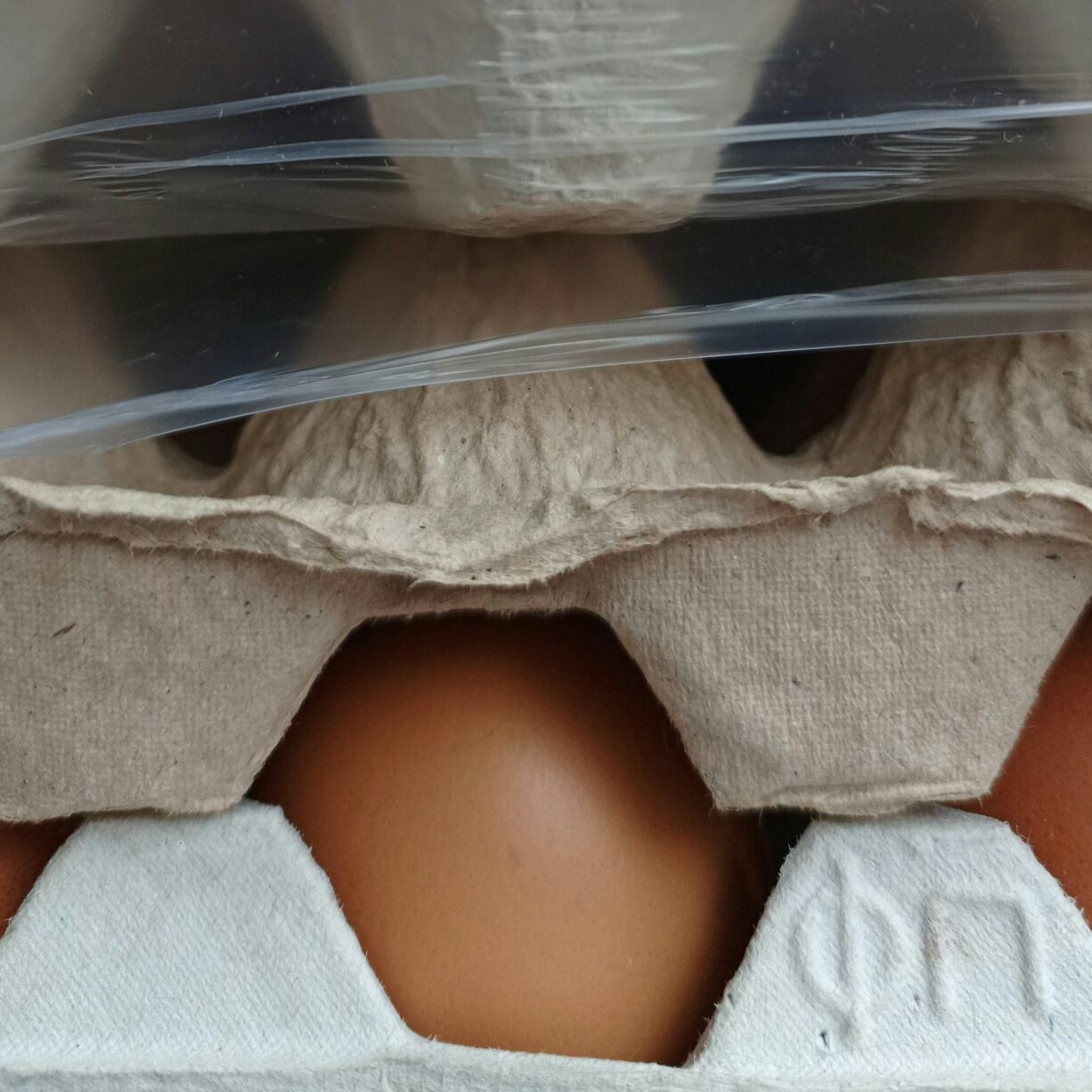
The Cost of Eggs
Sidney Tilghman | Essays
While the rest of the country loses their collective mind, you drive your chicken to the vet.
The country is losing it because the cost of a dozen eggs—caged, conventional, the kind made cheap and cruel—is $7, marching toward $8. Bird flu is in several states. One person had died. Another is sick. The virus rollicks toward dairy cows and meat birds and cats. Cats! An estimated 36 million laying hens are dead.
You are losing it because you’re driving a chicken to the vet.
36 million, the radio chirps. Your chicken is silent.
“Still alive back there?” you ask.
She doesn’t answer.
It’s the kind of number that calls to mind the Holocaust. You grew up in Virginia, in a city scant on Jews but with a Holocaust museum full of elderly docents hurling statistics like sucker punches. Your grade school teacher followed suit and compared the death toll of the Holocaust to the population of the state. How many Virginias, you wonder, are 36 million chickens?
*
In Costa Rica, your neighbor reports, beaches are littered with the bodies of migratory birds. A feathered apocalypse. Little bits of flu flying north.
This is the same neighbor you almost flattened with your car. He had been crossing the road in the night. You had been speeding home, distracted by the rooster bellowing from a crate in your backseat. You thought the near-miss might be a meet-cute. You apologized and blamed the bird.
“Have you ever heard a rooster scream?” you ask your neighbor.
Why do you always have poultry in your car? you ask yourself.
“Littered,” your neighbor says, returning to Costa Rica as he cracks open a beer, by now his almost-death forgotten. Turns out he has a girlfriend.
*
Your chicken, a hen, the one you are driving to the vet, does not have the flu. Nope. Rather, she is caked in blood and actively bleeding. If you weren’t so worried, it might be funny—this scene with your chicken, the absurdity of something so small containing so much blood. Blood in the shavings, sprayed on the walls of the coop. A little explosion on her perch as if a blood-filled balloon floated up and popped on the roost. Then there’s the hen herself, leaking from an indeterminate wound masked by a reddish-brownish-blackish mat of feathers. It’s hard to tell what is chicken and what is blood. You don’t know the specifics. You don’t know the how or why or what.
You looked around the coop for an opossum or a raccoon—a rat, even—but, apart from the blood, all seemed right. You counted your chickens: five hens plus a rooster. Absent an opossum, you trained your eyes on Raffle (the rooster). “If you did this,” you whispered, “I will kill you.”
Why are you always blaming the rooster?
*
“Blaming the rooster,” a man in a writing workshop repeats. “That dog’ll hunt.”
He doesn’t really say that last part, but you wish he had. (So many opportunities to say something interesting, lost! But isn’t that how it always goes?) Instead, he advises you to follow the thread. We live, after all, in a world full of roosters.
You know he’s thinking rooster-as-metaphor, but you’re thinking rooster-as-concrete-object.
*
The hens were a gift. They arrived on your 31st birthday along with an almond cake and two types of sausage. The friends who gave you the hens also gave you a book about living with hens written by the taller friend’s beloved ex-husband, now deceased. These chickens and their book are, you suspect, the best gift you’ve ever received. Upon arrival, one hen lays an egg the color of moss.
The rooster comes later. He is not a gift but an acquisition. You acquire him after reading an anecdote in the chicken book about a raccoon pulling a young bird through the 1-inch holes in chicken wire, one bite at a time. That night, you check your coop every hour. You hear the ghost screams of hens every time you slip into sleep. A rooster, the book tells you, will help protect a flock against predators. He can’t, of course, kill a raccoon, the book explains, but he will certainly let you know one is there.
So this is how you end up with a rooster almost loose in your car, nearly killing your neighbor as you speed home.
*
But just now it’s blame, not the rooster, that strikes you. The cost of eggs—on the rise for a while now—is blamed for a lot. The outcome of an election. A rash of egg-based crime, mostly theft. A surcharge at Waffle House. Rations in grocery stores reminiscent of the pandemic runs on toilet paper and garlic. Does one person need more than a dozen eggs a day?
You figure, if we tried harder, we could probably blame just about anything on the cost of eggs. Wildfires in Los Angeles. Florida’s vanishing coast. Russia and Ukraine. Gaza. The reemergence of Dr. Phil. This is kind of fun, you think. You wonder, in a moment of whimsy, if you could connect 9/11 to the cost of eggs, picturing a web of ghostly lines and vectors like a Mark Lombardi drawing. (People thought he was a conspiracy theorist whack job. Imagine if he had thrown eggs in there.) But nothing about 9/11, you sternly remind yourself, is whimsical.
If, however, we’re blaming things on the cost of eggs, isn’t that really a roundabout way of blaming hens and not the rooster? “Food is politics,” your boss likes to say.
*
In the car, you turn off the radio and turn on Ravel’s Bolero. The music starts. You worry about your chicken.
*
Right around the time you discovered the blood was also right around the time you were supposed to leave for work. You still go, but not before taking a picture of the carnage and sending it to your chicken friends. Your chicken friends are practical, farmers in their own right. One, the taller one, is a Buddhist; the other, a German. When you named the chickens, the Buddhist frowned and reminded you that a hen is a hen is a hen. Practice detachment. When you sent the picture, the German told you to call the vet. This is not the advice you expected, but you don’t want to kill your hen, so it’s the advice you take.
This is how you end up with a hen in your car, quiet apart from the reedy breathing of a clarinet.
*
You measure time in Boleros the same way a chicken measures sunlight in eggs. The drive to the vet is approximately two Boleros or 29 minutes; an egg is approximately fourteen hours of sun. At the peak of summer, a hen will lay an egg every 25 hours, producing one egg an hour later each day, until she hits nightfall and the cycle starts anew with sunrise. It’s winter now and your hens hardly lay anything at all. When they do manage an egg, it feels like a prize. Quite possibly the best gift you’ve ever received. An expression of sunlight you can hold in your palm.
*
A year before the hens and the rooster and your house and its coop and an election decided by eggs, you go on three dates with a Canadian allergist fresh out of med school. The third date feels an awful lot like treading water, which is funny considering that the second date involved swimming in the Connecticut River. (It was his idea, the swimming, but even so he seemed put down by how easily you cut through the current.)
On the third date, the allergist reveals himself a disciple of Andrew Huberman and 30/30/30, a practice of consuming thirty grams of protein within thirty minutes of waking up followed by thirty minutes of light exercise.
“Usually, I get closer to forty or fifty grams,” he says, motioning to the waiter that we’d have another round. He does not register my shock, my dismay.
“Forty or fifty? What is that? Seven eggs?”
“Oh, no. I usually only have four or five, then a protein muffin and some high protein yogurt or milk.”
Only four or five? High protein milk? You reply how you imagine anyone would in your predicament: “Gosh,” you mumble, “you must spend a fortune on eggs.”
“Not really. They’re only $2.99 a dozen at BJ’s Wholesale.”
Then you say what you would never otherwise except now you’ve gulped down a second negroni in record time. You tell him he is committing an act of violence against the Earth. You ask if he’s ever met a chicken. (Bolero has barely even started.)
The allergist is shocked, dismayed.
Yep, you think. This dog’ll hunt.
*
You have a complicated relationship with your rooster.
For a week after his arrival, all you do is apologize. Apologize and regret. Apologize, regret, and plot his demise. Your chickens seemed happy with a hen house, less so with a harem. You try to knock him away with a broom the first time you see chicken sex. You rejoice when the hens force him into a corner. You name him “Baffle” after a baffler (he has only one job here) and because of his effect on you. You are baffled. The easy rhythms of your home are cast in turmoil.
When you say “Baffle,” everyone hears “Raffle,” so that is who he becomes.
When you sign holiday cards you start with you (a woman), then your dog (a bitch), your cat (also a girl), your hens (hens), and, after much thought and hesitation, Raffle. You add, in parentheses, this distinction and a joke: (A rooster; the only man in my life.) You include the parenthetical on your sister’s card, but not on your parents.’ Definitely not on your grandmother’s. You include it on missives going to friends, but not ones addressed to former colleagues and graduate school advisors. On their cards you insist you are happy: “I am SO happy!” you write.
You do not sign any pet names on the card for your neighbor.
*
The same people who rename your rooster love to tell you rooster horror stories: children mauled, dogs uncoupled from their eyes, fathers and brothers and sons donning hockey gear and wielding shovels for the hand-to-hand combat of retrieving eggs.
The only thing you don’t mind about the rooster is the noise. He never makes his car sounds again. He crows and squawks and chuckles small guttural alarms that send your hens retreating to the coop. Once, he crows in the middle of the night and you rush outside only to find your hens asleep beneath a moon so bright against snow that your rooster is convinced it’s daylight. You fall asleep trying to remember those lines from Shakespeare:
And he will make the face of heaven so fine
That all the world will be in love with night
And pay no worship to the garish sun.
*
It seems you will keep the rooster.
*
On the second round of Bolero, it hits you. You are driving a chicken to the vet. You ask the question that someone at some point (probably your mother) taught you to ask anytime you find yourself with an animal in crisis on the way to the vet: how much are you willing to spend? Maybe it’s the dramatic build of Bolero or that your only points of reference are the vet bills incurred by your dog and your cat and your sister’s horses; perhaps it’s that you love these chickens and have already accepted that they will never—even if the price of eggs quadruples—ever make back what you spend on organic soy-free grain and organic soy-free treats, which is nothing to say for the double batches of millet, quinoa, oatmeal, and popcorn you make for them when it’s cold. (It’s almost always cold.)
$300. That’s the number. It arrives out of the ether as if you knew it all along.
$300, you think, seems fair for the life of your hen.
But then there’s the clarinet again and you picture a faceless veterinarian coming into the lobby and telling you it will cost $480.
This is how you realize you’ll really spend $500—$300 is just what you’ll say up front.
*
Three years before the chickens and two years before the Canadian doctor, you’ll be smack in the middle of what you call the Troubles. Your Troubles involve the pandemic, a cross-country move, a bad break-up that happens twice over and spans a year. You reinvent yourself. You become an English teacher, an art teacher, a farmer. You move to Vermont. You are a farmer. (Well, an assistant farmer.) You work on a farm where you grow vegetables and raise piglets. You drop round bales to cows and sheep in the dead of winter.
When your mobile slaughter guy bails and your meat birds begin to cannibalize, the head farmers do next to nothing. They extend the pasture by a few feet and add a second shelter. They count the days until the new slaughter date the same way you might count the days until a wedding. The farm crew kids begin to bring you dead and dying birds like offerings. At first, you quietly dispatch the still-living, but soon their necks are as thick as your forearms. You take these thick-necked birds with flayed backs and bloodied bodies to the field beneath your compost heaps. The grass is tall and the view is nice and there is almost always a breeze: you think it would probably be an OK place to die. You leave them and their shallow breathing by a white electric pole. You apologize. You pray for a fox. When you return to check an hour later, there is always nothing.
You—you can never tell your farm bosses how much money you’d pay to save a chicken.
*
When you get to the vet, you are horrified to find your chicken has bled through her crate, a cardboard box that once held spinach and has perfect 1-inch circles cut along the sides. You are doubly horrified to feel the heat radiating from the box, but comforted to feel her featherweight shift. A vet tech whisks her away as a receptionist hands you some forms. You fill in your name, your address, your email address, your phone number. You write down the hen’s name, Cowslip, and linger on the line for “Color.” Partridge? Is “partridge” a color? You jot it down even as you feel more and more like an ass. You sign a release forfeiting your right to sue.
A few minutes later, a vet emerges. She is tall and solid and easy to picture elbow-deep in a cow. “Are you You? You of Cowslip?” she asks.
You nod. Yes.
“Good news!” she says. “Your hen is fine.”
Really?
“Really. It looked bad, it did,” the vet says. “And I don’t think you could’ve figured it out safely on your own, but it was just a blood feather.”
She goes on to explain the mechanics of blood feathers, which are really just new feathers that require blood to grow. The feather shaft, which we usually think of as hollow, the vet explains, operates more like an artery. Sometimes, she tells you, a hen can even bleed out if the blood fails to clot or the feathers fail to mat. Cowslip has managed both.
“She must’ve knocked it or pulled it out,” the vet continues, “and once those things break, they bleed like a hose.” The veterinarian sprays the lobby with imaginary blood from her flailing arm.
Like a baptism, you are awash in relief.
They charge you nothing.
*
A few weeks after this drama with your chicken, you stumble across a USDA Veterinarian Indemnity Table for laying hens dated 2024. (You cannot find one for 2025.) If your flock gets wiped out by the flu, the government will pay as follows:
| Table eggs ($/dozen) | 1.52 |
| Chick (0-1 week) | 0.36 |
| Pullet (2-17 weeks) | 4.00 |
| Layer 1st lay (18-45 weeks) | 7.20 |
| Layer 2nd lay (46-65 weeks) | 3.60 |
| Pre-spent hen (66-85 weeks) | 1.80 |
| Molted hen (86-115 weeks) | 1.80 |
| Spent one-cycle hen (86+ weeks) | 0.01 |
| Spent molten hen (116+ weeks) | 0.01 |
When you sheepishly admit to the vet how much you were prepared to spend on your hen, she is dumbstruck: “Nothing, and I mean nothing, I could do for a chicken would cost $300.”
You leave Bolero and your real bottom line unspoken.
She continues: “I would never advise anyone to spend $300 on a chicken.”
*
On the way home, you stop at a grocery store and buy a bag of pre-popped popcorn. In the parking lot, you sit on your tailgate and snack with your hen, passing the popcorn one kernel at a time through the 1-inch holes in her cardboard box. Maybe the flu will skip Vermont.
There’s a farmer on the radio with 19 million layers across five states. He’s talking about avian influenza and the cost of eggs. He eats two of “his own” every morning: over easy when he can sit down for breakfast; hardboiled when he’s on the move. He can’t imagine life without eggs. Without hens. He calls it a devastation, the thought of culling a flock. The distinction between “devastating” and “a devastation” seems important here. “A devastation,” he repeats, almost a whisper, as if caught in reverie at the thought of so many dead.
The radio farmer doesn’t talk about the warehouses where his cage-free birds are kept. He doesn’t talk about the industrial fans that push and pull air and wood dust and particles of chicken shit over the backs of his hens. Absent is the mention of how they lay without the sun. He doesn’t dare hint at how quickly these fans will disperse first the flu and then a killing foam to wipe out whatever remains of his infected flock. He does not cite the USDA Veterinarian Indemnity Table.
19 million, you repeat.
It’s the kind of number that calls to mind the Holocaust. And because you grew up in Virginia, the death toll of the Holocaust lives on in your mind as the population of your home state. You remember that day in grade school, looking around the room, imagining all your classmates gone, your home empty, a whole state’s worth of grocery stores and sidewalks and neighborhoods vacant. How many Virginias are 19 million chickens?
You turn off the radio and turn on Bolero.
Sidney Tilghman is a writer and on-again, off-again farmer based in Vermont. Her recent work has appeared in Vermont Almanac, Prairie Schooner, and on a t-shirt for DIAGRAM.