


Postcards from a Volcano
Philip Metres | Essays
And that night, a cold December in 1989, my father was not in the family room, his usual evening haunt. The outside’s ink had painted the floor-to-ceiling windows, and the scattered stars of neighbor’s lights glittered in the distance. Home from college, I was surprised to find myself alone in the house. Inside, at last, the family room was entirely mine, which meant the stereo was mine, and I, a denizen of this domestic Lilliput, was seeking a song.
^^^
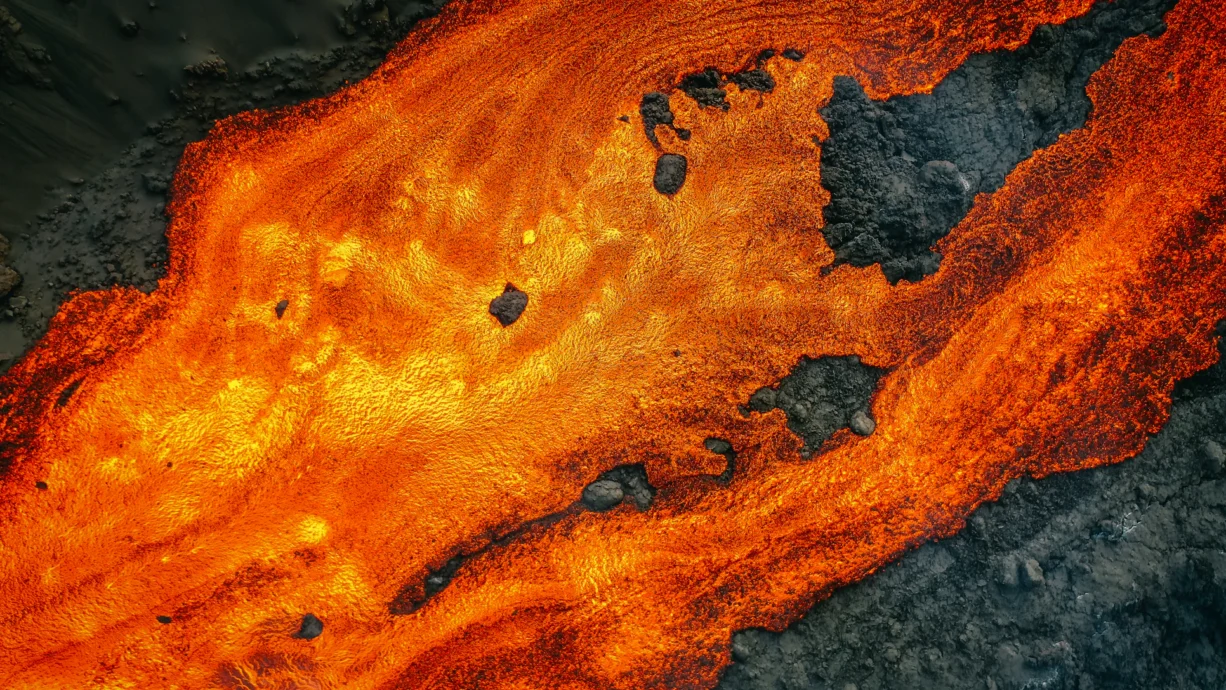
As a child, I was fascinated by volcanoes. I recall seeing, on our boxy television, the Mauna Ulu erupt in Hawai’i. Towers of orange-red flame leaping from the mouth, lava falls higher than Niagara, creating lava flows thousands of feet away, ejecting torrents of rock and smoke. I was in awe. You could be burned alive in that river of fire.
^^^
When I was young, I craned my neck up to see my father. I looked up to him. Or rather, also, I waited, watching in his shadow.
^^^
They would erupt, suddenly, my father’s gloomy moods, his occasional but always surprising lashings-out at family members. They would freeze me in my tracks—or, rather, cast me in ash.
^^^
My father had bought the stereo system in Hong Kong while on leave from Vietnam, and it had blown its way through various apartments and houses in California before it landed in our sleepy bedroom suburb of Chicago. Despite its analogue hulk, a vestige of the war, its massive wooden speakers could blow our eardrums bloody.
^^^
Once, as a child in San Diego, I saw a neighbor’s front yard covered with black volcanic rocks instead of grass. Holding one of the rocks in my hand, with its hard yet airy lightness, its sharp edges, I kept telling myself, I’m holding lava, I’m holding lava.
^^^
When he’d perform a feat of strength around the house, my father would push out his massive chest, saying, “Quinbus Flestrin! Man Mountain!” I had no idea who this Quinbus guy was, but I knew he was big and tough and I was soft, my muscles lean until my later teens.
^^^
Once, as a kid, I was having trouble with Caleb, the neighbor boy. He wouldn’t share. When my father heard, he was furious. He told me, “Let him have it!”
The next time I saw the boy, I said, “Caleb, do you want to have it?”
^^^
It was a game we played in the family room, my sister and brother and I. The floor was lava. We had to hop from sofa to pillow to chair, an archipelago of safe spaces, to stay off the floor. We didn’t want to get burned alive.
^^^
For at least a decade, in the family room, my father would chomp on—and sometimes smoke—one of his collection of wooden pipes, while watching the news. The sweet smoke of his pipe would colonize my nostrils, sending me into sneezing fits and out of the room.
^^^
That year in college, in a survey of English literature, I read Gulliver’s Travels, and a mystery was solved. While on a voyage by sea, Gulliver is caught in a storm. Shipwrecked, he winds up on an island, and falls asleep, only to awaken tied to the ground, surrounded by little people.
^^^
Whenever he was in the house, to me he was titan-sized, crowded out a room with his presence. Never mind that by this time I was his height, or taller. But with his barrel chest and booming voice—and more than that, his voluble presence and emotional friability, I always felt like a little child around him.
^^^
Quinbus Flestrin, it turns out, is the name the Lilliputians give to Gulliver. It literally means “man mountain.” Gulliver is a giant compared with the little people of Lilliput. The people of Lilliput are not merely small, they’re also small minded. When they ask him to destroy and enslave their enemy, the Blesfescu, he refuses, much to their dismay.
^^^
I turned the stereo dial just past 93, to WXRT (officially 93.1, the stereo dial was analogue), the radio station known for new, cool rock and roll, stuff that was almost-edgy but not really, like Steely Dan or Toad the Wet Sprocket, so all the more shocking that, in a fit of mad genius on an evening show that must have been a programming error, Hüsker Dü’s version of “Eight Miles High” began to play.
^^^
While crossing the Alps in 1693, the English writer John Dennis had an experience that caused him to change his mind about the nature of nature. At first, in the early winding ascent of Mount Aiguebellette, Dennis found the going “easie.” But halfway up, things changed.
^^^
Was it even music? It was as if “Highway to Hell” had been played at twice or three times the speed, a similar riff-guitar intro but one that immediately begins to careen, and the growl of a singer—was it even singing?—enters.
^^^
Dennis: “the unusual heighth in which we found our selves, the impending Rock that hung over us, the dreadful Depth of the Precipice, and the Torrent that roar’d at the bottom, gave us such a view as was altogether new and amazing. On the other side of that Torrent, was a Mountain that equall’d ours, about the distance of thirty Yards from us. Its craggy Clifts, which we half discern’d, thro the misty gloom of the Clouds that surrounded them, sometimes gave us a horrid Prospect. And sometimes its face appear’d Smooth and Beautiful as the most even and fruitful Vallies. So different from themselves were the different parts of it: In the very same place Nature was seen Severe and Wanton. In the mean time we walk’d upon the very brink, in a literal sense, of Destruction; one Stumble, and both Life and Carcass had been at once destroy’d. The sense of all this produc’d different motions in me, viz. a delightful Horror, a terrible Joy, and at the same time, that I was infinitely pleas’d, I trembled.”
^^^
Before my father the man-mountain, I bowed, kept my emotions inside, and tried to fit into the family story of immigrant achievement and gain his approval. Once, I shared my high school report card to my father, puffing his pipe while reclined in his family room easy chair. I had six As and one A-.
“What’s this A-?” he said.
I felt a burning shame rise up in me, but no words.
^^^
Dreadful. Precipice. Torrent. Roar’d. New. Amazing. Craggy Cliffs. Misty Gloom. Horrid Prospect. Severe. Wanton. Destruction. Horror. A Terrible Joy. This is the language of sublime experience, where the great heights and inhuman scale of mountain peaks cause terror. Death is a stumble away. And that admixture of feeling, the “delightful horror” and “terrible joy” cause an infinite pleasure and a trembling.
^^^
Adrienne Rich: “It is always what is under pressure in us, especially under pressure in concealment—that explodes in poetry.”
Rich herself, accused of being angry, of being shrill, was angry about being called angry. She was at home in her anger, a Vesuvius at home, as she called her progenitor, Emily Dickinson.
Still, too often, poetry’s explosions are like video of volcanoes erupting, erupting but without sound.
^^^
Even in sports—like during soccer, for instance, where I played defense, conservatively hanging back and taking few risks that might endanger the team, I remember hearing him yelling from the sidelines, “Attack the ball!” he called out. “Why are you hanging back?!”
^^^
But I was myself, often (too much) in my head, afraid to do something (anything?) that might cost the whole team, thinking before acting.
^^^
According to one origin story, the Byrds’ original version of “Eight Miles High” initially was called “Six Miles High,” a reference to traveling by jet, but Roger McGuinn changed it to “eight,” like the Beatles’ “Eight Days a Week”—something outside of the possible. Even sublime. Of course, the Byrds were also experimenting with LSD, and the “high” was doing double duty. Sublimity, after all, is not just “out there,” it’s the meeting of exterior might and interior quailing.
^^^
“Eight Miles High” had been inspired by John Coltrane’s Africa/Brass, itself being inspired by the ragas of Ravi Shankar. Inside every great song is another great song; like Russian dolls, we crack them open, only to discover that they contain another beauty—and therefore, whole worlds—within them, and another, and another.
^^^
His father, like me and my father before me, was named Philip. Born in Lebanon, he’d fled with his family as a baby in exile to Mexico. His father was murdered by bandits in their family store in 1923, before the family fled again to the United States.
He was a hard man, known to thrash his children if they angered him or broke his strict rules.
Or was he a soft man upon whom life dealt blow after blow?
Was he an angry Arab patriarch, or was he a brown man in a white world, simply trying to protect his children from the judgment and hate of others?
^^^
My fear of my father was not just fear, exactly.
Or rather, it grew, like a volcano’s beehive spatter chimney, spires of spatters on the surface of a lava fill, a monstrous ashen shell around my anger and pain, a suffering body, a flesh that kept growing even though the shell did not. Like a human kettle with the spout stoppered shut, my slow boil had nowhere to go.
^^^
What is a volcano but an eruption onto the earth of what has always been burning in its heart?
^^^
Just the other day, I was preparing to send my father’s letter tapes that he recorded during his time in Vietnam. He recorded them on three-inch tape reels and mailed them to his family in Brooklyn. As I opened one of the boxes, dated February 1, 1968, a sliver of a postcard tumbled out. It read: “Dear Mom and Dad, fighting is over in Saigon. Everything is quieted down. All’s ok with me. Love, Phil.” He’d somehow survived the Tet Offensive—one of the turning points of the war. The postcard says everything and nothing. He had no language to describe the indescribable.
^^^
I wonder, now: was I also a terror, a terror to my father? First born, less than a year into married life, two years after the war—could I have been the too-much-too-soon abyss whose tidal hungers and stormy cries threatened to capsize the delicate craft of a new life?
^^^
There are moments when the world terrifies me. When its sheer massive otherness—whether on a mountain or braving hard seas—that I feel my utter smallness. Looking over the edge of a cliff on Inis Mor in the west of Ireland, my whole body seizes with terror, becomes a bell ringing with a sound only I can hear, but drowns out every thought. I become a child. But rather than being only frightened, something else grows in me. A feeling of awe.
^^^
In A Philosophical Enquiry into the Origin of Our Ideas of the Sublime and Beautiful, Edmund Burke delineates the difference between classical ideas of beauty and sublimity. If Greek notions of beauty involved reason, proportionality, and light, inducing feelings of pleasure, then the sublime was almost its shadow-opposite—a realm of experience ruled by the irrational, disproportionate, and darkness, horror, and awe. Sublimity threatens to destroy us. We may find those moments of encounter with radical otherness to be traumatic in the extreme. Perhaps war, torture, and other forms of abuse are forms of radical otherness imposing themselves on us in ways that overwhelm the mind and body, violating the boundaries of flesh and spirit?
^^^
This is not an essay about a bad dad. No, my father loved me, loved me with a tenderness that was both fierce and close. It was the kind of love I wanted to give to my own children.
Perhaps too close? But like a caress of the neck when I was in the passenger seat and he was driving, I often felt captive to it. A chain I wanted to throw off.
It’s safer to say I did not know what boundaries were. That he was not predictable. He could explode—
I would place my hand to remove his hand, in that teenagerly way, to say that my body was my body.
But was it?
^^^
Do you remember, I ask my mom while writing this essay, that as a child I was fascinated with volcanoes?
Well, you lived with one, she replied.
^^^
Burke notes that a little bit of distance makes the difference: “When danger or pain press too nearly, they are incapable of giving any delight, and are simply terrible; but at certain distances, and with certain modifications, they may be, and they are delightful, as we every day experience.” A volcano erupts on television, and it’s almost beautiful. Those who run from its smoke and fire feel otherwise.
Where our brains break, and language fails, in the crags and crevices of experience, something echoes. That breathing room between the us that we know and the overwhelming that we do not yet know and cannot perceive the ends of.
This is the opening of art.
^^^
I’ve been trying to write about Hüsker’s version of “Eight Miles High” ever since I heard it. These lines, from my college poetry thesis, written over thirty years ago, try to capture it:
Together they sit. Looking out. A window.
A world. Another show
of souls in stark light, the words reduced
to a baby’s cry, and now this,
the pain there is
in silence.
^^^
But it’s too formal. It’s the description but not the feeling. It’s what Adrienne Rich said about her early poem, “Aunt Jennifer’s Tigers”: “Aunt Jennifer was a person as distinct from myself as possible – distanced by the formalism of the poem, by its objective, observant tone…formalism was a part of the strategy – like asbestos gloves, it allowed me to handle materials I couldn’t pick up bare-handed.”
Yes, we need distance, but too much distance and all we have is description. It’s a postcard of a volcano, when the truth calls for a livestream from the volcano’s edge. Beauty on the abyss of terror.
^^^
Back then, I saw my father always as too huge and too close, so that I could not tell where he ended and I began or as through a dark window, mirroring us and the night beyond. Whose looming gloom—but not just the gloom, also a love to large that it crowds the room where you two usually sit, watching the fire of the news in the corner.
^^^
Eight miles high, and when you touch down
You’ll find that it’s stranger than known
^^^
The song’s lyrics, it turns out, are not really about flying high, but what happens when you descend back to earth. How the whole world suddenly seems strange, unknown. Everything is other: the street signs no longer are street signs. And where is home, among these strange signs.
Ominously, the singer intones “Nowhere is there warmth to be found / Among those afraid of losing their ground.” Fear of change, fear of losing one’s connection, actually unhouses us, throws us out. Sublimity, perhaps, can destroy our small egos and open us into something majestic.
^^^
That night, on my father’s stereo, it was Hüsker Dü. They were named after a Dutch board game that tests memory. It means, “Do You Remember?” We used to play it in the living room, trying to hold onto the images beneath the cards once revealed, then turned over again.
Do you remember, Dad, playing that game? Children are always better than adults at remembering, at remembering what was once uncovered and then covered again.
^^^
The truth is that I could not make out a single lyric when Hüsker’s lead singer Bob Mould was singing. No, after “eight miles high, and when you touch down / you’ll find it,” it was outside language, impure utterance, a song closer to noise than I’d ever heard before. Moments of clarity detonated, drowned in feeling.
^^^
Rock critic Michael Azerrad calls the Hüsker cover “Quite simply… one of the most powerful pieces of rock music ever recorded.”
He understates the case.
^^^
At the two-minute mark, the song goes into a cry that lasts nearly 20 seconds, pauses into instrumental for thirty seconds, and then goes back into this scream-singing.
Not a song. It is a brawl, an open-heart surgery done without anesthetic performed on the surgeon himself.
He bawls it like a baby, a bewailing that shakes, a caterwaul of a howl, a keening over an open grave, a human squall.
^^^
They had recorded the entirety of Zen Arcade in one forty-hour burst, fueled by coffee mixed with crystal meth, over a used reel recording tape that once featured a TV performance by the Bee Gees.
Zen Arcade was a concept album about a boy who leaves his broken home to venture forth into the world—but he keeps carrying that broken home inside him. The sorrow, the rage, the pain is the through-line in a double-album that took me weeks to listen all the way through. And even then, it was too much. Much too much.
^^^
Bob Mould, the co-lead singer and guitarist, writes that their version of “Eight Miles High” was a warmup to the recording. It was the Ur text, the eruption that led to the rest. Bob Mould would write in his memoir thirty years later that “my vocal performance was beyond intense though. It was straight from the primal core—like the wailing of an abandoned child, or a stricken lone coyote howling on the side of the road.”
His description is just another postcard of the volcano.
^^^
One writer-reviewer, Jim Connelly, transcribes part of the ending in this way:
Waaaaaaaahaaaa!!!
Whaaaahaaaaaaaaaaaaa!!!
Ahhhhhhh haaaaahhhha!!!
Whaaaah haaaaaaaaaa!!
Ahhhhhaaaaaaaa!!!!
This, too, is a mere mockingbird attempt at mimicking what he hears, what I heard in the family room, coming from the stereo.
^^^
I wish I could have cried like that then.
^^^
My father was a therapist, and no doubt he would have read Arthur Janov’s The Primal Scream, published in 1970, the year I was born. Janov tells the story of Danny Wilson’s emotional catharsis during therapy, when he began to access deep childhood wounds. Janov invited him to call for his mommy and daddy, and Wilson began to convulse all over.
^^^
Janov: “It is at once a scream from the pain and a liberating event where the person’s defense system is dramatically opened up. It results from the pressure of holding the real self back, possibly for decades.”
The primal scream method would later be tried and touted by the likes of John Lennon and Mick Jagger.
^^^
Perhaps Randall Jarrell comes close to it when he writes, in a dramatic monologue of someone having traveled to the Arctic:
Here where North, the night, the berg of death
Crowd me out of the ignorant darkness,
I see at last that all the knowledge
I wrung from the darkness—that the darkness flung me—
Is worthless as ignorance: nothing comes from nothing,
The darkness from the darkness. Pain comes from the darkness
And we call it wisdom. It is pain.
^^^
Is it possible for there to be no physical violence, yet violence nonetheless?
^^^
In 1815, Mount Tambor erupted in Indonesia. It wasn’t the lava, but its ash that swirled across the globe, the great clouds that cast themselves over the atmosphere, causing global climate change, floods, famine, and snow in July 1816 in New England. It was during that year, a year without a summer, that Mary Shelley wrote Frankenstein, about the ambitious creator, Dr. Frankenstein, who found his creature, the son he made, hideous. The opposite of beauty. Something to be feared, hated.
^^^
In 1970, as the volcano in Hawai’i continued to spew in 1970, the primal scream was becoming widely known, and the Kent State and Jackson State protests of the Vietnam War transmogrified into mass killings of students, my father was in graduate school, now with my mom and a baby (me)—learning from the likes of Rollo May, Abraham Maslow, and Victor Frankl.
^^^
Rollo May: “Good art wounds as well as delights. It must, because our defenses against the truth are wound so tightly around us. But as art chips away at our defenses, it also opens us to healing potentialities that transcend intellectual games and ego-preserving strategies.”
^^^
In the process of writing, a flicker of a vague memory passes through me. That, one night at dinner, my father was so furious at my sister that he grabbed his knife, as if readying to stab. I’m not sure it even happened, so I call my sister and ask her.
Oh, it happened, she says. To this day, I have a fear of knives.
^^^
My dad took an independent study with Frankl, exploring the effects of on families who had members who were prisoners of war or missing in action. It would become his dissertation.
Is it possible to say that my father did not entirely return from the war, even after he returned?
It took Odysseus ten years to get home.
^^^
Frankl, he tells me, was a kind man. Wrote his first book on bits of stolen toilet paper, his first writings on logotherapy. He’d sewed his writings into his coat, but lice infestation caused the Nazis to burn all their clothes.
One bitter winter, on the way to the work mines, he was so weak from lack of food that he kept falling. Finally, he fell and couldn’t get up. So he lay there and imagined himself five or ten years, as a professor, talking about this experience—somehow, that projection into the future gave him the strength to get up and keep going.
Frankl created a little space in his imagination, an alcove among the crags and crevices of Hell.
How? How?
^^^
And where was Frankl’s anger? His rage at the Nazis? “Between stimulus and response,” he wrote, “there is a space. In that space is our power to choose our response.”
What is that space?
^^^
My father remembers how Frankl and his wife loved to eat at International House of Pancakes. Every table had at least two kinds of syrup. Its blue extreme-angled roof looked like an abstract idea of a mountain.
Pleasure ensues, my father remembered Frankl saying in lectures. It cannot be pursued. x
But maybe pancakes help.
^^^
Man mountain, mind mountains.
Gerard Manley Hopkins, in the throes of melancholia, wrote through a period of such self-torment that the sublime became an interior landscape:
O the mind, mind has mountains; cliffs of fall
Frightful, sheer, no-man-fathomed. Hold them cheap
May who ne’er hung there. Nor does long our small
Durance deal with that steep or deep. Here! creep,
Wretch, under a comfort serves in a whirlwind: all
Life death does end and each day dies with sleep.
Was that what it was? A kind of sublimity of depression that exploded into anger?
Those fall frightful mountains are in me. What am I doing in them? What am I doing with them?
^^^
I don’t know what Bob Mould was working through when he sang “Eight Miles High.” In his memoir, Mould reports that his father drank too much, was prone to dark moods, and violent with—or threatened violence against—his mother. He was also a young gay man still in the closet. But he was the golden child at home.
But Mould writes, “The word that always dogs me is catharsis…. It’s not necessarily that I feel better after creating or performing, but simply that I feel.”
^^^
“Eight Miles High” is the inarticulate babble that becomes another Hüsker song, “Whatever,” another Zen Arcade song that torched me when I first heard it. It’s in the lyrics, directly:
Mom and dad, I’m sorry
Mom and dad, don’t worry
I’m not the son you wanted but what could you expect?
I’ve made my world of happiness to combat your neglect
But it’s also in how they’re sung. How a child who knows he’s loved but not the way he wanted, a love with eruptions, and clouds, interminable clouds, and lava.
The chorus is one of external obedience and inner torment, sung increasingly as a scream:
Whatever you want
Whatever you do
Wherever you go
Whatever you say
^^^
But I was also in awe of my father’s honesty. He simply did not hold anything back. He ate voraciously, he belched majestically, he drank with gusto, he did not hide his passion for my mother, pulling her close, nor his appreciation of any beautiful woman, he sang loudest at church, wherever he went he was the most voluble, the least afraid, the least ashamed. I held him higher than human. I made him into myth. The one who doesn’t give a fuck. Doesn’t hide.
I wished I could be like that. Like Bob Mould, who sings of crying, who sings crying, and does not hide as he turns himself inside out.
But was my awe just a form of fawning?
I did not want to become like him, not entirely. He was too much of everything.
^^^
I heard a poet say yesterday that when he prays, he doesn’t care if he gets the words right. It’s not about getting the words right. For, he noted, scripture tells us, “Now in the same way the Spirit also helps our weakness; for we do not know what to pray for as we should, but the Spirit Himself intercedes for us with groanings too deep for words…”
^^^
In our family room, listening to “Eight Miles High,” home from college, I thought the family room was about to collapse into the earth or that I was about to vault into space.
^^^
I felt.
I felt.
^^^
In that abyss, in that family room that night, where was my father? It didn’t matter. In that torrent, I was alone. I was inside the music, eight miles high.
^^^
And then it ended. I was there, still, myself, some tectonic plates pushing up suddenly inside me.
^^^
Years and miles away, I see myself there, suddenly seeing a path winding through mountains.
^^^
These days, my father has a hard time walking, two balky knees worn out from a lifetime of running. His balance is bad. I sometimes hold his hand when we walk outside, around my childhood block. Like holding a child’s hand now, my holding him. He’s sorry for how he was, back there. Has wept. Has apologized. I have forgiven him. Many times. An eldest child fathers his father.
But he’s still there somewhere inside me, the father that loomed above me.
^^^
How do I access my power, the whole volcano, without destroying myself, other people, the whole world?
^^^
A volcano is a rupture in the crust of the earth. Back then, I wondered if it tapped to the earth’s very core. That the volcano was some kind of tunnel to the gates of hell. No, my daughter the geology major explains to me, the magma chamber is situated between the crust and the core.
She corrects me gracefully, without anxiety. She remembers me really losing my temper only once—the only time I remember—when she decided to “yank my chain,” in her words, and refuse to get out of the tub. I threw a plastic floaty toy as hard as I could across the bathroom and erupted a flood of curses.
^^^
Which is to say that, within me always, is the volcano of my father.
No, inside me is my volcano. Yes, part of an archipelago of volcanoes, but my own.
^^^
When my father leaves a voice message for my daughter, he castigates her for not calling him back, saying he’s worried about her. She, who has been sick for two years, listens to the messages and bursts into tears.
I’m furious. I’m gonna kick his ass, I say. I leave a curt text that I want to talk with him.
^^^
He calls. Are you angry with me, he says.
Yes, I say. Yes. Don’t talk to my daughter that way.
I feel like someone else when I say it.
^^^
My own. Its mouth is the shape of my voice, a black hole without words, an O that is like a baby’s cry to a pain with no name and no balm, and an O that is in awe of this indescribable life, a maw that yawns so wide it can turn the whole sky into the reddest red fire.
Philip Metres is the author of thirteen books, including Dispatches from the Land of Erasure (2025), Fugitive/Refuge, and Sand Opera. His work has garnered fellowships from the Guggenheim Foundation and the NEA, and has received the William Carlos Williams Award, the Adrienne Rich Award, three Arab American Book Awards, and a Pushcart Prize. He is professor of English and director of the Peace, Justice, and Human Rights program at John Carroll University and Core Faculty at Vermont College of Fine Arts MFA.