


Fatally Online: A Review of Mark Doten’s Whites
November 18, 2025 | blog, book reviews, news
Review by Carson Oliver, MFA ’26
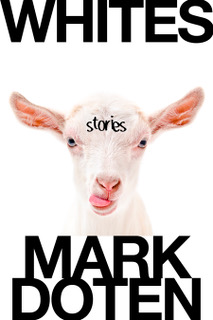
Whites
160 pp. Graywolf. $17.00
Mark Doten’s first story collection, Whites, is explosive, reckless, and abrasive. Firmly situated in the era of the internet, COVID, and Trump, this collection epitomizes the confusion of modern times.
While Don DeLillo’s White Noise tackled the advent of TV with a deft irony, Whites feels more urgent and arguably, more terrifying. If DeLillo wrote for a generation numbed by media, Doten writes for a generation that is radicalized and empowered by it. They pull from the darkest places of the internet: Twitter, dark web message boards, and alt-right podcasts. Doten also makes the very bold choice to write these stories in the first person or in a very close third person. The book has a way of channeling misinformation and delusion through an assortment of fever dream monologues, giving a voice to narrators most fiction wouldn’t dare to embody. January 6th rioters, COVID deniers, and Elon Musk himself all feature in this disturbing and exhilarating book.
Doten’s singular style is perhaps best exemplified in “Banana Bunch Challenge.” The story opens with a series of 4chan posts from a gay white nationalist. These posts describe the 4chan user killing his father, stepmother, and aunt in grisly detail, making ample use of 4chan slang and slurs. Then, after the same user attempts to shoot up a nearby high school, the perspective shifts to a teenage survivor of the shooting. After the new narrator and his friend serendipitously subdue the shooter, the kids expect to be treated as heroes, but instead, the teens are denounced online. In response, they attempt to regain fame by adopting pro-gun views and later, by calling a SWAT team on themselves, which fails miserably. In Whites, even victims are rarely vindicated.
Doten ridicules his narrators indirectly, but also gives space for their voice, at times allowing their inner life to be oddly gorgeous. In “Pray for Q,” a mother who subscribes to Replacement Theory believes that her son has been replaced with a body double. The mother then kills her son and puts his body in her trunk to dispose of in a nearby field. As she is driving, she describes her surroundings: “The taillights are so vivid, the way they’re interweaving with the lights of oncoming traffic—it’s almost legible, you can almost find meaning in the flow of light.” This passage reveals the mother’s ability to find reasoning in chaos. Amidst her delusion, she still finds a perverted logic by which to justify her beliefs and actions. Through this character, Doten unearths an alien beauty from the crevices of an extreme micro-culture.
Doten’s narrators are certainly misguided, but they also possess a powerful, dangerous level of conviction. Readers get a sense that these characters are crumbling while telling their stories. Words and sometimes whole phrases are obsessively repeated. Narrators misremember and self-correct. Doten perfectly captures the nature of the chronically online, and he recognizes that how they think is reflective of how they speak. His stories are so powerful because they aren’t just caricatures pulled from a twisted imagination; they are products of real cultural fallouts, of a society that isn’t sure what to do with itself. More than anything, Doten places what it means to be white in today’s world by identifying whiteness as a sociopsychological construct, a delusion of victimhood and purity.
Even though Doten is embodying these characters, it’s obvious that they think little of them. It’s rare for a novel to so clearly root against its narrators. However, Whites is less about the individual characters and more about the nation that houses them. Most of the stories in this collection are works of realism, and this is what makes Whites so startling. Doten demonstrates that today’s realism could be mistaken for surreal stories of the past. Reading Whites is sometimes an exhausting and cringe-inducing experience, but this is the point. Doten wants readers, especially white readers, to sit in the uncomfortable truth of today’s internet-obsessed world. They force white readers to face the ugly consequences of whiteness.
While much of today’s literary fiction is careful and measured, Doten shows that literary fiction can also be shocking. As AI threatens to impede on art and political rhetoric becomes increasingly polemical, Whites will only appear more apt and more pressing.

Mark Doten is the author of Trump Sky Alpha and The Infernal. One of Granta’s 2017 Best of Young American Novelists, they are an editor at Soho Press and have taught at Princeton University and Columbia University. They live in Princeton, New Jersey and Mexico City.