


Exceptional Beyond Exclusion: A Review of What to feel, how to feel
November 20, 2025 | blog, book reviews, news
Review by Todd Tremble, MFA ’27
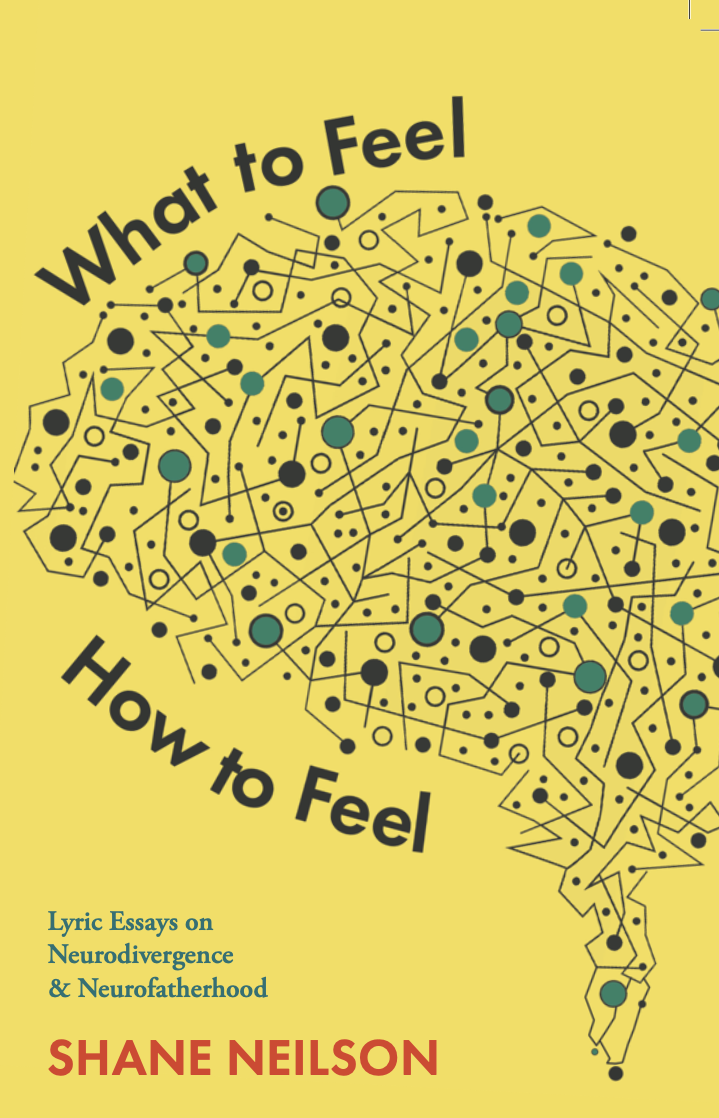
What to feel, how to feel
180 pp. Palimpsest Press. $21.95 US / $21.95 CDN
“If I can see and sense the world, then why can it not welcome me?” is the central question investigated in What to feel, how to feel, Shane Neilson’s debut book of “lyric essays on neurodivergence and neurofatherhood.” Multi-generational neurodivergence has manifested in a variety of challenging ways for the three observed generations of men in Nielson’s direct line. The “mad and autistic poet-physician” harkens the neurodivergent and neurotypical reader alike into the fray of his mind as he battles with the stigma that harms those who think differently. These essays are deeply personal yet balanced with medical research and statistics. They call upon the reader to empathize with the individual as a way of galvanizing others toward the fight against systemic discrimination against neurodivergent people. What to feel, how to feel is simultaneously lyric essays, memoir, and humanized case studies, mixing personal experience with hard evidence to compassionately convince us how harmful ableist stigmas attached to the neurodivergent community can be. Neilson’s essays don’t only focus on the harm though, as this narrative looks trauma in the eye and is propelled by hope and love, with humor and poetics balancing out the darkness in the room.
What to feel, how to feel highlights the realized and potential contributions that neurodivergent people can offer in the medical field and elsewhere, if only given appropriate accommodations. Neilson reflects on his years of study and work in the medical profession, showing us both challenges and successes stemming from experiencing the world with a “different” type of thinking. Though his path was fraught with friction, and his autism diagnosis did not come until his 40s, Neilson shows through his own life how a person with Autism Spectrum Disorder (ASD) and Borderline Personality Disorder (BPD) can excel. As a medical student, practitioner, and professor, Nielson and those around him benefit from the less-common perspective that comes with his mind-body experience. Ultimately, What to feel, how to feel moves us through three major sections, focused on: the past (his father), the present (his own life), and the future, as he meditates on his experience of raising an intellectually disabled (ID) son while managing his own neurodivergence.
This book of essays is not an easy read, and that is exactly Neilson’s intent—to challenge ableist preconceptions about identity, capability and expectations of those deemed “other” by the social-medical systems of Canada (and elsewhere). Neilson moves through his childhood of abuse at the hands of his father, an explosive alcoholic whose destructive self-medication exacerbated and externalized the harm caused by his own undiagnosed and untreated autism and bi-polar disorder. The first section primes the reader, confronting the history of psychology regarding neurodivergence through his imagined meetings with the controversial psychologist Erving Goffman. Neilson also excavates his own neurodivergent family history, complete with news clippings, family photos, and other artifacts on mid-century rural New Brunswick. Lamenting his own unsupportive environment in the 1980s, Neilson shows empathy despite his well-earned grievances for his father. Neilson grew up hearing, “YOU ARE SHIT, SHIT, YOU ARE SHIT, WORTHLESS SHIT, USELESS, BROKEN, NOTHING.” Without pardoning, Neilson imagines the pain that turned his father into the monster he became, “But what could it have been like for my father, growing up in rural New Brunswick in the 1940s and 1950s? Worse.”
“Section II: Difference” is where the similarities between Neilson and I, with our shared, stigmatized differences, became most clear. I am neurodivergent in different forms than Neilson, his father, and son, but the experience of “invisible” disability rings true time and time again. Among the familiar experiences were Neilson’s exclusion by other children, alternating identifications as gifted and broken, and feeling “so sad as a child. I didn’t know what to think or do. I didn’t have any skills or know how to ask for help. So, I just read books, lots of books, which helped a lot.” As a high-performing adult without visible markers of disability like mobility aids, he also grapples with internalized self-doubt, and thoughts of malingering in response to others downplaying his experiences as “normal stuff… everyone gets low sometimes.” In light of my own diagnoses, people will say things like, “Everyone is a little autistic/ADHD,” but no one says, “Everyone has a bit of cerebral palsy/muscular dystrophy.” Pivoting from difference to similarity, Neilson reminds the reader that while he may be partially broken in different ways from them, we are all a bit broken and in need of love. This section is bolstered by statistics and medical citations, while questioning the normative medical system as a whole. Filled with feelings of isolation, frustration, and anger over his own stigmatization and challenges as a trailblazer for practicing physicians and medical educators with neurodivergent diagnoses, Neilson then guides us to his most impactful conclusion.
“Section III: Neurofathering” is both painfully honest and brilliantly illuminated by his deep compassion and love for his intellectually disabled son. The potency lies within the potential for positive change, as Neilson works his best to break the cycle of generational trauma by giving his son the care and accommodation he deserves to live a good life. “Love is also that I understand he cannot be made to go faster, that slowness is his nature.” Neilson does not correct, or condemn, his son as he was taught by his own father, but nurtures and fosters.
What to feel, how to feel has arrived at a time when the harmful conversations and pseudoscience around neurodivergence, especially autism, need to be countered by the medical field and the humanities. We can move society beyond stigma and into a place of accommodation for those who process the world differently. This is a must read for anyone who has grappled with their own neurodivergence, and everyone with a neurodivergent person in their lives—and trust me, you do, as we are everywhere. “No one can prevent me from seeing what’s beautiful,” Neilson declares in the penultimate essay, and this book is a beauty that others would be rewarded to see.

Shane Neilson (mad; autistic) is a poet, essayist, and physician from New Brunswick. His prose has appeared in The Walrus, the Globe and Mail, and swamp pink. His book of lyric essays, What to feel, how to feel (Palimpsest, 2025), was a finalist for the Governor-General’s Literary Award in 2025.