


An Interview with Rickey Fayne, author of The Devil Three Times
February 19, 2026 | blog, Interviews, news
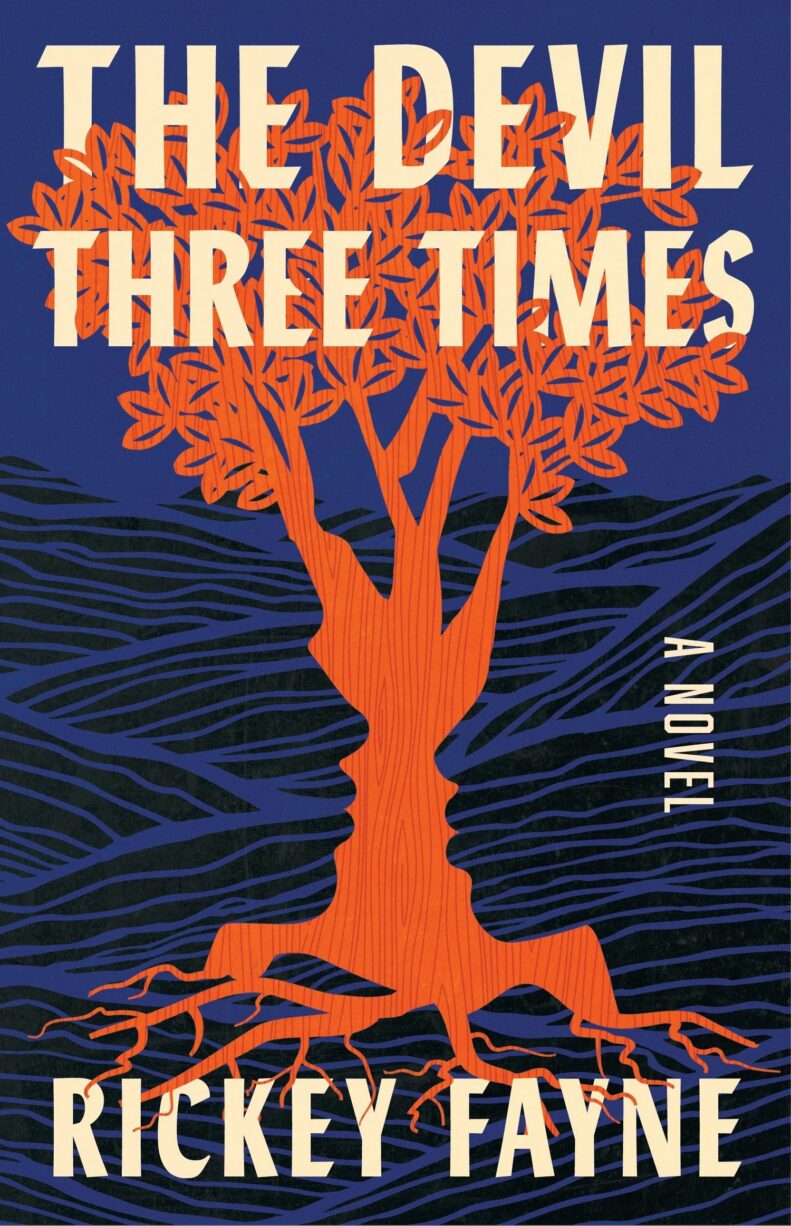
Back in December, I (Ebony Sade, MFA ’27) had the privilege of talking to author Rickey Fayne about his 2025 debut novel, The Devil Three Times. The novel is a deep imagining of enslavement in Tennessee. It brings forth a magical reckoning of ancestry as it spans across eight generations of a Black family whose members are each visited by the Devil.The Devil Three Times was a finalist for the Center for Fiction First Novel Prize and longlisted for both the Pen Open Book Award and the Pen/Hemingway Award.
Ebony Sade: How did the research process change or add to your plot line? What did you find that ended up changing your story, if applicable? And are there any parts of the story that you realized needed changing that you struggled to let go of?
Rickey Fayne: Hmm, that’s a tough one. A lot of the research for the book happened before I knew I was writing a book. I was doing a graduate program in literary criticism and a lot of the background information sort of came by way of that. I started writing during that program. I did have a couple of chapters that I kept moving around based on what decade they were happening in. That was the biggest thing. I feel like at one point I had people driving in the car, and then I was like—when was this kind of car invented? Or, when did this exist? And so I had to change some things around for that. Those changes happened maybe toward the middle because the novel kind of started in the middle and then grew backwards and then forwards, if that makes sense. A lot of the parts where I was most unsure about things were actually the parts in the middle rather than the parts on either end. So, the stuff that seems like it would be really research heavy or like I’d have to think a lot about, like in the 19th century, those parts sort of flowed more easily because I felt more grounded in that time, just because of having read so many books in the 19th century.
Ebony Sade: So a lot of the research came before you even knew you were writing a novel?
Rickey Fayne: Yeah, so I was doing a dissertation on possession and West African spirituality in 20th century Black novels. A lot of the stuff came from that. Of course, I was reading a bunch of stuff from that time period all the way up from like Pauline Hopkins’ Of One Blood in 1903 to Octavia Butler’s work in the ’70s. I was also doing a lot of research specifically about West African spiritual traditions and thinking about how those had a deep influence on a lot of the slave rebellions and revolts in the 19th century which were sort of fueled with that as the backdrop. And I thought, well, what happens to all of that after slavery, it didn’t just disappear. And so I’m trying to argue that a lot of Black authors sort of draw on those traditions in their work when they feel like more traditional means of political redress are inaccessible. All of that research was sitting in my head before I’d even started to write one word of fiction.
Ebony Sade: What did you find that you needed to learn more about, and how often did you need to pause in order to learn more? How did you go about implementing your findings into the story?
Rickey Fayne: Let me think, there was a lot of stuff toward sort of the ’80s and ’90s about music where I realized that I had all these songs and albums, but I had to really think about, for each chapter, was this album available for them to listen to in this [specific] year? If it wasn’t, then what’s something else? Those sort of changed the storylines a bit. I particularly had a lot of back and forth about Anita Baker because I really loved that album Rapture. And I was like, this is central to these things! So, I was like should I move everything else around just so Rapture could be prominent or should I shift it to Minnie Riperton’s Adventures in Paradise? I sort of gave myself a mini education on ’80s music just by nature of trying to fit that one album in.
Ebony Sade: Were there any facts or story elements that you hesitated to include in your novel?
Rickey Fayne: Yeah, and this mostly has to do with wanting to explore racism and systemic oppression, but I didn’t want to feel like we were wallowing in it or relying too much on it or thinking too hard about it. I kind of wanted it to be something that’s present in people’s lives, but I don’t want it to be the most important thing about them. Even when they’re enslaved and day to day life is horrible, there are definitely still moments of joy, moments of rest, right, where people have crushes on one another and you get mad at your mom still even though you’re living through this horrible situation. There’s a scene I hesitated with where one of the characters who’s enslaved gets whipped, and I went back and forth about whether this scene needs to be in there. We’ve seen this not only in other slave narratives, but in neo-slave narratives, right? This is something people know happened. But I told myself, well, even if it’s something people have seen before, when I’m thinking about this character and their life, this is a pivotal moment for them. And so by virtue of that, I should leave it in.
Ebony Sade: Did you read the Bible before and or during the writing of this book?
Rickey Fayne: I definitely did. I joked once that this is what happens when your mom won’t let you take books to church to read. You just start reading random sections of the Bible when you get bored. I think I tried to work my way through the Bible once when I was in middle school or high school, and then with some of the characters, I knew the Bible was really important to them. So, for example, when I was writing John’s chapter, I actually reread the book of John.
Ebony Sade: Is John the character based off or inspired by the book of John then?
Rickey Fayne: He was and I remember when I was a kid being sort of inspired by that book in the Bible. It wasn’t hung up on rules in the way that like—I have a whole thing about how the Bible shifts once we get to Paul’s chapters and he sort of clamps everything down. He’s like, “Women can’t do this,” “You can’t be in love with this person,” “You can’t do that.” But there’s a moment like right there in the Gospels where it just feels like unabashed love without the rules being so strict. So, I was thinking of that and how John sort of has these impulses but feels restricted by what he’s been taught.
Ebony Sade: When you talked about the Bible, you did mention love several times and with that and also, throughout reading the novel, I was really curious about how you approached the devil’s humanity. How do you reason or imagine the devil’s humanity in your novel against Christian and Catholic notions of the devil’s means, purpose and darkness?
Rickey Fayne: Yeah, I would say a lot of that comes from like Black folklore, particularly thinking about, you know, the folktales Zora Neale Hurston collected. The devil was a really small part of the book in the early drafts, and then with each draft his role sort of grew bigger and bigger. I was like, Well I remember that Zora Neale Hurston has some stories about the devil, let me go and look at those. And when I did there’s just one super short one that’s like a paragraph long where this guy is on his way to work and he jumps a fence post and tears his shirt and he says “Ah! The devil.” And then he hears somebody crying, and he turns around and sees the devil. The devil is like, You know, everything y’all say is my fault isn’t my fault. Some of that stuff is on y’all. You can’t put everything on me. That’s when the devil in this book sort of came to life. Every side has more than one story. When you take away the names and the baggage, and if someone was allowed to present the case to you, what would you think of their story?
Ebony Sade: What does it mean for you inside and outside of the novel for the devil to be a friend and a brother to Jesus rather than his adversary?
Rickey Fayne: Growing up, I felt like there were two churches, you know? There’s the one where you have this radical message of love and whatever you do, you’ll be forgiven. The err is human, we’re here for you, we’re your brothers and sisters in Christ. And then there’s the other church where it’s more like you shouldn’t be doing that, that’s against God, right? There’s a really easy way where all of a sudden, someone can become thought of as irredeemable. And so the first entity we get taught that is irredeemable is the devil. If you say someone’s “in league with the devil,” you know that’s it for them. You can say or do anything you want to malign them. But I thought, what if we can find a way to have some sort of empathy for this figure? And then I feel like that opens the door to not really leaving anyone behind and if you have empathy for the devil, you can have empathy for anyone.
Ebony Sade: That definitely comes across. If the devil is capable of tenderness and loyalty even, the choice to make him a kind of savior feels less ironic and more inevitable.
Why choose the devil as the savior for enslaved Africans? Where did that idea come from, and how long has it been with you? If the novel didn’t start with the devil, when exactly did he become the driving concept?
Rickey Fayne: Yeah and this goes back to a lot of the research I was doing about West African spirituality and religion. And there’s this way in which I feel like Black people’s minds were sort of colonized across the diaspora and what they were allowed to do and believe and sort of carry with them from Africa was very much sort of governed by which colonial entity was in power. If you look at Haiti, Cuba, Brazil, where it was Spain and France and Catholicism as the order of the day, there’s a lot of ways in which people maintain those [African] traditions under the guise of Catholic saints. In that way there was enough room or enough entities built in that you could sort of have a way of praying to more than one person. It’s not uncommon to pray to saints, right? So, I took that and ran with it. But in the U.S., you know, outside of Louisiana, it was all Protestantism, and there are no saints in Protestantism. There’s only what you have in the Bible. And so what happened was a lot of those stories and beliefs about those divinities, some of them sort of got smushed into the devil’s character. And you can sort of see that in the folklore about the devil, but if you look at the roots of it, you’ll see, oh, that’s a Yoruba story about Esu Elegbara or Shango. So, there’s this way in which that was kind of already baked in. But then I feel like there’s this way in which culturally, it was sort of pressed onto this because anything that wasn’t clearly Christianity, but was spiritual in any way, got sort of relegated to devil worship. Like, Oh, you’re working those roots. That’s the devil, right? Doing this or that, you know, that’s the devil. So those two things were already, I feel, there in the zeitgeist. I just pressed on them a little bit.
Ebony Sade: In relation to pressing on the notions that have already been swirling around, there are moments in the book where the devil is Black and others where he’s white. Sometimes he talks country and sometimes not.
How did you go about characterizing the devil? Why does he shape-shift by race and not, for instance, an animal, like a snake or a woman, like Eve?
Rickey Fayne: That’s a great question. I was thinking about going back to Yoruba cosmology, specifically Papa Legba or Esu Elegbara because there’s this way in which he [the devil] sort of shape-shifts depending on the individual and what they need. And I kind of had that in mind, but also, we have this idea of the devil in European-Western culture where the devil is sort of this figure that can adapt to any sort of terrain in order to trick you into doing the wrong thing. So I was kind of just drawing on those [ideas], but also thinking about the ways in which what we think of as “evil,” how that gets racialized and how that changes in different time periods and for different people. So there’s this way in which we internalize God as white, Jesus as white. The devil, we don’t really think about. He’s like this barely human thing, right. Gosh, I never thought about making him appear as an animal though.
Ebony Sade: Will you define devilment for the novel?
Rickey Fayne: Oh, devilment. I think of devilment as sort of like “good trouble,” you know. It’s like you stir stuff up and it’s uncomfortable, or it may not seem like the thing you want to be doing at that moment, but once everything settles, you realize, Oh, I’m in a better place [than] I was before it happened.
Ebony Sade: What elements specific to the region of Tennessee that you grew up in were natural facets of the novel, and what was added?
Rickey Fayne: I think all the stuff about the river, it’s like I grew up really close to the Mississippi River. Even though I didn’t see it every day, it was sort of this huge thing I always knew was there. So, all of the bodies of water in the book. With any place that I’ve lived, I’m very consciously like, Where is that large body of water? And I don’t have any rational explanation for why. But it’s always something I feel like I orient myself to. When I lived in Chicago, I thought, okay, the lake’s here, so I know where I am. Or, when I was living in San Diego, I’m like, okay, the ocean’s over there. I sort of leaned into that by thinking about what the water has meant culturally and spiritually—in Christianity, but also, I feel like in every world religion, including West African religions, water is this essential thing and it’s physical as well as spiritual.
Ebony Sade: Listening and reading to how Tennessee lives in the book, specifically talking about the river, it just solidifies how memory lives on in place and nature, longer than people do. In regards to how memories stay intact, especially through generations within the novel, I was really curious about each descendant’s ability to see.
I’m thinking about ancestors like Yetunde and Cassandra, in addition to the devil becoming shadowy, haunting figures towards the end. Could this be a commentary on how over time and through generations, the presence of our ancestors and even the concept of them may dull over time and become less vivid?
If that applies, what do you think that says about real life descendants of not just our enslaved ancestors, but any person whose family bond with spirituality weakens over time?
Rickey Fayne: That’s something I’m always thinking about and always have thought about because I feel like our connection to what came before us is always there. The world we live in is sort of built step by step, detail by detail from the past, nothing in existence exists in itself because of the present moment. Everything has a deep history or a reason why it’s shaped that way. Even the fact that we’re sitting at a table with chairs, right? Those chairs have a deep history, right? Why did we make them? Why do we make them this way? Why did we decide this is a thing? I feel like more and more we’re sort of taught or encouraged to forget that and only think about what’s going to come next. Also, specifically in the U.S., there’s this pressure on everyone to forget the thing that made them and their family particular. I remember feeling this way, specifically when I was teaching high school and I had a room full of only white students, but I was teaching about race. I asked about their ethnic ancestry—you identify as white, but what ethnicity? What songs, what traditions or what spirituality was different? If you’re German versus Irish versus English, right, what lies beneath the surface there? And they’d all been sort of taught that it [ethnicity] was just this thing that really didn’t matter for them. But the more and more they talked about it, they realized, Oh, this does influence what my mom believed or what things I think about or how I feel about the world. But we’re sort of taught to leave it all behind in pursuit of something else, right? That idea of all melting together. But I feel like if you just melt together into this one bland thing, then what’s the point of anything, we’ve lost all the flavor.
So, I really wanted to think about that for myself, but particularly for Black people. I’ve had [non-Black] students, friends and colleagues who like to be like, Oh, well, you know, in the 1700s or whatever, my ancestors were doing this or that, and they have those stories and their films. But I feel like for most Black people in the U.S., we don’t have access to that in the same ways. So, in order to know our own stories, we have to know all Black people’s stories. Right? We have to soak in what everyone was doing at every point in time, and then hope that somewhere in that you’ve sort of sifted through what your ancestors’ experiences were like. And I remember being very, very sort of saddened by that fact that I would really, like, just never know. For instance, I don’t know when my people came here, under what conditions or what area of Africa they would have called home. What were their specific religious traditions, what were their names? And then I feel like I got to a point where I started to focus on the little things that have stayed with us. You know how you sort of unconsciously adopt the mannerisms of your parents? I remember the moment where I saw very clearly that my mother is just like my grandmother. I feel like those little things, they’ve always been with us in a way. And I feel like what you’re seeing in your family members now, a lot of that was probably with them back then and so I kind of wanted to think about how those little things get carried forward or how people can have similar personalities to ancestors they’ve never met. There are family members whose personalities I have a really clear idea of just because whenever a cousin or one of my aunts and uncles would do something, they would evoke this person’s name in this way, right? There’s a way in which all of that is sort of kept alive, but we don’t really think about it in that way. So I kind of wanted to pay homage to that in a way.
Ebony Sade: I was really interested about the meaning or origins of mental illness being made with Twyla as a character—What power or ability does it evoke in and for Black people?
Rickey Fayne: The ways in which we as a society or societies across time have dealt with and thought about mental illnesses, sort of varies really wildly. This goes back to the research I was doing about West African divinities. I remember I came across someone who, on their website, claimed to be somewhat proficient in that [specified] religion. They were saying things like, Oh, you know, people want to diagnose everyone with this, but in our religion, we would just say they’re a child of Shango. I feel like there’s an impulse in American culture to pathologize, right? Rather than honor and appreciate those differences. We’re rounding the bend on some of that with thinking about neurodivergence and what skill sets things lend people or how they’ve been made to sort of compensate and how that can actually give them a leg up in the world or access things a different way or a new perspective that’s valuable to everyone. And so I feel like there’s a way in which, you know, at another point in time, in another culture—I’m thinking about the characters in the book—they would have been appreciated or venerated for having their abilities.
Ebony Sade: The devil at the crossroads imagery appears multiple times in the novel. Was this meant to directly relate to the legend that is Robert Johnson? If so, would you say Bennie is a sort of embodiment for Johnson?
Rickey Fayne: Oh yeah, that’s exactly right. 100%. And that goes back to thinking about the way in which West African religious beliefs sort of came into contact with Christianity in this way because I feel like we all know the legend of Robert Johnson at the crossroads, but also, Papa Legba or Esu Elegbara, they’re also the divinities of the crossroads, right? There’s also this tradition in a lot of West African cultures where spirits sort of grant musical talent or artistic talent in this way. I was definitely thinking about those things and if someone reads the Robert Johnson story and they’re a scholar of Yoruba cosmology, they know how that looks eerily similar to what’s happening there.
Ebony Sade: What do you think readers take away from the novel, and was that always the intention for you to leave readers?
Rickey Fayne: That’s a tough question for me, because I feel like, and you know about this as a writer, that what you set out to write is rarely what ends up on the page. I feel like I have in my mind this message of, like, I don’t know, this is going to sound cliché, like hope and love and radical empathy, but I feel like in order to get there, we also have to have, like a deep accounting of everything that’s wrong or like, I feel like the way in which when we talk about forgiveness and love and understanding, right, there’s a tendency to want to gloss over, oh, don’t bring up those wrongs or don’t think about that. It’s like, no, we have to like, get at that and bring it all out into the open in order for us to get to that space.
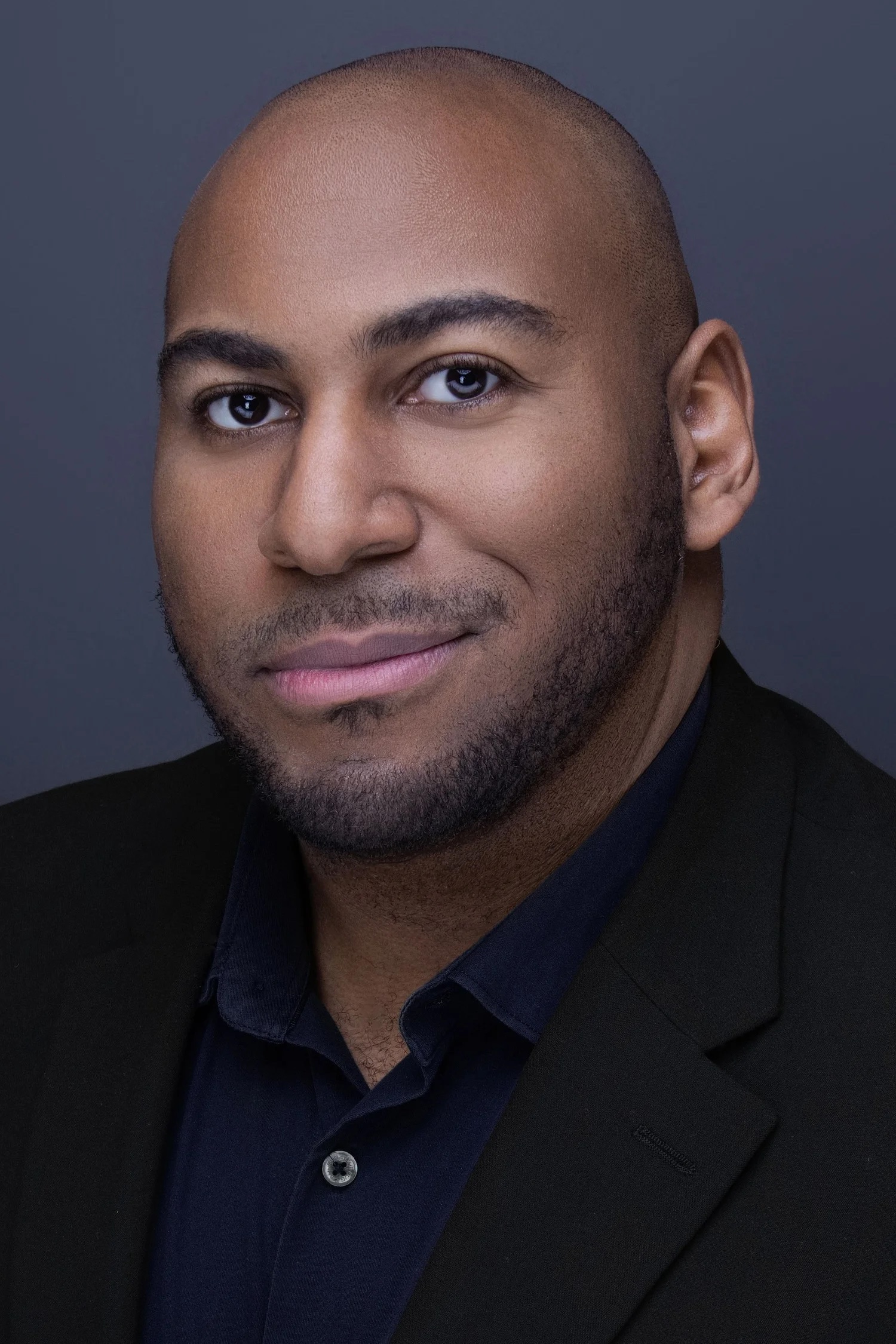
Rickey Fayne is a fiction writer from rural West Tennessee whose work has appeared in the New York Times, American Short Fiction, Guernica, The Sewanee Review, and The Kenyon Review, among other magazines. He holds an MA in English from Northwestern University and an MFA in Fiction from the Michener Center for Writers at the University of Texas. His writing embodies his Black, Southern, over-churched upbringing in order to reimagine and honor his ancestors’ experiences. He has received support for his writing from Tin House, Community of Writers, Kimbillio, Sewanee, Bread Loaf, Yaddo, Willapa Bay, and MacDowell. Currently, he teaches fiction writing at the University of Wisconsin, Madison.