


I’ll Send For You
Ashley Danielle Moore | Fiction
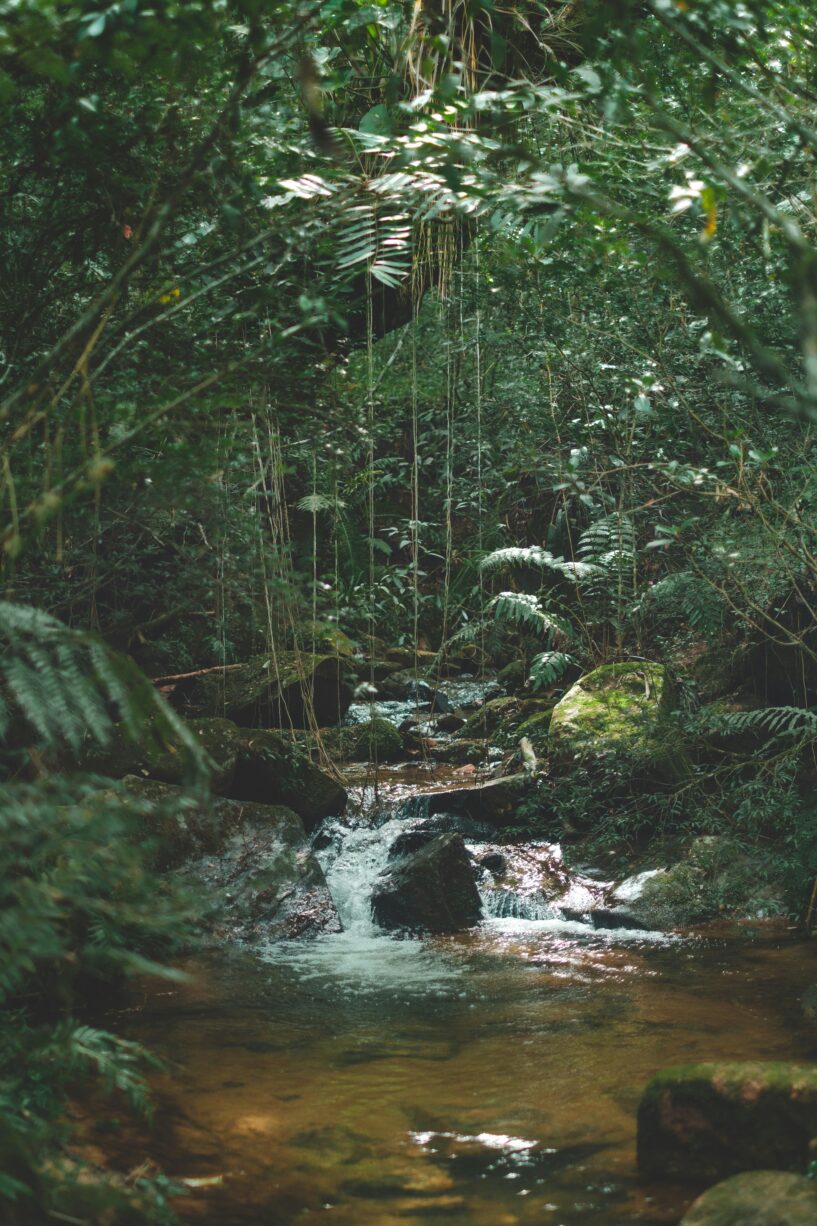
Our mother summoned us to meet her in Jamaica, to say goodbye to our dying granddad. I’d met him once before as a toddler, but my sister, Brittany, never. Despite being warned that the family home was rural, up in the mountains, that it got pitch black after sunset, had no nightlife, no convenience store (or anything for that matter) within walking distance, Brittany still imagined we’d be in, or at least near, a resort town. As we were being driven past shops, bars, beaches, and young people, Brittany snapped photos and oohed and ahhed. But once we hit the mountain road and climbed upward, she got quiet and kept her phone in her lap. Brittany stared at a wall of green outside her window. She had packed a carry-on full of bikinis.
“Told you.”
A man claiming to be our cousin drove. Cousin Bart had recognized our faces in the crowd at Arrivals. The entrance was guarded by Jamaican soldiers holding rifles and German Shepherds. Cousin Bart approached us, saying, “If this ain’t the spitting image of Auntie Evie.” Still, Brittany and I sat in the backseat like he was a cab driver, not our cousin. His wheels kicked up orange dirt.
“We’re here to mourn,” I reminded Brittany, whose mouth was fixed in a pout. She scooted away from me. Despite the dust clouds, Brittany eventually took photos of the vegetation through the window.
Cousin Bart explained what they were, pointing out the coconuts at the tops of trees, the mangoes, breadfruit, ackee. “I’ll give you a proper tour once we reach the house,” he said.
When forever passed he pulled off to the side of the road to let his engine cool down. He pointed at a speck of red surrounded by foliage on the other side of the valley. “That’s where your granddaddy stay.” He pointed further down, at another dot of red, “That’s where I stay.”
*
Up close Granddad’s house was a bold choice of Pepto Bismol pink. Rusty grilles covered the veranda and bay windows. A satellite dish was bolted onto the terracotta roof, but I later found out it had long been out of commission.
My sister snapped more pictures as Cousin Bart lifted our bags from the trunk. He wouldn’t let me help carry them inside, chiming, “You’ll hurt! You’ll hurt!” He held all of our luggage in his hands and in a headlock as he crossed the yard. “Mind your step,” he warned, but I didn’t. My foot rolled over something hard and Brittany caught me by the arm.
“Dummy, he just said…”
The yard was well-fruited though I didn’t know what the trees were yet. I dodged nuts and seeds with every step. Thick shrubs of croton, a plant I’d bought from a nursery but killed within weeks under my care, lined the yard. I never knew they could grow that big. I still had a bare stick in a nice pot back at home.
Our mother yanked us aside and warned us. “Eat what they put in front of you,” and more directed toward Brittany, “Don’t weed smoke.”
“I’d have to find it first,” Brittany said.
My mother shot her a look, a side-eye that normally had more effect, but her eyes strained. She’d been at that house for weeks, caring for her father and stepmother. The stomach of her blouse was wet.
“I’m kidding, baby girl,” Brittany said. “Relax.”
*
We spent ten days in Jamaica—seven too many—with no way to be helpful. Brittany and I spent most of the time in Granddad’s musty room, sitting on buckling wicker chairs. His body was tucked underneath layers of quilts and bedding. He was just a head on a thin, damp pillow, breathing awkwardly.
I was a toddler the only other time I’d met him, and had no recollection of him or that visit. We only knew Granddad as a voice, choppy from poor reception. The call would always drop.
Half the time I forgot he was in the room until Bart’s mother, who’s not my mother’s sister but was introduced to us as our Auntie Jody, dropped by to change him. She made small talk with us as she stripped Granddad’s bed and dressed it with clean linens. Brittany and I helped by doing the corners or holding up his stiff body for a few moments. I didn’t understand a word Auntie Jody said. Neither did Brittany, who kept asking, “What you mean?” Auntie Jody spoke slower and Brittany comprehended, answering, “Yeah, we like it out here.” I could only grin and nod like a fool. Some combination of her and Cousin Bart, or her and my mother, would sponge-bathe Granddad, change his diaper, and dress him in clean pajamas. They stripped him naked, propped his body against theirs, each of his limbs flopping over their shoulders and knees. Brittany and I would look away, at our laps, at our phones that had no service, at the yard beyond the window.
I only understood Auntie Jody when she wished he’d wake up for us and say hello. She carried out his dirty linens and clothes that my mother would wash.
When Step-granny woke from her nap, we’d hang out with her in the kitchenette and watch her cut up goat meat and veggies. Step-granny had a face and neck full of skin tags and couldn’t stand on her feet for too long. So we’d wash the bowls and pass her things. “Bart butchered a billy goat before you come.”
Three days in Brittany admitted, “I can’t do much more of this shit.”
*
When Cousin Bart stopped by, we asked him, “What happened to our tour?”
“Me no forget. Me no forget.”
We put on closed-toe shoes, long sleeves, and pants, if we had them, upon his request. I tried to talk Brittany out of wearing a Redskins jersey, first by claiming it was too thick for the heat, second by pointing out that she didn’t even follow hockey. Finally I told her how I actually felt. We were still bickering as Bart led us through a canefield, wielding a machete.
“I dig the shirt,” he said.
“We’re part Cherokee on our father’s side.”
“Alleged,” I said. I explained to Cousin Bart that every black American had an unsubstantiated claim to being part Native American.
He cut down a few stalks of sugarcane, peeled it, and told us to munch on the stringy stuff—we could swallow it if we wanted to. A loose rag was draped over his head—the way NBA players wear their towels on the sidelines. His fingernails were dirty. “All the folk up here mixed with Taínos,” he said. “How you think we learn everything?”
“Oh, we double Indian!” Brittany exclaimed.
I spat out a mouthful of stringy pulp. I expected the sugar to be too sweet, a punch in the face sweet, given it came straight from the source. But it was mild. I wondered if he had picked a bad one.
Cousin Bart cleared the brush by chopping down elephant ears and banana leaves. Still, we got regularly thwacked by something. We hiked on a muddy trail formed by cow traffic. A billy goat cried. I couldn’t find it, but I heard twigs snap and leaves rustle. Brittany straggled behind, snapping photos she’d probably show her coworkers or post as soon as she had service. I’d spot her, a slice of red, in the thicket.
She caught up, sweating and fanning her jersey. “Yall about to lose me. Imma give you a little Indian War Cry. You know that is, Bart?” He shook his head. She demonstrated.
I cringed so hard I nearly snapped my spine. “Don’t teach him that!”
“You hear cry, that means come get me.”
Cousin Bart giggled. “Okay, Ms. Brittany. If that’s how you send for me.”
Sometimes we emerged on neighbors’ properties and I recognized other houseplants I’d killed. Here they were thriving, in mature form as a bush or tree. I pointed at a yard full of snake plants. “Oh, I killed one of these!” I announced. Bushes of Chinese hibiscus. “Killed those too!” A lemon tree. More croton bushes. A rubber tree that couldn’t fit in a hug. “Killed that and that and that.”
Cousin Bart tried to be encouraging. “It hard for them outside the tropics.”
We watched Brittany take selfies with a massive brown cow wearing a bell on its collar. When she reached us, she asked something I should have seen coming. “Who out here got weed?” It was probably the longest she’d gone without a joint in a while.
I only cared because our mother specifically told her not to, thus, I gave her shit. Brittany always accused me of being too something—whiney, boring, sensitive, much. “This might make him uncomfortable.” From what I’d seen, Cousin Bart seemed like a wholesome country boy, he stuck close to his mother and took care of his family.
“Bart, this bothers you?” she asked.
He laughed—but I also laughed when I was uncomfortable. “I have a friend,” he said. Bart pulled out a tiny cell phone too small for his hands. He drafted a text that took some time as he had to keep tapping to reach each letter at a time.
*
Step-granny made curry goat for dinner again. The same meal every day felt clinical. My mother ate in a tired silence, sucked the meat off the bones, and threw the bones out the window. Her hands were ashy, which felt criminal in the tropics. The bones landed in the yard as a thud.
Step-granny told me about how naughty I was the last time I visited. “Badly behaved. Badly behaved,” she yelled. “Remember, Evie, how she yank the sheets off the line?” My mother nodded. “I almost let you sleep outside, in the bush, and let the Duppy come get you. But your motha wouldn’t let me.”
“I’m a good girl. Right, Step-granny?” Brittany asked, kneeing me under the table.
“Yes. You a good girl.”
*
The next day, and every day after, Cousin Bart marched over to the property carrying coconuts he’d foraged and his machete. I couldn’t stop staring—the way he chopped off the shell fast and precise, and without hurting himself. Brittany nudged when I stared too hard or long.
“Every mineral and vitamin God ever create in coconut water,” he said, handing us ours. Sip after sip, I thought he might not be kidding.
Brittany smacked her lips. “Keep these coming.”
After he and his mother changed Granddad, we piled into his little hoopty. Brittany sat up front. A bikini top knot dug into the nape of her neck. Bart drove us to a one-story building covered in flaking paint. We met his friend, Irving, a skinny guy with uneven dreads, inside the parlor. It seemed as if the whole neighborhood was in the parlor, lounging on mismatched furniture and queuing up dancehall music videos on the TV. Multiple oscillating fans were going and in a corner was a lone clothing rack full of T-shirts going for 2400 JD. Bart hung back to catch up with an old classmate and have a carrot juice. They referred to the parlor as the café.
Irving normally charged tourists to enter the farm but told us to put our wallets away. He escorted us through multiple rooms, none indicating a place where coffees could be made, to the backyard that was full of tires packed with soil. “The nursery,” Irving explained. He offered his hand as we stepped over jagged rocks and brought us to a field full of cannabis my height. Irving was chipper and lithe as he walked us through the rows and had us smell. Brittany could already identify everything by color and scent and picked out what she was going to purchase. Their conversation went over my head. I was too hot to feign interest—I would have been better off in the café. But Irving was so impressed with Brittany that he went on a quest to make her something special.
“You think ma will smell this on us?” I asked.
“Her dad dying. She’s preoccupied.”
Irving returned, rolling up his concoction. Brittany seemed relieved when I passed, but Irving goaded me with c’mons. “Ya sure? Ya sure?”
Brittany told him, “She’s too sensitive.”
She had a few fair reasons. I had called her in the middle of the night, sure I was dying and begged her to take me to the ER—quite a few times. Panic attacks. Emotionally-induced when my college boyfriend left me for a girl who looked exactly like me. Adderall-induced, losing days of sleep, thinking I could write a memoir while the emotions were still raw. Brittany called out of work and sat all day in the visitor’s chair when I got admitted. She didn’t tease me or show any ounce of annoyance when my exams came back clear. I usually felt better after a few hours on the hospital bed anyway.
Another time I was convinced that I had some sort of downstairs cancer. My abdomen was swollen; I had funky discharge and it hurt to piss. Farrah Fawcett had just put out a special about her terminal anal cancer and facing her mortality. All her symptoms sounded uncomfortably similar to mine, but I only tested positive for chlamydia. I confessed that I’d been hooking up with the neighborhood fuckboy—nothing serious—just something to tide me over until I got a new boyfriend. Brittany didn’t make fun then either, flexing an unusual restraint at a golden opportunity. She took me to the pharmacy before taking me home, and none of it ever made it back to our mother.
Irving picked off perfect cannabis stems that looked like high-fives and had us pose. He snapped photos for the farm’s Facebook page and when Brittany wanted the pictures for herself, they exchanged numbers.
*
By day six my sister managed to get a ride to a rum estate. Now that I could get behind.
“I don’t want to hear shit about who owns what, what it used to be, or how early it is for hard liquor,” she said.
“Fine by me.”
We had our morning coconuts. I collected the shavings on the floor of the veranda and tossed them in the trash, then out the kitchen window. Bart and Auntie Jody were in the bedroom, sponge-bathing Granddad—a task Brittany and I had started leaving the room for. He still hadn’t woken up, but he was mumbling.
I figured Bart was taking us until I was told his car was in the shop. Also, he wanted to stay behind and help with housework. Irving pulled up in a Corolla, and my mother, who’d been pinning house-dresses and bleached towels on the clothesline in the yard, stopped and stared him down. Brittany told her the truth.
“We’re going to the rum distillery,” she said, marching across the yard.
“You getting drunk!”
“No, we gonna learn about the machines. You should come for a drink.”
Our mother hadn’t caught on that Brittany was high most of the time. Brittany had enough stealth and charisma to always get what she wanted and get out of whatever she didn’t want to do, without guilt or shame.
“We won’t get drunk,” I promised, squeezing our mother’s dry hands. Her skin was getting grayer and grayer every day. “You should take a nap,” I told her.
Irving introduced himself to my mother and upon finding out that she knew his father—had gone to grade school and gotten baptized with Irving Sr.—she softened. But the women, our mother, Auntie Jody, and step-granny didn’t like the idea of us venturing off with a stranger, no matter who he was related to or how well Bart knew him, and forced Bart to join.
*
We were drunk by noon, except Irving who didn’t drink. Then we ate the overpriced and mediocre grilled snapper special in the distillery’s accompanying restaurant. I was happy to break the monotony of curry goat, but Bart and Irving balked at what the restaurant charged considering what was served.
“Highway robbery,” Irving said. “No wonder no local come here.”
Brittany treated as a thanks for the rides but bargained with me. She decided that I would cover our shared cab home when we landed at JFK airport. “There’s a hotel with a pool around here?” she asked.
This was the closest we’d been to a beach since the rum distillery was down the mountain, but we were still quite a ways away from it, according to Bart and Irving.
“But those people in swimsuits,” she said, pointing at a nearby table. “And them and them.” I spotted a bikini knot on her neck, like a tag sticking out of her shirt.
The boys couldn’t promise a beach or a pool. “Maybe another day,” Bart suggested. But seeing Brittany sulk, they mentioned having heard of nearby falls, a popular spot for tourists though they’d never been themselves. The server said the estate offered a bus, but after hearing the price, Irving asked for directions.
*
We parked in a gravel lot and followed a trail through a wooded area. “This is different,” Bart said. He walked looser after the rum tasting. The air was more humid, with the kick of a breeze, but we questioned if we were at the right place until the path opened up, revealing tourists in swimsuits and mangroves in a black river. Curved bamboo lined both sides of the riverbank, creating a canopy where they crossed at their tops—a hallway of towering bamboo as far as the river stretched. Everyone stopped to take photos, even Bart, whose phone I didn’t realize had a camera.
There was an option to take a bamboo raft, but Bart admitted he couldn’t swim and didn’t want to risk it. I could swim but didn’t trust the construction. It seemed like we were all in agreement about hiking along the riverbank when Brittany and Irving pulled a fast one.
“We’re on vacation,” she said.
“It a part of the experience,” said Irving, and they flagged down a guide standing on a raft.
*
I had to tell Bart to watch his step a few times, but he caught himself when he tripped. “Pardon,” he said to the tree roots ripping up the ground. We hiked along a trampled embankment parallel to the river. I caught glimpses of Brittany and Irving when their raft appeared between gaps in the stalks. They cuddled on a shared cushion and disappeared when their guide rowed around patches of sawgrass.
“You need water?” I asked Bart, unsure how I’d make good on that.
“No, no.” He belched then blushed then told me pardon. He pointed up. “You like plants. You know this fruit?” he asked, trying to change the subject. I looked up at something round, green, and spiky and thought an unripe coconut. He corrected me. “Soursop. You brew the leaves to fight cancer, stress, insomnia.”
“Those leaves can’t cure cancer.”
“Didn’t say cure but it help. Natural chemotherapy.”
They were now sharing a joint as their raft passed us. She somehow got hold of a coconut with a bendy straw.
Bart pointed at a mango tree and told me that their leaves fought off high blood pressure; at papaya leaves, that they strengthened the immune system. I plucked the leaves and separated them into different pockets for further research. I’d been curious about weaning myself off of Western medicine.
Though far away, I watched the back of their heads close in. “Look at this, Bart!” I hissed and pointed at their raft.
Bart found it hysterical. “Aw, Irv in heaven,” he said, glossy-eyed. Then seeing that I wasn’t as amused, added, “He not that type of guy. She’d wipe the floor with him anyway.”
*
I didn’t know how to measure kilometers, but the raft guides had assured me that two on foot was nothing. Bart and I got very lost. The river curved and the embankment hitched up a hill in the opposite direction. We briefly caught sight of the river again, but all the rafts were gone. The embankment went further up, in a denser area full of gullies that tore up the hillside.
“We shouldn’t lose sight of the river,” I said, but Bart disagreed.
Irving called Bart’s cellphone, curious about our whereabouts. He said they were at the falls. I could hear his voice screaming over rushing water.
“We come soon! We come soon!” Bart said before hanging up. He pointed behind us. “I think this way.”
The sun was going down and the last thing I wanted was nightfall in the bush. I climbed down the muddy slope and dug my shoes between leaning stalks of bamboo on the riverbank. “I’m staying here. A raft’s gotta come back this way.”
“We just missed a turn. Come,” Bart said, trying to lift me. He had sobered up.
I looked at all those trees and rocks and shook my head. “I’ll wait for a raft.” I’d rather put my faith in its construction than navigate the bush. Bart kept huffing, growing more frustrated with me. I stared into the calm black water unwilling to budge.
“Fine, he said. “Wait here.” But as soon as he was out of sight, I regretted it.
I called his name repeatedly—scrambled back up the slope, screaming for him. I didn’t wander too far from the river, afraid of losing sight of it as the sun dipped behind the mountain. I tripped over a root and fell down the slope, tearing up shrubs and weeds in an attempt to break my fall. I crawled to the impression my shoes had made in the mud, where Bart had told me to stay. I called for him again but nothing. Through mud-streaked tears, I let out a pitiful Native American war cry. Of course he didn’t show. Then it started happening again.
Heartbeat getting too rapid. My vision blurred then came the nausea. I lay on my back in the mud. Intrusive thoughts kept saying this might be the real one. If I had cell service I would have asked Siri again for signs of heart attack in women, stroke symptoms in women, or asked her to call Brittany. I could acknowledge that it was most likely psychosomatic—that my mind was tired of me and trying to erase itself. The doctors had assured me that no one has ever died, or will ever die, from panic attacks, but there’s still agony from the near success. Farrah died on the same day as Michael Jackson—her death completely overshadowed and we forgot to mourn her. I felt like I was going to prove all the doctors who ever doubted me wrong and cried for my mother, who’d have another person to bury.
I was rolling in mud when I heard twigs snap. A figure stood above me. “Girl, have you lost ya mind?” Bart said, severely. He stood me up and tried to slap the mud off my back and caked into my hair but quickly gave up. He kept me on my feet and walked us through the bush.
*
I spent the rest of my time foraging leaves and brewing pots of tea, mainly for myself, but I shared it with the household. My mother called my first batch pitiful and spat out the brown sludge that stuck to her tongue.
“You don’t mash them,” she said. “And they not dry enough.” Luckily Granddad and Step-granny had a stash in their pantry. My mother showed me how to simmer the leaves with ginger and cinnamon for a richer flavor. She introduced me to a sieve and showed me how to use it.
On our last night, we ate mannish water—the billy goat’s head, stomach, intestines, testes, and feet stewed in onions, halved potatoes, and carrots. I didn’t think about it and spooned myself without looking into the bowl. Brittany picked out only and all of the veggies. She clocked that Cousin Bart’s interactions with me were more formal, if not cold. He was still upset about the bush. I told her about my incident, no worse than what she’d seen before, but felt her eyes dart between me and Bart as we ate at the dining table.
When Granddad still hadn’t woken up for us, my mother asked, “Why you didn’t come sooner?”
*
Cousin Bart’s car had come out of the shop in time to give us a ride to the airport. Half of my checked bag was full of dry leaves. But there were many signs posted around the airport entrance—‘Don’t Sneak Out Local Fruit, Vegetables, Meat, Marijuana’ with accompanying images under the red circle and slash.
“You should be fine with a checked bag,” Brittany said from the front seat.
But once I saw the Jamaican soldiers with their rifles and dogs, I didn’t want to risk it. I dumped all the leaves into Bart’s trunk.
“Pussy,” Brittany said.
*
We were told our flight was delayed at the Delta gate. We found an empty row of chairs with chargers under the seats, plugged our phones, and connected to the courtesy wifi. Brittany finally asked what was on her mind. “You tried to hook up with Bart in those woods?”
“No, Brittany. I told you all that happened.”
“Be honest,” she said. “I won’t judge.”
Our flight kept getting delayed, so Brittany hit up some souvenir and duty-free shops. I sat at the gate and watched our carry-ons. She returned with packaged rum and a T-shirt with a Rasta resting on the Nike check. Underneath him read, ‘Just Do It Later.’
“I think his mother is Mom’s cousin,” she said, collapsing into an electric massage chair. She didn’t pay to turn it on but ground her back into it. “That makes him like a second cousin, which isn’t so bad. Technically legal.”
“Nothing happened.”
“But I wouldn’t put it past you,” Brittany said. Further noting, “The fact that you’re not even offended…”
I didn’t indulge her any further—too busy looking up the health benefits of soursop, papaya, and mango leaves. Most sites I found online only sold them as seedlings in nursery pots, but I couldn’t trust how they were raised. What if the soil was tainted? I searched for organic seeds and googled how long it would take to develop into a tree, the ideal soil, light, and temperature conditions.
The lady at the plant store had called me a nurturer—a kind way of saying I waterboarded my plants, fried them under harsh and constant grow lights. She wouldn’t process a refund when I returned with my receipt and a lone stick in a nice pot.
“You always do the most,” Brittany said, “for very little reward.”
Our plane was now ready, but the pilot had to be replaced. Upon mayhem at the desk, a gate agent hopped on the microphone and clarified that the FAA had strict regulations. Our pilot would exceed his daily flight time limit. We needed to wait. “It’s out of our hands,” she signed off, then hid behind a partition.
I built shopping carts across various websites and received the packages a week after returning to Harlem. Nothing changed. Half of the seeds never grew roots. The rest sprouted one or two fragile shoots that shriveled up when I wasn’t looking.
Pots of dry soil lined my living room forever—a constant reminder of that trip though I couldn’t recall what trees and bushes I tried to replicate, just a notion of their scale. We forgot to mourn Granddad. He died after we’d maxed out our PTO, but we watched his funeral on Facebook live. Brittany came over, frowning at the pots. The first things that came to mind about that trip to Jamaica were weeping on the Black River, of course—humiliation doesn’t wear off easily—but also my mother’s dry hands, how she also looked lost, mechanically scrubbing, hanging, and folding clothes while her father lay dying in his bedroom.
Ashley Danielle Moore is a graduate of the Michener Center for Writers, where she was a finalist for the Keene Prize for Literature. She is currently a Writing Fellow at the Fine Arts Work Center. She has also received fellowships from Vermont Studio Center, Kimbilio, and the Prague Summer Program. Her work has appeared in Apogee Journal, The Saint Ann’s Review, and elsewhere. She is currently working on a collection of short stories.