


Route 128 to Mendocino
Amber Flora Thomas | Essays
I’ve always thought of Route 128 in Northern California as a deep road. Unfolding as it does, through mountains and forests, rising and sinking in hairpin turns; it cuts through five different topographies in quick succession. One moment I’m going north then west, then east, and north again all within the same series of curves so wound and snaked through rock, hill, farmland, forest, and along river that my gut threatens to come undone after nearly every mile. The road can’t be ignored for one moment, which is why I think of it as deep, holding me in its grip mile after mile, as I drive toward Mendocino.
I’d picked up 128 90-minutes north of San Francisco on Highway 101, where the Redwood Empire Sawmill blocks the morning sun with tree stumps stacked 50 feet in the air. Here the cell phone signal weakens to a single bar or less, radio stations go static, and I know that I have crossed into the remote, the out there, the country. Gripping the steering wheel in my rental car, I try to relearn the correct technique for braking into a curve and accelerating out of it, but when the curve goes on and becomes a second and third curve on the narrow two-lane road whose edge is often a hundred-foot drop on one side, all I can do is remember to breathe through my mouth to keep the nausea at bay.
Living in the flats of North Carolina the last decade has ruined my skill as a driver of the deep road. But even as my wheels argue with middle lane markers, clip clipping as I weave inside the double white lines again, I don’t need to remind myself why I’ve come back here because at the end of this gut-wrenching three-hour route is my hometown, Mendocino. And like an exile, returning to the place I’ve loved the most in the world, I will drive this road until it lets out at the Pacific, and possibly, this time bring me closer to making peace with the past.
*
It’s a late morning in June and fat clouds drift above the yellow hills. In a vineyard off to the left, heavy bunches of grapes weigh the leggy bushes, their rows growing up to the roadside, a seasonal gold about to be harvested. I snap my eyes back to the asphalt and take a deep breath as another series of curves uncoils before me. A glance in the rearview shows a black SUV has caught up with me and rides my slow retreat out of each dip. The urgency to get anywhere is the difference between tourists and locals on this road, but here I am driving like a stranger, unsure of the next bend, terrified of what might come. Momentarily, I speed up, trying to remember what is around the next corner, telling myself that I know the way as good as anyone who lives here, that this journey must be stored somewhere deep in my body’s memory.
At the next turnout, I put on my blinker and let the speed-demon by.
I learned to drive on this road. At fifteen with my dad in the passenger seat, the window down and a hard breeze tearing at my ponytail, I didn’t know what was so hard about driving.
“Easy. Easy,” Dad said. “Ease off the gas a bit.” He was bracing himself with a hand on my headrest and the other gripping the dashboard, sweat trickling into the wrinkles on his deep brown forehead. He looked over my arm at the speedometer: 65 mph, ten miles over the limit.
Maybe I am not the best person to tell anyone how to drive this road. I’m not particularly interested in visiting the over thirty vineyards peppered throughout this region. One time I traveled through here with a girlfriend and we stopped at some vineyards, sampling prize-winning vintages and filling up on complementary cheese and crackers, I found the combination of wine tasting and a winding route from the passenger’s seat not at all agreeable.
Still, I always stop in the café in Booneville for a pastry and a coffee, standing outside in the sun, letting the wooziness abate some before the next stretch. I get out my cell phone since this is one place along 128 where I get an okay cell signal, and I check for missed calls or text messages. This is also where my father lived for many years with my stepmom, down a side street I can see from where I stand outside the café. I can picture it still, a cottage with rotting floors and peeling paint that languished above a creek that flooded every winter. Yes, I think, its down that road, but look away, taking the last bite of my pastry.
Back on the highway, just after Boonville where it straightens, I think of this stretch as my father’s, meaning every time I drive through here the memory of him trying to teach me to drive pours back over me, and I relive it again.
It had been fine until he saw a police car passing, going in the other direction, and he panicked. We hadn’t drive five miles when he made me pull over and wait while we watched the police car disappearing in the distance. Turn signal blinking and gear shift in Park, the heat of the day crept in. I’d felt it, though, the sense of control behind the wheel, motor groaning under my feet, the feel of going faster and faster, the openness of the road to take me anywhere.
“God damn it,” he yelled. “I told you to slow down!” His left hand came up and popped me on the back of the head before I could duck. I felt something jangle in my skull and then an ache shot behind my eyes; I squeezed them shut and grimaced. “Don’t you realized what these cops would do to me?!”
A bead of his spit hit my ear. I was too afraid to wipe it or to make any move.
“Do you want to see me go to jail?” His eyes cut into me.
While the engine chugged and settled into a rumbling wait, I found myself remembering, oh, yes, my father is a black man. And the police will find any excuse to arrest a black man. As his lighter-skinned, half-white daughter, I sometimes forgot how blackness is perceived by the world, especially in rural California where my father was an anomaly. Not living with him for many years, I could forget his constant fear and vigilance, which found us on the side of the road, an ache ricocheting in my skull.
He hadn’t hit me in three years, since beating me in the van during a Thanksgiving visit with my uncle and his big family. Afterwards, Dad said, I was too old for him to be hitting me. “This is the last time I’m going to spank you,” he said as he fit his leather belt back through his pant loops.
While I waited for the next hit, I realized I’d lost that part of me that could just take whatever was coming. I nearly raised my hand to hit him back but caught myself and brought my hand to the steering wheel again, its sticky plastic gripping my palm. I hunkered down and knew I’d take it, if it meant I could learn to drive and get out of there, away from him, and the rest of my family.
Carefully, I looked over at Dad. He was gazing out at the now empty road. His breathing had slowed a little. He hadn’t meant to hit me, but this is often how it began with the bursting bubble of anger or fear and then the dance under his open palms or the belt. Then afterwards, his apology. “Why do you always have to make me so angry?” The sweetness of having him for this brief interlude all to myself. He loved me, he did.
I let my hands drop into my lap and felt the irreversible weight of his fear descend. He was terrified of the police. I knew this, but somehow it just hadn’t registered in my mind. He mumbled something I couldn’t hear. Often, he talked to himself in moments of stress. I just had to wait for the terrible tale to finished spinning through his mind.
“Oh, wow, honey. I’m sorry I hit you,” he sighed. His thumb pressed the corner of his left eye, so maybe I wouldn’t see him tearing up. And then he tried to laugh a little.
I didn’t realize I was crying until I felt the wet slide under my chin. I didn’t know if I was crying because my head was swimming with ache, or because he was crying. I’d only seen him tear up once years before, when Mom told him she wanted a divorce.
“Hey,” he said, brightly now. “Why don’t you let your old man drive the rest of the way home?” He jerked the door open and walked around the front of the car.
I struggled to pull the stubborn buckle on the seatbelt. By the time it came loose, he was already opening my door. I slid across the seat, my jeans catching on a crack in the vinyl as I pushed over.
He waited on a Winnebago to pass before he merged with traffic. With his hands on the wheel, my shoulders relaxed.
After a few miles, I asked, “Are you still going to teach me to drive?” I was thinking about my plans for escape after high school.
But this was the only lesson he ever gave me.
*
On the straightway, this time I slow down, hoping maybe forgiveness, whatever it is and however it happens will catch me finally. Now that I think of it, this was the last time he hit me, and it wasn’t so bad. Not a brain-rattling welt I’d feel hours later. This was the road though, just after Booneville, leaving the golden hills for the redwood forest.
I stop at Gowan’s Oak Tree, a fruit stand near Philo. I buy a quart of apple cider, four Braeburn apples, and because I know I’ll be in Mendocino a week this trip, a tray of candied dates.
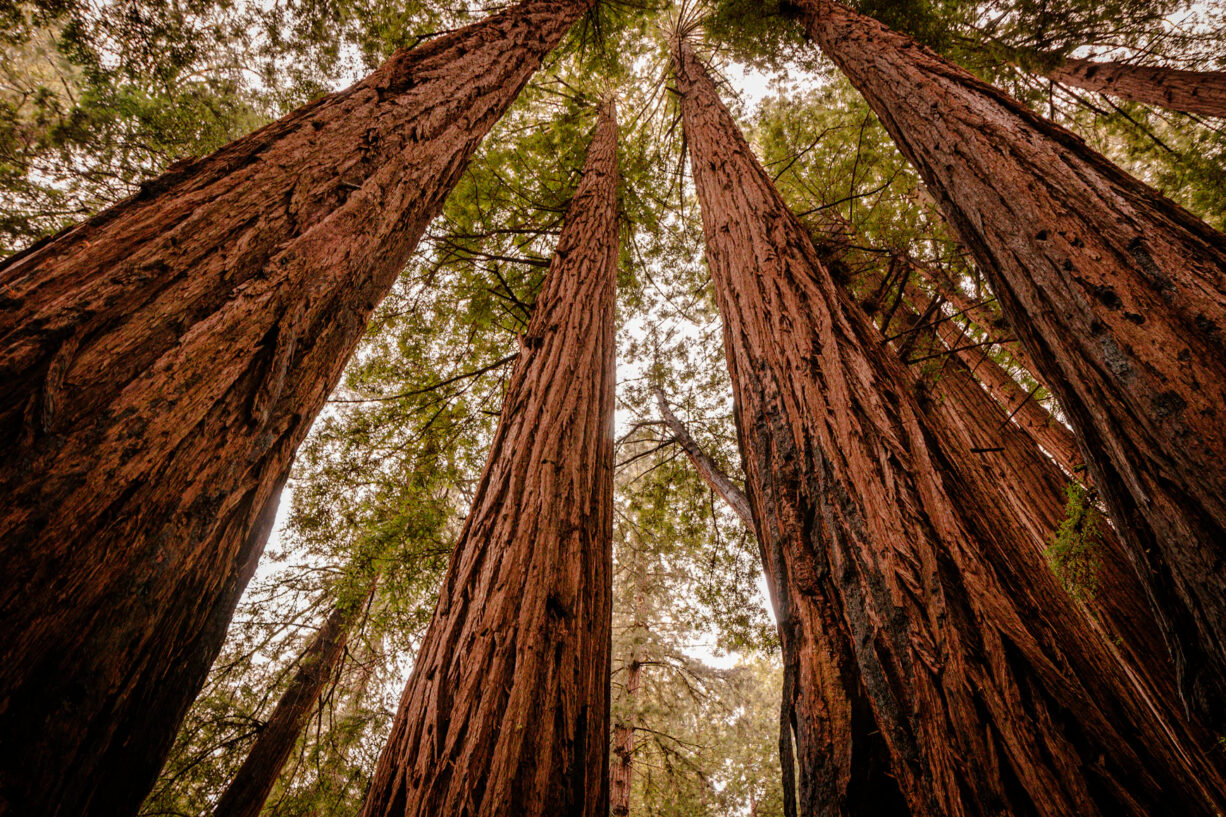
After Gowan’s the distance between shadow and sunlight narrows as I move into the redwood forest and a particular kind of headache is invoked by the blinking regularity of this exchange. In another ten miles, I pull over beside an old fallen redwood trunk with an eight-foot diameter, and park. I’ll take a quick walk out to the Navarro River. This was the first place we camped in the redwood forest when I was ten, and my siblings and I rushed from one giant tree to the next, elated with our own smallness for once.
A short walk lets me out at the river which is shallow and calm today. Dragonflies hunt the surface for smaller bugs. I snap some pictures to post on Instagram, making sure to take the quintessential shot looking straight up through the treetops, but after only ten minutes I’m ready to leave.
It’s time to get there, I think. As I walk through fern and the needle-packed trail to where I’ve parked, I swear I can smell the ocean. Not even ten miles to where 128 merges with Highway One. The last curves are the worst, but after making it this far, the rhythm fits the comfortable stretch of the steering wheel in my hands and the necessary pressure of my foot on the pedals. When I pull back onto the highway, I don’t slow down. Each curve is an unfolding grip that I meet easily and at a speed far above the speed limit because finally I remember this road.
Before I know it, I am out of the blinking shadow and light beneath the redwoods. I’m so close to the Pacific, I must keep going. I roll my window down and breathe the mossy shadow scent of the forest. A crushed skunk on the shoulder is acid to my nose and lingers. The radio which has been static for the past two hours tunes into a sermon that’s been going on as far back as I can remember, promising damnation to the sinner. “Hell fire and brimstone,” the preacher purrs, before static cuts in again.
I gather strength. The mood of the curves fortifying my patience, the wide corners, the tight loops drawing me west. The road is coiling and uncoiling before me. I brake at 30 mph and accelerate at 45 mph out of forested night into a sunny day. To my right, Navarro Mountain. To the left, Navarro River and our favorite swimming hole where we spent nearly every day in the summers. The river comes into view and quickly disappears again. Flood watermarks visible on the trees twenty or more feet up shows where the route is impassable in the winter. I promise myself I’ll stop at the old swimming hole on my way out of town in a week.
The road is impeccably maintained with guardrails, big black arrows mark the curves, so drivers don’t lose control. The dangerous corners marked by reflective tape and paint. Turn out lanes every two miles. There are so many chances to get it right on a road like this, no excuse for tagging lane markers, no reason to let my rhythm go off again.
The closer I get to the estuary where Navarro River pours into the Pacific, the highway briefly straightens out. No one is on the road with me this morning. I flip the radio off and listen to air play on the car tires, a song that sends me right back to him. I ease my foot off the gas to make the getting there a little slower. I hear my father saying, “Easy, easy.”
Amber Flora Thomas is the author of Eye of Water, which won the Cave Canem Poetry Prize for a first book by an African American poet. Her other books are The Rabbits Could Sing, and most recently Red Channel in the Rupture. Her poetry and essays have been published in Prairie Schooner, The Georgia Review, Orion Magazine, Colorado Review, Alaska Quarterly Review, and Ecotone, as well as numerous other journals and anthologies. A native of northern California, she currently lives on the Pamlico River in North Carolina and teaches creative writing at East Carolina University.